What if you could trade your current routine for a high-paying trucking career in just a few weeks without getting lost in a mountain of paperwork? You probably already know that the trucking industry offers incredible stability, but the path to getting started often feels blocked by confusing rules. Between the latest ELDT mandates and the stress of finding an affordable training program that speaks your language, it’s easy to feel overwhelmed. You aren’t alone in wanting a straightforward way to navigate the cdl license requirements florida has in place for 2026.
We’re here to clear the road for you. This guide simplifies the entire process, showing you exactly how to master the Florida CDL requirements while finding the fastest and most cost-effective path to your new career right here in Orlando. We’ll provide a clear step-by-step checklist, explain the new electronic medical certificate updates, and share the secrets to passing your exam on the very first try. From understanding the difference between manual and automatic transmission training to overcoming language barriers, you’ll find everything you need to start your engine with confidence.
Key Takeaways
- Learn the difference between local and interstate age limits and why your Florida Class E license is the essential first step toward your new career.
- Understand the mandatory DOT physical process and how to find a certified medical examiner to keep your application moving forward.
- Master the cdl license requirements florida by following a clear path from studying the handbook to obtaining your Commercial Learner’s Permit.
- Discover why the ELDT mandate means you must choose an FMCSA-approved training provider to legally qualify for your CDL skills test.
- Find out how local Orlando training with bilingual support helps you overcome language barriers and pass your exam on the first try.
What are the Basic Eligibility Requirements for a Florida CDL?
Getting behind the wheel of a big rig starts with meeting the foundational Commercial Driver’s License (CDL) standards. Florida sets specific rules to ensure every driver on the road is prepared for the responsibility of hauling heavy loads. To get started, you’ll need to review the cdl license requirements florida mandates for all new applicants. These rules cover everything from your age to your legal status in the United States. Don’t let the paperwork intimidate you; it’s just the first step toward a stable career.
Are you ready to make the jump from a standard car to a commercial vehicle? It’s a big step that requires a clear plan. Before you sign up for training at a school like East USA CDL Academy, you must ensure your basic paperwork is in order. To better understand this concept, watch this helpful video:
Age and Residency Standards
You can start your trucking career earlier than you might think. If you’re at least 18 years old, you can haul freight anywhere within the state of Florida. This is known as intrastate driving. It’s a fantastic way to gain experience while staying close to home. Once you turn 21, the entire country opens up for interstate operations. You can’t skip steps; you must hold a valid Florida Class E license before you can apply for your commercial permit. Florida law requires you to prove you live here permanently. You can use a lease agreement, a mortgage statement, or a Florida voter registration card to satisfy this requirement. If you’ve just moved to Orlando, make sure you transfer your out-of-state license first.
Document Checklist for the DMV
Real ID compliance is mandatory at every Florida DMV office. Don’t show up empty-handed. You’ll need proof of your Social Security number and evidence of legal presence in the U.S., such as a birth certificate or a valid green card. If your current name doesn’t match your birth certificate because of a marriage or divorce, bring the legal court documents to prove the change. Missing a single document can set your timeline back by weeks. Get it right the first time so you can move on to the actual training. Use this quick checklist for your visit:
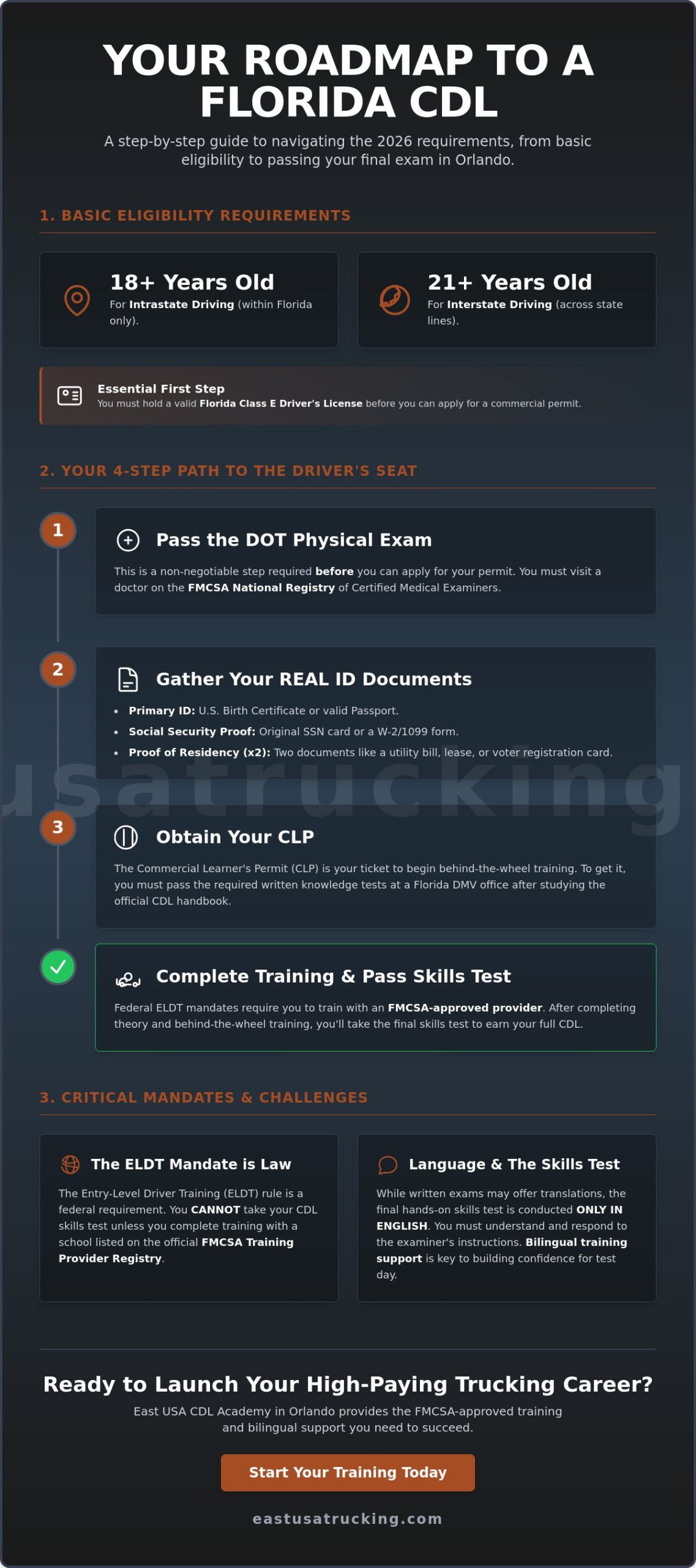
- Primary ID: U.S. Birth Certificate or valid Passport.
- Social Security: Original card or a 1099 form.
- Residency: Two separate documents, like a utility bill and a voter card.
Keep in mind that the federal government requires the skills test to be conducted in English. You don’t need to be a native speaker, but you must understand and respond to the examiner’s directions. You also need to read road signs without a translator. While the written tests are often available in other languages, the practical exam is not. At East USA CDL Academy, we help bridge this gap with bilingual support during your training so you’re fully prepared for the final exam.
Medical Certification: Passing the DOT Physical
Operating a commercial vehicle is a physically demanding job that requires more than just driving skill. To ensure road safety, the federal government mandates that every driver must be medically fit for the task. Passing a Department of Transportation (DOT) physical is a non-negotiable part of the cdl license requirements florida mandates for every new applicant. You can’t skip this step. In fact, you must have your medical results on file before you can even apply for your Commercial Learner’s Permit (CLP).
Finding the right doctor is your first priority. You cannot visit just any family physician for this exam. You must choose a provider listed on the FMCSA National Registry of Certified Medical Examiners. These professionals are specifically trained to understand the stressors of long-haul trucking and the physical stamina required to manage a heavy rig. If you have questions about how your health history might impact your training, reach out to our team for practical advice on starting your journey.
The DOT Physical Exam Process
The exam is straightforward but thorough. Your medical examiner will check your vision and hearing to ensure you can react to signals and sirens on the road. You must have at least 20/40 vision in each eye, with or without glasses. They’ll also monitor your blood pressure and check for underlying conditions like diabetes or sleep apnea. If you’re healthy, your Medical Examiner’s Certificate (MEC) is typically valid for two years. However, if you have a condition like high blood pressure, the examiner might issue a certificate that expires in one year or six months to ensure more frequent monitoring.
Self-Certification Tiers Explained
Florida requires you to tell the state exactly how you plan to use your license. This is called self-certification. Most students aiming for a Class A license select Tier 1: Non-excepted Interstate. This category allows you to drive across state lines and haul all types of freight. It also requires you to maintain a current DOT medical card at all times.
The way you submit this information has changed recently. As of June 23, 2025, medical examiners are required to transmit DOT Medical Exam information electronically. The Florida Department of Highway Safety and Motor Vehicles (FLHSMV) no longer accepts paper medical certificates. You can verify your status and view the full list of Florida CDL requirements on the official state portal to ensure your records are up to date. If you let your medical certificate expire, the state will automatically disqualify your CDL, which can lead to costly fees and delays in your career.
Don’t let a manageable medical condition stop you from pursuing your goals. The FMCSA offers waivers for certain physical impairments, provided you can prove you can operate the vehicle safely. Focus on getting your physical completed early so you can move on to the written exams and behind-the-wheel training.
How to Pass the Florida CDL Knowledge and Skills Tests
The road to your license is paved with two major hurdles: the written knowledge exams and the practical skills test. You can’t just hop in a truck and start driving. First, you must master the Florida CDL Handbook. This manual is your roadmap for everything from cargo safety to air brake systems. Once you feel confident, you’ll head to the DMV to secure your Commercial Learner’s Permit (CLP). This permit is the “golden ticket” that allows you to practice on public roads under the supervision of a licensed driver. Meeting the cdl license requirements florida mandates for testing is all about disciplined preparation.
The Knowledge Exams (Written)
To get your CLP, you must pass three core written tests: General Knowledge, Combination Vehicles, and Air Brakes. Each test requires a score of at least 80% to pass. If you’re worried about the language, Florida offers oral exams in both English and Spanish for these written portions. However, the best way to guarantee you walk out with your permit is to invest in professional CDL exam prep. Studying alone is tough. Working with mentors who know the common pitfalls makes a huge difference. If you don’t pass on the first try, the knowledge retest fee is $10.00.
Since the ELDT Mandate took effect on February 7, 2022, you must also complete a registered training program before you can take your skills test. This federal rule ensures every new driver has a baseline of safety knowledge. Once you have your CLP in hand, Florida requires a mandatory 14-day waiting period. Use this time wisely for intensive behind-the-wheel training. You can’t rush the process, so focus on the fundamentals during these two weeks.
The Skills Test (Road Test)
When the waiting period ends, you’ll face the three-part Skills Test. This is where you prove you can handle the machine. It starts with the pre-trip inspection. You’ll walk around the vehicle and identify critical safety components, explaining exactly what you’re looking for to ensure the truck is roadworthy. If you fail the pre-trip, the test ends immediately. Don’t overlook the small details like light lenses or air lines.
Next is the basic vehicle control section. You’ll perform maneuvers like straight-line backing, offset backing, and docking in a controlled yard. Finally, you’ll head out for the road test. You’ll navigate real Orlando traffic while an examiner watches your every move. You must demonstrate safe turns, proper lane changes, and smooth braking. It’s intense, but passing these cdl license requirements florida has established proves you’re ready for the professional world. If you need to retake this portion, the skill retest fee is $20.00.
The Entry-Level Driver Training (ELDT) mandate is the biggest shift in trucking regulations in recent years. Effective February 7, 2022, the FMCSA requires all new Class A and B applicants to finish a standardized program before they can sit for their skills test. You can’t just “learn from a friend” anymore. This mandate ensures every driver has a baseline of safety knowledge, which is a core part of the cdl license requirements florida enforces in 2026. Since the mandate began, the Training Provider Registry has recorded over 1.9 million trained drivers as of May 2026.
East USA CDL Academy is a fully registered provider. We handle the logistical heavy lifting by reporting your completion directly to the federal registry. This means you can focus on your skills while we manage the compliance.
The E-Restriction and Your Career
When you choose your training path, you’ll face a choice: manual or automatic. Many newcomers prefer automatic transmission CDL training because it allows them to master the road without the stress of shifting gears. If you pass your test in an automatic truck, your license will have an “E” restriction. This simply means you aren’t authorized to drive manual commercial vehicles.
Is an E-restriction a career killer? Not at all. Most modern fleets in Florida have switched to automatic trucks for better fuel efficiency. However, if you want to work in specialized hauling or heavy equipment, you might eventually need to drive a manual. If you already have a CDL with an “E” restriction, you can remove it by completing a specific restriction removal course. This typically involves 10 hours of behind-the-wheel practice on a manual transmission and a new skills test.
FMCSA Training Requirements
The ELDT rules split your education into two parts: theory and behind-the-wheel (BTW). There is no federal minimum for the number of hours you must spend in class, but you must score at least 80% on the theory assessment. For the BTW portion, you must demonstrate proficiency in all required maneuvers. Meeting the cdl license requirements florida has established for 2026 requires a school that stays current with these federal shifts.
The environment where you train matters. We use a private 4-acre facility in Orlando, which gives you the space to practice backing and docking without the pressure of public traffic. This private range speeds up your learning curve significantly. Once you’ve mastered the maneuvers, we transmit your data electronically to the TPR. This electronic reporting is vital; without it, the DMV won’t let you schedule your final exam.
Ready to start your training with an approved partner? Contact us today to reserve your spot in our next class.
Why Orlando Drivers Choose East USA CDL Academy
Finding a school that understands your specific needs makes all the difference. While the cdl license requirements florida sets are the same for everyone, the way you prepare for them isn’t. At East USA CDL Academy, we focus on removing the barriers that stop motivated drivers from starting. We offer competitive $3,200 training packages designed to be the most affordable in the Orlando area. You don’t have to break the bank to launch a career that pays well. We believe in transparency and efficiency, helping you move from the classroom to the cab as quickly as possible.
Logistics matter. We maintain a private fleet of eight trucks, ensuring you get the hands-on time you need without waiting in line. Perhaps our biggest advantage is that we are a state-authorized third-party testing site. Instead of waiting months for a DMV appointment, you can take your skills test right here on our range. It’s faster, more convenient, and significantly less stressful. You’ll test on the same ground where you practiced, giving you a distinct home-field advantage.
Bilingual Training Success
Language shouldn’t be a barrier to your professional growth. Our CDL School Spanish English Orlando program is a favorite for a reason. We have bilingual instructors who guide you through the range practice in the language you’re most comfortable with. This builds a deep understanding of the vehicle’s mechanics and safety protocols before you face the examiner. Since the state requires the final skills test to be conducted in English, our instructors spend extra time ensuring you master the specific English commands and technical terms needed to pass with confidence. We bridge the gap so you can focus on your driving skills. If you’re searching for an escuela de manejo CDL en español cerca de mi that prepares you for Florida roads without the long commute, our Orlando program is built exactly for that purpose.
Fast-Track Your Career
We know you’re likely balancing a busy schedule. Many of our students work other jobs while they study, so we offer flexible scheduling to fit your life. When test day arrives, you’ll use one of our school trucks for your road test. This is a huge benefit. You’ll be testing in the exact same vehicle you used during your behind-the-wheel training. It eliminates the “new truck jitters” and lets you focus on demonstrating safety in real Orlando traffic. If you’re ready to master the cdl license requirements florida has established and get on the road, apply to East USA CDL Academy today. We’re ready to act as your partner in this new career move.
Launch Your Professional Trucking Career Today
You now have a clear roadmap to navigate the cdl license requirements florida mandates for 2026. From passing your DOT physical to mastering the three-part skills test, each step brings you closer to professional independence. Remember that the federal ELDT mandate requires an approved training partner. This makes your choice of school the most important decision you’ll make this year. Success isn’t just about reading the handbook; it’s about getting hands-on experience in a supportive environment.
We provide the specific tools you need for a first-time pass. Practice on our 4-acre private training facility with our diverse 8-truck fleet to build real-world confidence before your exam. Our expert bilingual English and Spanish instructors ensure you understand every technical detail, regardless of your native language. We’ve simplified the process so you can focus on the road ahead. Are you ready to stop dreaming and start driving?
Start your trucking career for just $3,200—Enroll at East USA CDL Academy
The industry is waiting for skilled, reliable drivers like you to fill essential roles. Don’t let confusing regulations or language barriers hold you back from a stable future. Your new career is just one application away, and we’re ready to help you every mile of the way.
Frequently Asked Questions
Do I need a CDL to drive a box truck in Florida?
You only need a CDL if the box truck has a Gross Vehicle Weight Rating (GVWR) of 26,001 pounds or more. Most standard small delivery box trucks fall under this limit and only require a Class E license. However, if you plan to haul hazardous materials in any size vehicle, you must meet the cdl license requirements florida has established for specialized endorsements. Always check the weight plate on the door frame to be certain.
How much does it cost to get a CDL in Florida?
The state of Florida charges a $75.00 fee for an original commercial driver license. If you need to retake the knowledge portion, there is a $10.00 retest fee, while a skills retest costs $20.00. Adding endorsements like Hazmat or Tanker costs $7.00 each. Keep in mind that local tax collector offices often add a $6.25 service fee to any credential they issue. These state fees are separate from your tuition costs.
Can I take the Florida CDL test in Spanish?
You can take the written knowledge exams in Spanish at most Florida DMV locations. However, federal law requires the practical skills test to be conducted entirely in English. You must be able to understand and respond to the examiner’s directions without a translator. Our bilingual instructors help you practice the specific English commands and technical terms needed to pass this portion with confidence and move your career forward.
How long does the CDL training process take in Orlando?
Most students complete their training within three to six weeks depending on their previous experience and the specific course they choose. Our intensive programs focus on both theory and behind-the-wheel proficiency to get you road-ready quickly. Because we offer on-site testing, you can often secure your license immediately after finishing your training instead of waiting for a state appointment. This efficiency helps you start earning a paycheck sooner.
What happens if I fail my CDL road test?
If you don’t pass your skills test, you can schedule a retest after paying a $20.00 state fee. You don’t have to retake the parts you already passed, such as the pre-trip inspection or basic maneuvers, if you successfully completed them. We recommend additional practice sessions on our private range to fix the specific errors that led to the initial failure. Our instructors provide targeted feedback to ensure you succeed on your next attempt.
Is there a waiting period after getting my permit (CLP)?
Yes, you must hold your Commercial Learner’s Permit (CLP) for at least 14 days before you can take the skills test. This mandatory waiting period is designed to give you enough time for behind-the-wheel practice. Use these two weeks to master the cdl license requirements florida enforces for vehicle control and road safety at an approved training facility. Rushing the process often leads to mistakes, so focus on quality practice during this time.
Can I get a CDL with a criminal record in Florida?
You can obtain a CDL with most criminal records, but certain serious offenses will disqualify you permanently. Felonies involving the use of a motor vehicle, human trafficking, or the distribution of controlled substances often result in a lifetime ban. It’s best to check with the FLHSMV regarding your specific situation before investing in training. Most employers also run their own background checks as part of their standard hiring and insurance process.
What is the difference between Class A and Class B licenses?
A Class A license allows you to operate combination vehicles, such as tractor-trailers, with a towed unit weighing over 10,000 pounds. This is the most versatile license for long-haul careers. A Class B license is for single heavy vehicles like dump trucks, delivery trucks, or large buses. If you want the most job opportunities and the highest earning potential, a Class A license is generally the better choice for your future.