Would you settle for a $36,392 salary when you could be earning over $74,000 just by choosing a different piece of plastic? Deciding between a Class A vs Class B license Florida can feel like a high-stakes gamble if you don’t understand the legal fine print. It’s frustrating to sort through confusing weight limits and towing rules while worrying about whether your choice will limit your future job options. You want a career that offers growth, not a dead end.
We know you’re looking for a reliable way to enter a Florida logistics market projected to hit $97 billion by 2030. This guide clarifies exactly how these licenses differ so you can pick the path that matches your professional goals. We’ll break down the specific weight thresholds, compare current Florida salary data, and explain the latest 2026 testing requirements. You’ll gain the clarity needed to choose the right training program and start your new career with confidence.
Key Takeaways
- Master the legal weight limits and the 10,000-pound towing rule that separates these two professional licenses.
- Compare Class A vs Class B license Florida requirements to see which one fits your long-term income goals and lifestyle.
- Explore the 2026 salary data for Florida drivers and the growing logistics market in Orlando.
- Follow a step-by-step guide to the CLP phase and mandatory ELDT training to avoid common testing delays.
- See how bilingual instruction and on-site testing at a specialized Orlando facility can speed up your professional development.
Understanding the Basics of Florida CDL Classifications
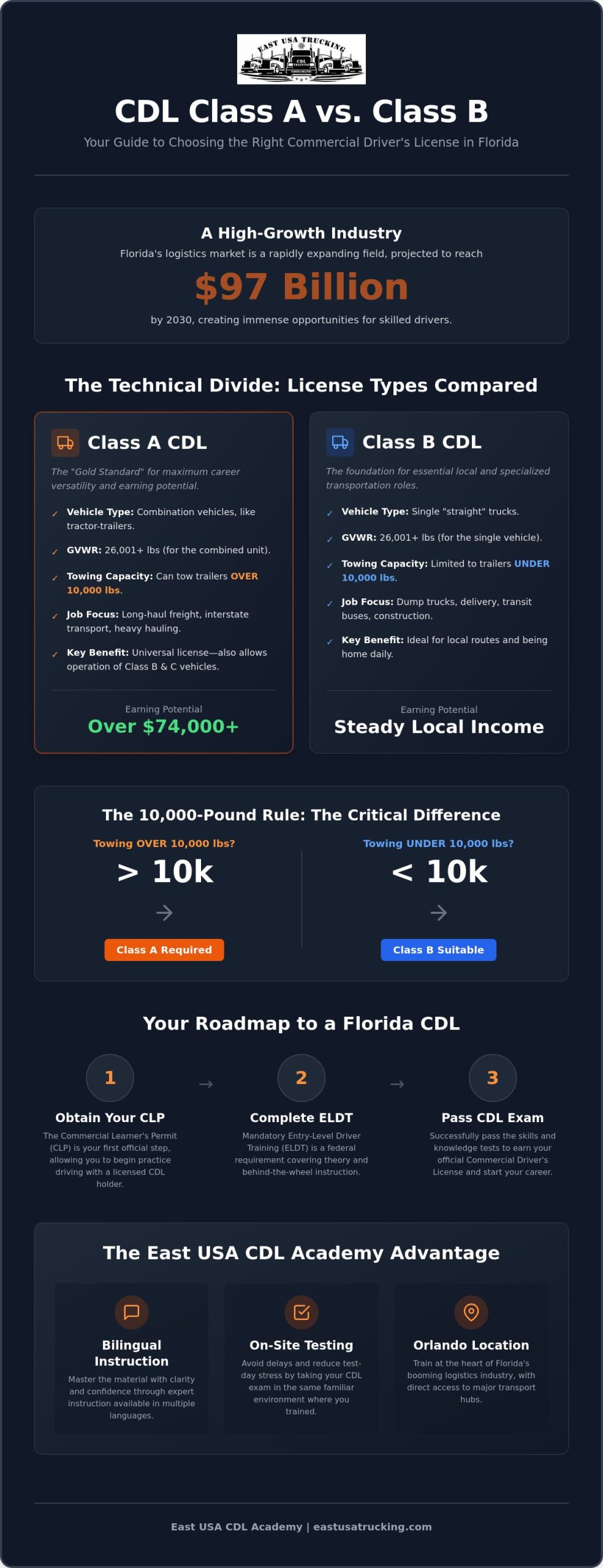
A Commercial Driver’s License (CDL) is more than just a permit; it’s a professional credential that proves you have the specialized skills to handle massive vehicles safely. In Florida, this license is your entry into a high-stakes world of logistics and transport. The most critical number you need to know is 26,001 pounds. This is the Gross Vehicle Weight Rating (GVWR) threshold. If the vehicle you want to drive exceeds this weight, you must step beyond a standard Class E license. Understanding CDL Classifications ensures you follow federal standards while meeting Florida’s specific safety requirements.
To visualize the differences between these licenses and how they impact your career, watch this helpful video:
Florida’s role in the national economy makes these classifications vital. The state’s logistics market is on track to grow to $97 billion by 2030, and daily vehicle miles traveled reached 371 million in 2024. Whether you are moving freight through the Port of Miami or delivering construction materials in Orlando, your license class determines your utility. Deciding on a Class A vs Class B license Florida depends on your desire for flexibility and your long-term income goals. While Class A offers the most freedom, Class B provides a steady path for local, specialized roles.
What is a Class A CDL?
A Class A license is the “gold standard” for professional drivers. It allows you to operate any combination of vehicles with a GVWR of 26,001 pounds or more, provided the vehicle you’re towing weighs more than 10,000 pounds. This is often called the “universal license” because it usually grants you the authority to operate Class B and Class C vehicles as well. If you see a massive tractor-trailer on the Florida Turnpike, the driver almost certainly holds a Class A. Simply put, a Class A license is defined by its unique ability to handle heavy combination vehicles and large trailers across state lines.
What is a Class B CDL?
A Class B CDL is designed for drivers who prefer “straight trucks” or large single vehicles. This classification covers any single vehicle with a GVWR of 26,001 pounds or more. You can still tow a trailer with a Class B, but that trailer must weigh less than 10,000 pounds. This makes it the ideal choice for driving dump trucks, large delivery vans, or transit buses. You won’t be pulling heavy freight containers, but you’ll be essential for local commerce and infrastructure. The biggest technical divide is the towing limit; you cannot legally haul heavy trailers with a Class B license.
The Technical Divide: Weight, Towing, and Vehicle Types
Why does a few thousand pounds of trailer weight change your entire career path? The answer lies in the technical specifications defined by the state. When comparing a Class A vs Class B license Florida, the Gross Vehicle Weight Rating (GVWR) is only half the story. You must look at the “Towing Rule” to find the real line in the sand. If you plan to haul a trailer that weighs more than 10,000 pounds, you’re legally required to hold a Class A license. This rule is what separates a standard delivery driver from a heavy-haul professional. Choosing between a Class A vs Class B license Florida means deciding how much weight you’re comfortable pulling behind you.
Reviewing the official Florida CDL Requirements shows that a Class A license is essentially a “master” credential. It gives you the versatility to operate not only heavy combination vehicles but also the single-unit trucks covered under Class B and Class C. This makes Class A the preferred choice for those who want maximum job security. You aren’t just limited to one type of cargo; you can switch between long-haul freight and local deliveries as the market shifts. It’s about having more tools in your professional toolbox.
Endorsements act as specialized upgrades to your base license. For example, adding a Hazmat (H) or Tanker (N) endorsement allows you to transport high-value materials that standard drivers can’t touch. If you want to pull two or three trailers at once, you’ll need the Doubles/Triples (T) endorsement. These certifications expand your capabilities and often lead to higher pay scales in the Florida logistics sector. Think of endorsements like skill levels in a video game; the more you have, the more “missions” you’re qualified to take on.
Vehicles You Can Drive with a Class A
- Tractor-trailers: The classic 18-wheelers and big rigs used for interstate commerce.
- Flatbeds: Essential for hauling construction equipment and oversized machinery.
- Livestock carriers: Specialized trailers for transporting animals across state lines.
- Tanker vehicles: Large units designed for liquids or gases (requires an N endorsement).
Vehicles You Can Drive with a Class B
- Straight trucks: Large single-unit vehicles often used for local furniture or appliance delivery.
- Dump trucks and cement mixers: The backbone of Florida’s booming construction and infrastructure industry.
- Utility trucks: Vehicles used by power companies and municipal maintenance services.
- Buses: Includes city transit, tour, and school buses (requires Passenger and/or School Bus endorsements).
If you’re still weighing your options or want to see these vehicles in person, get in touch with us to discuss which training path fits your mechanical interests and career goals.
Career Outcomes and Earning Potential in the Florida Trucking Industry
Orlando has transformed into a powerhouse for the logistics industry. With the Florida freight market projected to grow to $97 billion by 2030, the demand for qualified drivers is at an all-time high. This isn’t just a temporary spike; it’s a long-term shift driven by a persistent driver shortage and an aging workforce. When you look at a Class A vs Class B license Florida, you aren’t just choosing a vehicle type. You are choosing a lifestyle and a specific income bracket. Understanding these financial realities helps you plan for a stable future in the Sunshine State.
The numbers speak for themselves. In 2026, the average annual salary for a Class A driver in Florida is approximately $59,214. Depending on your experience and the cargo you haul, that range can climb as high as $84,000. Class B drivers typically see an average salary of $36,392, with most earning between $31,400 and $39,600. While the entry point for both is accessible, the ceiling for Class A is significantly higher. For a broader view of national trends and working conditions, you can check the Truck Driver Career Outlook to see how Florida compares to the rest of the country.
The Class A Career Path: Long Haul and High Pay
Choosing Class A opens doors to Over-the-Road (OTR) and regional routes. Major carriers and regional logistics firms in Orlando prioritize Class A holders because they can haul the heaviest loads. This path offers a higher earning ceiling, especially if you specialize in refrigerated freight or hazardous materials. You have the ultimate professional freedom; you can drive almost any commercial vehicle on the road today. It’s the best option for those who want to maximize their lifetime earnings and don’t mind spending a few nights away from home to secure a bigger paycheck.
The Class B Career Path: Local Routes and Stability
A Class B license is perfect for those who value predictable schedules. Most Class B jobs involve local delivery, construction, or public transit roles that get you home every single night. While the maximum salary potential is lower than Class A, the work-life balance is often superior. You’ll find plenty of opportunities in Orlando’s booming construction sector driving dump trucks or cement mixers. It’s a stable, reliable path for drivers who want to serve their local community while maintaining a steady routine with their families. The entry barrier is lower, making it a fast way to start earning at least $45,000 annually as an entry-level driver.
Long-term job security in Florida remains strong for both classifications. However, the Class A license provides more flexibility. If local construction slows down, a Class A driver can easily pivot to long-haul food distribution or retail logistics. By choosing the right Class A vs Class B license Florida path now, you’re setting the foundation for a career that can adapt to any economic climate.
The Road to Your License: Florida CDL Requirements and Training Steps
Earning your commercial credentials in 2026 requires a clear plan. Before you decide on a Class A vs Class B license Florida, you must meet the basic eligibility standards. You need to be at least 18 years old for intrastate driving or 21 for interstate routes. You’ll also need to prove Florida residency and pass a DOT physical examination. This medical certificate usually costs between $75 and $150. It proves you’re physically fit to handle a heavy vehicle safely. Don’t skip this step; you can’t move forward without it.
The next phase is the Commercial Learner’s Permit (CLP). You’ll head to a local tax collector’s office or DMV to pass written knowledge tests. The state fee for this permit is $6.25. Once you have your CLP, the federal Entry-Level Driver Training (ELDT) mandate kicks in. This isn’t a suggestion; it’s a strict federal requirement that has been fully enforced for years. You must complete your training with a provider listed on the FMCSA’s Training Provider Registry. You cannot schedule your skills test without this certification being logged in the federal system.
Step-by-Step Florida CDL Application Process
Start by visiting a certified medical examiner to get your medical card. Next, study the Florida CDL manual and pass the general knowledge exam. If you’re going for Class A, you’ll also need the combination vehicle test. After passing, you’ll hold your CLP for at least 14 days. During this time, you’ll complete your mandatory behind-the-wheel hours at a certified school. This is where you master the technical skills needed for the road. Once your ELDT training is complete, your school will upload your results so you can book your final exam.
Testing in Florida: What to Expect
The Florida Department of Highway Safety and Motor Vehicles doesn’t conduct the skills test directly. Instead, you’ll use an authorized third-party testing site. For a Class A vehicle, these fees range from $150 to $700, while Class B testing ranges from $100 to $400. The test itself consists of three parts: the pre-trip inspection, basic vehicle control, and the on-road driving test. Many students fail the pre-trip because they miss small details like checking air brake leaks or light connections. When choosing between a Class A vs Class B license Florida, remember that the skills test for Class A is more complex due to the trailer. Practicing on the same equipment you’ll use for the test is a massive advantage.
Ready to start the process? Contact our team today to schedule your ELDT-certified training and get behind the wheel with confidence.
Choosing Your Path at East USA CDL Academy in Orlando
Deciding between a Class A vs Class B license Florida is a major step toward your financial independence. You need a training partner that understands the local Orlando market and the specific challenges of the 2026 trucking industry. East USA CDL Academy provides a straightforward, no-nonsense environment where you can master the skills required for either classification. We focus on efficiency and transparency; we want you to spend less time in the classroom and more time behind the wheel earning a paycheck.
Accessibility is a cornerstone of our academy. We offer bilingual instruction in both English and Spanish to ensure that language never stands in the way of your career goals. Our entry point for Class A training starts at an affordable $3,200, making professional development reachable for motivated newcomers. You’ll train on a spacious 4-acre facility designed to mirror real-world driving conditions. With a private fleet of 8 trucks, you won’t be standing around waiting for your turn to practice. You get the hands-on experience necessary to handle heavy equipment with total confidence.
Our Training Programs and Facilities
We provide flexible options tailored to your specific career path. If you want the “universal” Class A license, you can choose between our Automatic Transmission or Manual Transmission Standard Beginner Courses. For those who already have a license but need to brush up on their skills, we offer a CDL A Refresher Course and a CDL Restriction Remove Course. Having these options allows you to customize your education based on the Class A vs Class B license Florida path you’ve chosen. We also provide specialized CDL Exam Prep to help you pass your written tests on the first try.
One of our greatest advantages is our status as an authorized third-party testing site. You don’t have to deal with the stress of an unfamiliar environment on your big day. You will take your final skills test on the same 4-acre lot where you practiced, using the same trucks you’ve already mastered. This familiarity significantly reduces testing anxiety and increases your chances of success. Whether you are using a school truck or your own vehicle, we make the testing process as seamless as possible.
Start Your Career Today
Investing in your future shouldn’t be a financial burden. We offer financing options to help you manage the cost of your training while you prepare for a high-demand career. To enroll, you’ll need your valid Florida driver’s license, your DOT medical card, and your Commercial Learner’s Permit. Our team is ready to walk you through every step of the paperwork to ensure you meet all 2026 federal ELDT requirements without any delays. Don’t wait for the market to pass you by; the opportunities in Orlando are waiting for you.
Ready to drive? Contact East USA CDL Academy today!
Take Control of Your Professional Future
You now have the facts to make an informed decision about your career path. Whether you choose the massive earning potential of Class A or the home-daily stability of Class B, you’re entering a market with incredible momentum. The choice between a Class A vs Class B license Florida comes down to where you see yourself in the next few years. With Florida’s logistics sector projected to reach $97 billion by 2030, your professional skills will be in high demand for a long time.
We make the transition into trucking straightforward and accessible. Our $3,200 training package provides the hands-on experience you need on the exact equipment you’ll use for your final exam. As an authorized 3rd party testing site with bilingual English/Spanish instructors, we remove the barriers that stand between you and your first commercial paycheck. It’s time to stop overthinking and start driving. Start Your Trucking Career with Orlando’s Best CDL Training and secure your place in this booming industry today.
Frequently Asked Questions
Can I drive a Class B vehicle with a Class A license in Florida?
Yes, holding a Class A license generally allows you to operate Class B and Class C vehicles. This is why many drivers choose the Class A vs Class B license Florida path, as it offers maximum career flexibility. If you’re licensed for a tractor-trailer, you’re legally qualified to drive single-unit straight trucks or delivery vans without needing a separate license.
Is it harder to get a Class A or Class B CDL?
Class A is technically more challenging because you must master coupling and backing up a trailer. The pre-trip inspection is also more extensive since it includes the trailer’s components and air lines. While Class B focuses on large single vehicles, Class A requires a higher level of mechanical coordination and spatial awareness during the third-party skills test.
How much does CDL training cost in Orlando for 2026?
At East USA CDL Academy, our automatic transmission beginner course is $3,200. This price provides a high-value entry point for those looking to start their careers quickly. You’ll also need to budget for state fees, such as the $75 original license fee and third-party skills test fees, which range from $150 to $700 for Class A vehicles.
Do I need a Class A license to drive a dump truck in Florida?
No, a Class B license is typically sufficient for driving a standard dump truck in Florida. These are single-unit vehicles with a GVWR over 26,001 pounds. However, if you plan to pull a trailer weighing more than 10,000 pounds behind that dump truck, you’ll need to upgrade to a Class A to remain legal on the road.
Can I take my CDL road test in Spanish in Florida?
You can take the written knowledge exams in Spanish, but the skills test must be conducted in English. Federal regulations require all drivers to understand and respond to official traffic instructions and commands in English. Our bilingual instructors help you bridge this gap by explaining technical concepts in Spanish during your practice sessions at the academy.
What happens if I have an automatic transmission restriction on my license?
An automatic transmission restriction, known as Restriction E, means you are legally prohibited from operating commercial vehicles with a manual gearbox. If you want to remove this, you must retake the skills test in a manual vehicle. Many drivers start with an automatic to get on the road faster, then return for our restriction removal course later.
How long does it take to get a Class A CDL in Florida?
Most students complete their Class A vs Class B license Florida training in three to six weeks. This timeline includes your mandatory ELDT theory and behind-the-wheel hours. Your speed depends on how quickly you pass the written permit exams at the DMV and your availability for practice sessions at our 4-acre Orlando facility.
Is a Class B CDL worth it for local delivery jobs?
Yes, a Class B is highly valuable for drivers who prioritize being home every night. You’ll find consistent work in local food distribution, construction, and public transit. While the average salary of $36,392 is lower than Class A, the predictable schedule and lower training intensity make it an excellent choice for many Florida families.