Did you know that Florida import volumes are up 10% this year, creating a massive surge in demand for local delivery and construction drivers? You’ve likely seen this growth happening all around you, yet the path to joining the industry feels blocked by confusing regulations. It’s completely normal to feel overwhelmed by the latest federal ELDT mandates or worried about how language barriers might affect your training. You want a stable career, but you don’t want to spend months stuck in a classroom or wasting money on the wrong program.
This guide simplifies everything you need to know about Class B CDL training Florida so you can get on the road in weeks, not months. We’ll show you how to satisfy the 2026 federal training requirements and find programs that offer the bilingual support you need to succeed. From mastering the pre-trip inspection to finding the right school in Orlando, we provide the roadmap you need. Read on to discover how to secure your future in the trucking industry and find the best training options to fit your professional goals.
Key Takeaways
- Understand the specific Florida requirements for a Class B license, including the mandatory Entry Level Driver Training (ELDT) standards.
- Explore high-demand career paths in Orlando’s booming construction and waste management sectors for Class B drivers.
- Learn how to identify the best Class B CDL training Florida has to offer by verifying school registry status and training yard standards.
- Discover how specialized exam prep and flexible testing options can help you secure your commercial license in weeks.
- Master the process of moving from a Commercial Learner’s Permit to a full license with our breakdown of the 2026 regulations.
What is Class B CDL Training in Florida? Understanding the Basics
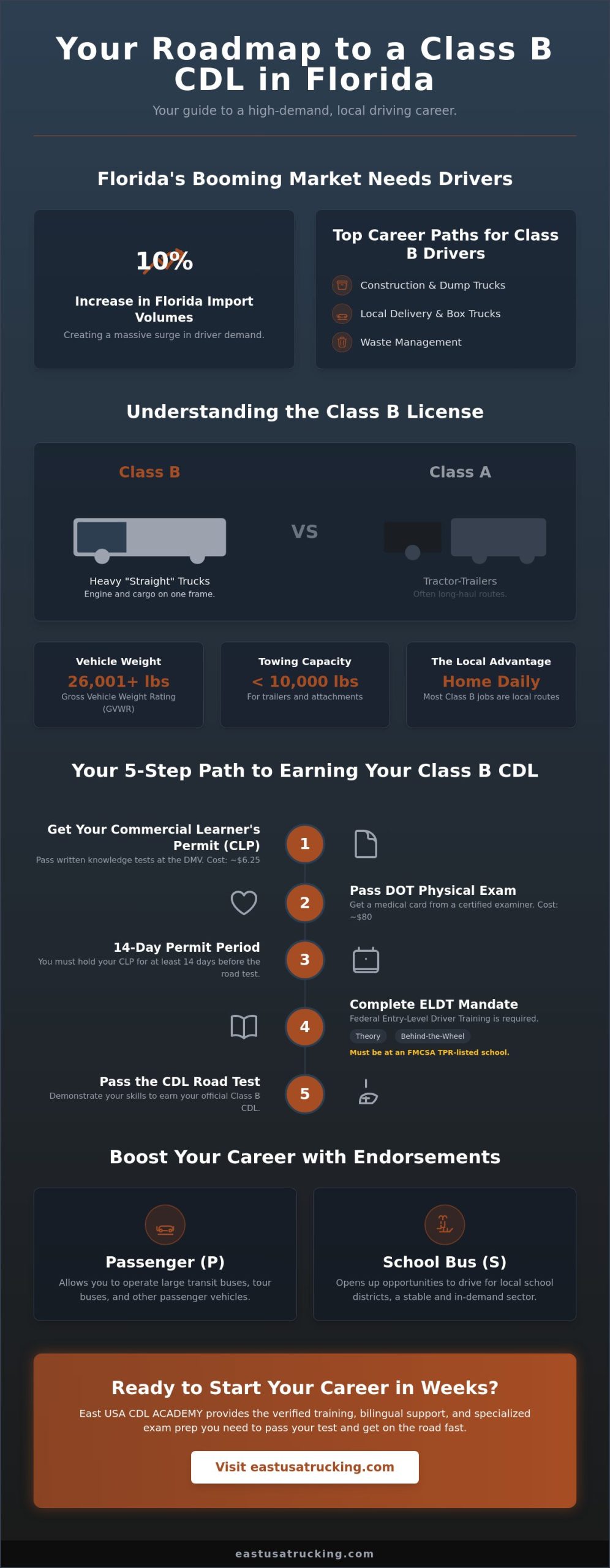
Entering the world of commercial driving starts with understanding which license fits your career goals. A Commercial Driver’s License (CDL) is not a one size fits all credential. For many Floridians, Class B CDL training Florida offers the most direct path to a stable, high paying job without the need to spend weeks away from home. Florida HSMV standards define a Class B vehicle as any single unit with a gross vehicle weight rating (GVWR) of 26,001 pounds or more. Unlike Class A, which focuses on massive tractor trailers, Class B is designed for heavy “straight” trucks where the engine and the cargo area are part of the same frame.
Before we dive into the specific vehicle types, watch this demonstration of a common maneuver you will master during your training:
The “Local Advantage” is a primary reason drivers choose this classification. Class A drivers often haul freight across state lines, but Class B roles are almost exclusively local. You’ll find these drivers operating dump trucks at Florida construction sites, driving large passenger buses in our tourism hubs, or navigating delivery box trucks through city streets. If you want a career that lets you be home every night for dinner, this is your best option. While a Class A license allows you to drive Class B vehicles, the training for Class B is often faster and more focused on the specific equipment you’ll actually use on the job.
Who is Class B Training For?
This training is ideal for career changers who need to enter the workforce quickly. You don’t need months of study to get started. It’s also the perfect fit for individuals who feel intimidated by the complexity of coupling and uncoupling large trailers. If you are looking for opportunities in the Central Florida construction or municipal sectors, obtaining your license through a professional program like East USA CDL ACADEMY can put you in the driver’s seat of a stable career in just a few weeks.
The Scope of a Class B License
Understanding your limits is vital for safety and legal compliance. With a Class B license, you can tow a trailer, but only if that trailer weighs less than 10,000 pounds. If the trailer exceeds that weight, you’ve moved into Class A territory. To increase your versatility, you can add endorsements to your license. The Passenger (P) endorsement allows you to drive large transit buses, while the School Bus (S) endorsement opens doors at local school districts. Mastering these basics during your Class B CDL training Florida ensures you remain compliant with all state and federal regulations while maximizing your earning potential.
Florida Class B CDL Requirements and ELDT Standards
Getting your commercial license is a structured process that starts long before you sit in the driver’s seat. You first need to secure a Florida Commercial Learner’s Permit (CLP). This requires passing several written knowledge tests at a local DMV office. According to the Florida Class B CDL Requirements, you must hold this permit for at least 14 days before you can attempt your final road test. The permit fee is currently $6.25. During this waiting period, you’ll also need to pass a Department of Transportation (DOT) physical. A certified medical examiner will check your health to ensure you can safely operate heavy vehicles. This medical card usually costs about $80 and is a mandatory part of your file.
The Role of ELDT in 2026
The federal Entry-Level Driver Training (ELDT) mandate has completely changed how you get licensed. You can’t just practice with a friend and take the test. You must complete a program from a school listed on the FMCSA Training Provider Registry (TPR). This training is split into two parts: theory and behind-the-wheel (BTW). Theory covers the rules of the road and safety protocols. BTW training is where you get hands-on experience in a real truck at an authorized facility. Choosing the right Class B CDL training Florida ensures your completion data is correctly uploaded to the federal database. If you want to see how our program fits your schedule, feel free to check our current availability.
Age and Residency Rules
Florida sets clear rules for who can drive commercially. If you are 18 years old, you can apply for an intrastate CDL. This means you can drive anywhere within the state borders. You must be 21 years old to drive across state lines or transport hazardous materials. As a Florida resident, you’ll need to provide your Social Security number and two proofs of residential address. Your vision must meet the 20/40 standard in both eyes. These rules ensure that every driver on the road is prepared for the responsibility of handling a 26,000-pound vehicle.
Once your training is finished, you’ll face the state-administered Class B road test. This test includes a thorough pre-trip inspection, basic control maneuvers, and a driving exam on public roads. The fee for your original CDL is $75. If you don’t pass the skills portion on your first try, the retest fee is $20. Following these steps in order keeps your progress on track and helps you avoid unnecessary delays in your new career.
Class B Career Opportunities in the Florida Job Market
Florida’s economy is surging, and the logistics sector is leading the charge. With import volumes up 10% year-over-year as of May 2026, the demand for local distribution has never been higher. While long-haul trucking often gets the spotlight, the real growth for local residents is in Class B roles. These positions keep our cities running. From the massive construction projects in Orlando to the daily food deliveries at our world-famous resorts, Class B drivers are the backbone of the Sunshine State. Completing your Class B CDL training Florida puts you in the perfect position to capitalize on this supply-driven market recovery.
While many are finding success on the road, those interested in other high-growth transportation sectors in the state can look to 2FLY Airborne for professional pilot training that opens up a different set of career opportunities.
The construction sector in Central Florida is a primary employer for new drivers. You’ll find consistent work operating dump trucks, concrete mixers, and specialized equipment for infrastructure projects. Beyond construction, municipal roles offer incredible stability. Waste management companies and city departments provide predictable schedules and competitive benefits. If you prefer a fast-paced environment, the food and beverage industry is always hiring. These drivers handle the “final mile” of delivery, ensuring that products move from distribution centers to local storefronts and restaurants safely and on time.
Local vs. Over-the-Road (OTR)
Do you want to sleep in your own bed every night? That’s the biggest question facing new drivers. Class A careers often require weeks away from home, navigating multiple states. In contrast, Class B roles are almost exclusively local or regional. This makes it the preferred choice for parents and residents who value a consistent work-life balance. Most Class B drivers in Florida work standard day shifts. You’ll start your morning at a local yard, complete your route, and return home by evening. It’s a professional driving career that doesn’t require you to sacrifice your personal life.
Florida Salary Expectations
Entry-level pay for Class B drivers in Orlando is currently very competitive due to the tight capacity in the market. As of early 2026, the tender rejection rate for truckloads sits at 16.4%, meaning companies are desperate for reliable operators. You can further increase your earning potential by adding endorsements to your license. For example, a HazMat endorsement allows you to transport specialized materials, which often commands a higher hourly rate. All reputable employers now require proof that you’ve met the federal Entry-Level Driver Training (ELDT) standards before they’ll consider your application. Investing in professional Class B CDL training Florida is the fastest way to move from a trainee to a high-earning professional in a matter of weeks.
How to Choose the Best Class B CDL School in Orlando
Choosing a school is the most important decision in your career journey. Don’t settle for the first result you see online. First, verify that the school is on the official FMCSA Training Provider Registry. If they aren’t on this list, your training won’t count toward federal requirements. You should also look at the physical environment. A quality program needs space. Look for facilities with training yards of at least 4 acres. This ensures you have plenty of room to practice backing maneuvers and turns without feeling crowded or unsafe. Large yards allow for multiple stations, meaning you spend more time driving and less time waiting.
Drive time is another critical factor. Ask about the truck-to-student ratio before you sign any paperwork. You want a school that prioritizes your time behind the wheel rather than one that leaves you standing on the sidelines. High quality Class B CDL training Florida should offer a private fleet of trucks. This consistency allows you to learn on the same equipment you’ll use for your final state exam. When you’re comfortable with the specific truck you’ve been practicing in, your confidence during the road test will be much higher.
Bilingual Support: Training in English and Spanish
Clear communication is non-negotiable during behind-the-wheel sessions. In Orlando, many aspiring drivers speak Spanish as their primary language. If English is your second language, find a school with bilingual instructors. These professionals help you master technical industry terms in both languages. This approach builds the confidence you need to handle complex maneuvers and pre-trip inspections. Success rates for bilingual students in Central Florida are significantly higher when they receive instruction in their native tongue. It removes the stress of a language barrier so you can focus entirely on the mechanics of driving.
Facility and Equipment Quality
The quality of the trucks you train on directly impacts your readiness for the road. Some schools use outdated or poorly maintained vehicles. Avoid these programs. A private fleet leads to better training consistency and fewer mechanical delays. Learn about our Orlando facilities and fleet to see the standard you should expect. When you practice on modern equipment, you’re better prepared for the technology found in today’s commercial vehicles. If you’re ready to start your journey with a team that values your success, reach out to our admissions office for more details on our upcoming Class B sessions.
Start Your Career with East USA CDL ACADEMY’s Class B Program
Take the first step toward your professional driving career today. East USA CDL ACADEMY offers a specialized program designed to turn beginners into confident commercial drivers. We realize that handling heavy machinery can feel like a major challenge at first. That is why our instructors provide patient, step by step guidance through every part of the curriculum. You’ll spend your training hours at our 4 acre private facility in Orlando. This spacious yard provides a controlled environment where you can practice backing, turning, and parking without the stress of city traffic. Our Class B CDL training Florida is built around your success, offering affordable tuition and flexible payment options to help you start your journey.
Clear communication is the foundation of our instruction. East USA CDL ACADEMY employs bilingual instructors who are fluent in both English and Spanish. This ensures that every student fully understands the technical requirements and safety protocols needed to pass the state exam. We don’t want language barriers to stand in the way of your career goals. Our staff is dedicated to helping you master the pre-trip inspection and on-road maneuvers in the language you feel most comfortable using. This inclusive approach has helped many local residents in Central Florida secure their licenses and start working in weeks.
Flexible Training and Testing Options
We understand that your time is valuable. To help you get on the road faster, we offer on-site 3rd party testing. This means you won’t have to deal with the long wait times often found at government testing centers. You have the choice to use one of our school trucks or even your own truck for the road test. This flexibility allows you to test in the equipment where you feel most confident. If you want to simplify your learning experience, explore our automatic transmission training options to see if this modern path is right for you. We provide both automatic and manual courses to ensure you are prepared for the specific type of equipment you plan to operate.
Enrollment and Next Steps
Joining East USA CDL ACADEMY is a straightforward process. Your first step is to schedule a consultation and a tour of our Orlando facility. During this visit, you can see our fleet, meet the instructors, and get answers to any remaining questions about the enrollment process. Make sure you have your Florida driver’s license and learner’s permit ready to go. We are organized and ready to help you transition into this high demand industry. Contact us today to start your Class B training and take the first step toward a stable, local career.
Launch Your New Career Today
Choosing a Class B license means choosing a career that values your time and your community. You’ve learned how the right training program bridges the gap between federal mandates and your first day on the job. By focusing on local opportunities, you can enjoy the stability of a professional driving role while staying close to home every night. Mastering the skills required for this license isn’t just about passing a state test; it’s about opening doors to Florida’s thriving construction and logistics industries. The demand for qualified drivers is high, and the path to entry is straightforward when you have the right support.
East USA CDL ACADEMY is ready to help you reach this milestone. As an FMCSA Certified ELDT Provider with a 4-acre private training facility in Orlando, we provide the professional environment you need to succeed. Our bilingual English/Spanish instructors ensure that every student receives clear, expert guidance throughout the process. Ready to drive? Contact East USA CDL ACADEMY for affordable Class B CDL training Florida! Your new career is within reach. Take action today and start moving toward a more secure and prosperous future.
Frequently Asked Questions
How long does Class B CDL training take in Florida?
Most students complete their Class B CDL training Florida in approximately two to four weeks. The exact timeline depends on your personal learning pace and how quickly you master the mandatory Entry-Level Driver Training (ELDT) theory and behind-the-wheel requirements. Because Class B vehicles don’t involve complex trailers, you can often transition from the classroom to the road much faster than Class A students.
Is a Class B CDL easier to get than a Class A?
Yes, many drivers find the Class B license more accessible because it focuses on single “straight” trucks rather than articulated vehicles. You won’t have to learn the difficult maneuvers associated with backing up a 53-foot trailer or the technical process of coupling and uncoupling. If you prefer driving dump trucks, delivery box trucks, or buses, this classification provides a simpler and more direct path to employment.
Can I drive a school bus with a Class B license?
You can drive a school bus with a Class B license as long as you obtain the necessary state endorsements. Specifically, you’ll need the Passenger (P) and School Bus (S) endorsements, which require additional knowledge and skills testing. This makes the Class B license the standard choice for individuals looking to work for Florida school districts or private transit companies.
Do I need to know how to drive a manual transmission for a Class B CDL?
You don’t need to learn a manual transmission if you plan to operate modern automatic trucks. Many schools offer an Automatic Transmission Standard Beginner Course that allows you to train on the equipment most commonly used in today’s fleets. Just keep in mind that testing on an automatic truck will result in an “E” restriction on your license, which limits you to driving automatic commercial vehicles only.
What happens if I fail the Class B road test in Florida?
If you fail the skills portion of the exam, you can schedule a retest after a mandatory waiting period. Florida DHSMV requires a $20 skill retest fee for each attempt after the initial failure. It’s common for students to need a second try, so don’t be discouraged. Many programs offer refresher courses or extra practice sessions to help you polish your skills before your next appointment.
Are there financing options available for CDL school in Orlando?
Yes, many reputable schools in Orlando offer flexible tuition packages and financing options to help manage the cost of your professional development. While the cost of training varies, these programs are designed to be an investment in your future career. You should always ask about available payment plans during your initial facility tour or consultation to find a solution that fits your budget.
Can I get my Class B CDL if I only speak Spanish?
While federal regulations require you to read and speak enough English to understand traffic signs and communicate with law enforcement, bilingual training is a massive advantage. Instructors who speak both English and Spanish can help you master the technical terminology and pre-trip inspection steps more effectively. This supportive approach ensures you’re fully prepared for the state exam regardless of your primary language.
What is the difference between Class B and Class C licenses in Florida?
The primary difference is the weight and purpose of the vehicle you are operating. A Class B license is required for single vehicles with a weight rating of 26,001 pounds or more. A Class C license is for smaller vehicles that don’t meet the Class A or B weight limits but still require a CDL because they transport 16 or more passengers or carry hazardous materials.