Did you know that the 14 days following your permit approval are the most critical window for your entire trucking career? You have already cleared the first hurdle, but the path from holding a piece of paper to commanding a Class A rig is where many drivers get stuck. It is natural to feel a bit of anxiety about technical air brake questions or the latest Florida traffic regulations. Knowing exactly what to do after getting CDL permit Florida is the difference between starting your new job next month or getting caught in a loop of DMV retests.
We understand that the transition feels high stakes. You want to pass your skills test on the first try and avoid the frustration of missing documents or confusing local laws. This guide provides a clear roadmap to help you master the transition from permit holder to professional driver. We will preview the mandatory 2026 Entry-Level Driver Training (ELDT) requirements, the specific paperwork needed for the Florida DMV, and the steps to enroll in a high quality Orlando training program. Let’s turn that permit into a professional license and get your career on the road today.
Key Takeaways
- Grasp the essential 14-day waiting period and the 50-question general knowledge format required for your Florida CLP.
- Master high-probability exam topics including tire tread depth inspections and heavy-load steering logic.
- Study Florida-specific road rules like the “Move Over” law and state-specific bridge weight formulas to ensure compliance.
- Discover exactly what to do after getting CDL permit Florida by following a 2026 study roadmap focused on the most critical handbook chapters.
- Evaluate your career path by choosing between automatic or manual transmission training once your permit is secured.
Understanding the Florida CDL Permit (CLP) Essentials
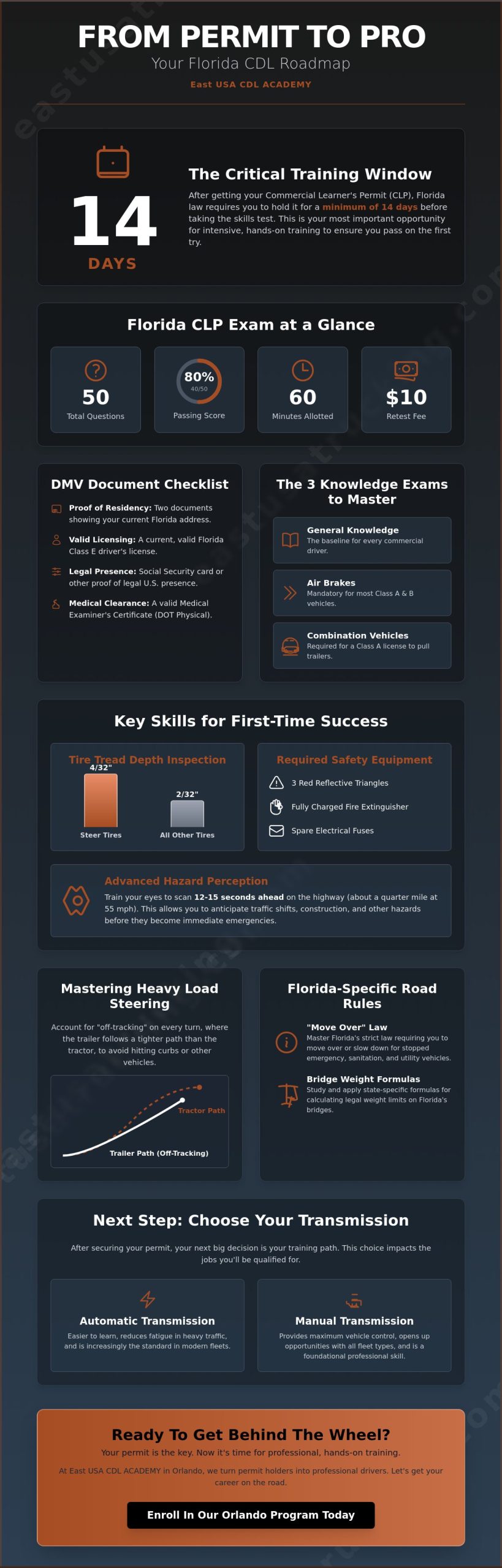
Securing your Commercial Learner’s Permit (CLP) is the moment your trucking career officially shifts from a dream to a reality. In Florida, this permit acts as your learner’s license for the big rigs. You must hold this permit for at least 14 days before you can even schedule your skills test. This period is not just a wait; it’s your primary training window. Knowing exactly what to do after getting CDL permit Florida helps you maximize this time so you don’t arrive at the testing site unprepared.
To earn the permit, you’ll sit for a 50-question General Knowledge exam. Florida gives you exactly 60 minutes to complete it. You need to get at least 40 questions right, which is an 80% passing score. This test ensures you understand the fundamentals found in a Commercial Driver’s License overview, covering everything from basic control to emergency procedures. If you don’t pass on the first try, Florida charges a $10 retest fee. Once you have it in hand, you are legally allowed to operate a commercial vehicle on Florida roads, provided a licensed instructor is in the seat next to you.
Watch this video to understand the immediate steps you should take once your permit is in hand:
Checklist of Required Documents for the Florida DMV
Don’t let a missing piece of paper stall your progress at the DMV. You need to bring several specific items to ensure your application goes through without a hitch. These documents verify your identity and your physical readiness for the job. As of May 2026, Florida has also resumed issuing permits to eligible non-U.S. residents with specific visa types like H-2A or E-2, provided they meet all other criteria. You will need:
- Proof of Residency: Two documents showing your Florida residential address.
- Valid Licensing: A current Class E driver’s license.
- Legal Presence: Your Social Security card or proof of legal presence in the United States.
- Medical Clearance: A valid Medical Examiner’s Certificate (DOT Physical) from a certified provider.
The Three Knowledge Exams You Must Master
Success requires passing specific exams tailored to your career path. The General Knowledge test is the baseline for every driver. If your truck has air brakes, which most do, the Air Brakes exam is mandatory. For those aiming for a Class A license to pull heavy trailers, the Combination Vehicles test is the final piece of the puzzle. Mastering these three areas ensures you have the theoretical foundation to start training at East USA CDL ACADEMY. Thorough preparation is the most vital part of what to do after getting CDL permit Florida, as it sets the tone for your entire professional driving career.
General Knowledge Checklist: High-Probability Exam Topics
Passing the written test is a major milestone. But do you know what to do after getting CDL permit Florida to ensure you stay safe during those first behind the wheel hours? You need to master high probability topics that examiners prioritize during the evaluation process. For example, hazard perception isn’t just about looking at the car directly in front of you. On busy highways like I-4, you must train your eyes to look 12 to 15 seconds ahead. This allows you to anticipate traffic shifts or construction hazards before they become immediate emergencies.
Every pre-trip routine starts with a rigorous vehicle inspection. You must verify your tire tread depths with precision. Steer tires require at least 4/32 of an inch of tread, while all other tires need at least 2/32. Don’t forget your essential safety equipment. You are required to carry a fully charged fire extinguisher, three red reflective triangles, and spare electrical fuses. Reviewing the official Florida CDL requirements will help you identify every specific component the state expects you to inspect before hitting the road.
Mastering the steering logic for heavy loads is a significant shift from driving a standard car. You have to account for off-tracking on every turn to avoid hitting curbs or other vehicles. Space management is equally vital in our state. Sudden summer downpours can instantly double your required stopping distance. A good rule of thumb is to maintain one second of following distance for every 10 feet of vehicle length, adding an extra second if you are traveling over 40 mph. If these technical details feel overwhelming, reach out to our team for personalized guidance on your study plan.
Emergency Procedures and Safety Logic
When an emergency occurs, your reaction must be automatic. Controlled braking involves applying the brakes as hard as possible without locking the wheels. Stab braking requires you to lock the wheels, release them immediately, and then apply them again once the wheels start rolling. If you must pull over on a divided highway, place your warning triangles at 10 feet, 100 feet, and 200 feet toward the approaching traffic. For fire safety, remember that using water on an electrical or fuel fire will only make it worse; always use a B:C rated extinguisher.
Driving in Hazardous Florida Conditions
Florida-Specific Road Rules and Sign Categories
Florida plays by its own rules once you leave the classroom and hit the pavement. Understanding these local nuances is a vital part of what to do after getting CDL permit Florida. National standards give you the foundation, but our state’s specific laws keep your record clean and your license valid. For instance, the Florida “Move Over” law is strictly enforced. When you see emergency vehicles, tow trucks, or even utility and sanitation vehicles stopped on the shoulder, you must move over a lane. If you can’t move over safely, you are legally required to slow down to 20 mph below the posted speed limit.
Safety extends to your personal conduct as well. Florida maintains a zero-tolerance approach for commercial drivers. While the standard limit for passenger vehicles is 0.08%, your limit is 0.04%. Refusing a sobriety test in Florida often leads to an immediate one-year disqualification of your commercial driving privileges. This aligns with the broader FMCSA CDL program standards that prioritize highway safety across the country. Breaking these rules doesn’t just result in a fine; it can end your career before it truly begins.
Weight limits are another area where Florida specifics matter. You must understand the state’s bridge formulas and axle limits to avoid costly citations at weigh stations. Florida’s sandy soil and high water table mean our roads are sensitive to overweight loads. Always check your weight distribution before leaving the yard to ensure you aren’t putting too much pressure on a single axle group.
The Florida Road Sign Checklist
Don’t confuse a “Low Clearance” sign with a “Weight Limit” sign during your pre-trip planning. In older parts of Orlando and coastal cities, low-hanging trees or historic bridges can be a hazard for high-profile rigs. You will also encounter “No Engine Brake” zones in residential areas throughout Central Florida. Using your Jake brake in these areas can result in noise ordinance violations. Also, keep a sharp eye for flashing yellow signals at rail crossings. In Florida, these often indicate a train is approaching even if the gates haven’t dropped yet; always prepare to stop your heavy vehicle early.
Navigating Florida Intersections and Highways
Intersections in Florida can be complex. You will likely encounter multi-lane roundabouts which require you to claim both lanes to prevent smaller cars from passing you on the inside of a turn. When traveling on major arteries like I-95 or the Florida Turnpike, stay out of the left lane unless directed otherwise by signage. If an accident occurs, Florida law requires you to notify law enforcement immediately if there is any injury or if vehicle damage appears to exceed $500. Knowing these reporting steps is a key component of what to do after getting CDL permit Florida to protect your professional standing.
Your 2026 Study Roadmap for First-Time Success
Success starts with the right materials. Your first task is to download the official 2026 Florida CDL Handbook from the FLHSMV website. This is the primary source for every question you will face. Don’t try to memorize the entire book at once. Instead, prioritize Chapters 1, 2, 3, 5, and 6. These chapters cover the core essentials: general knowledge, driving safely, transporting cargo, air brakes, and combination vehicles. Understanding these fundamentals is the most productive part of what to do after getting CDL permit Florida because it builds a foundation for the hands-on training that follows.
Florida’s diverse workforce means many applicants are more comfortable in Spanish than English. If English is your second language, seek out bilingual resources. Total comprehension is more important than simple translation. You need to understand the logic behind the rules, not just the words. Use practice tests that offer detailed explanations for every answer. Rote memorization often fails when the DMV rewords a question to test your actual understanding. If you find yourself struggling with the technical terminology, contact our experienced instructors at East USA CDL ACADEMY for a study plan that fits your needs.
Effective Study Habits for Future Drivers
Your brain retains information better in short bursts. Study in 20-minute focused blocks followed by a five-minute break. This technique prevents burnout and keeps your mind sharp. Create flashcards for “magic numbers” like the tread depths and following distances discussed in previous sections. To verify you actually understand a concept, explain it out loud to a friend or even to yourself. If you can’t explain why a certain safety check is required, you haven’t mastered the material yet.
Test-Taking Strategies: The Process of Elimination
The DMV written test often includes “distractor” answers. These options sound technical or official but are fundamentally incorrect. Use the process of elimination to narrow your choices. Avoid answers that include absolute words like “always” or “never.” In the world of commercial safety, the correct answer usually accounts for variables like weather and traffic. When in doubt, always select the option that prioritizes “Safety First.” The examiners want to see that you value the safety of the public over speed, convenience, or fuel economy. What to do after getting CDL permit Florida includes perfecting these test-taking skills so you can walk into the DMV with total confidence.
Next Steps: Enrolling in Hands-On Training in Orlando
The moment you walk out of the DMV with your Commercial Learner’s Permit, that 14-day mandatory waiting period mentioned earlier begins. This is not just a regulatory pause; it is your window to master the physical mechanics of a tractor-trailer. Identifying what to do after getting CDL permit Florida during these two weeks determines how quickly you start earning. You must move from the handbook to the driver’s seat. Look for training facilities that offer at least 4 acres of dedicated practice space and a private fleet. This ensures you spend your time executing maneuvers rather than waiting for your turn in a crowded yard.
Securing your spot in a top tier program also requires financial planning. Before you commit your time, verify CDL school payment plans in Florida to see how you can fund your career in 2026. You also need to decide between manual or automatic transmission training. While manual rigs offer broader utility, many modern fleets have shifted entirely to automatic systems. Your choice should reflect the specific type of regional or over the road hauling you intend to pursue. We focus on providing the transparency you need to make this decision with total confidence.
Why East USA CDL ACADEMY is the Choice for Orlando Drivers
We provide the logistical mastery and personalized support necessary to bridge the gap between permit and license. Our instructors offer affordable CDL training in Orlando with programs starting at $3,200. You won’t just be a number at East USA CDL ACADEMY. We utilize bilingual instructors who speak both English and Spanish fluently to ensure no technical safety detail is lost in translation. You will practice on our expansive 4-acre facility using one of our 8 dedicated training trucks. This high volume of “wheel time” is the secret to building the muscle memory required for the state skills exam.
Finalizing Your Class A CDL
The final phase of what to do after getting CDL permit Florida involves perfecting three specific skill sets: the pre-trip inspection, backing maneuvers, and the final road test. Many students now choose automatic transmission CDL training to simplify the learning curve and enter the workforce faster. Once you feel ready to test, you don’t have to wait for a government appointment. You can schedule your third-party CDL testing right here at our academy. We use our own trucks and our own site to keep the process efficient, familiar, and stress free. Take the next step today and turn that permit into a professional paycheck.
Secure Your Future on the Florida Road
You’ve already cleared the biggest hurdle by securing your permit. Now, you must focus on mastering the technical skills and Florida-specific regulations that define a professional driver. From respecting the Move Over law to perfecting your pre-trip inspection, your success depends on high-quality practice during your 14-day waiting period. Understanding exactly what to do after getting CDL permit Florida ensures you don’t waste a single day of this critical window. It’s the difference between just having a permit and holding a high-paying license.
East USA CDL Academy provides the logistical mastery to get you behind the wheel quickly. We offer affordable beginner training starting at $3,200 and feature bilingual instructors who speak both English and Spanish fluently. As an authorized 3rd party testing site, we handle everything from your first practice session to your final road test right here in Orlando. Don’t let your permit expire while you wait for a DMV appointment. Start Your Career: Contact East USA CDL Academy Today. The road is waiting for you, and we’re ready to help you drive on it with confidence.
Frequently Asked Questions
How many questions are on the Florida CDL general knowledge test?
The Florida CDL general knowledge test features 50 multiple-choice questions. You are given a 60-minute window to finish the exam at your local DMV office. These questions test your understanding of vehicle safety, control systems, and basic inspection routines found in the official handbook. It’s a fast-paced exam that requires you to know the material inside and out before you sit down at the computer terminal.
What is the passing score for the CDL permit test in Florida?
You need a score of 80% to pass the Florida permit test. This translates to getting at least 40 out of 50 questions right. If you fall short of this mark, you’ll need to pay a $10 retest fee to try again. Use your initial results to identify which specific chapters require more study time so you can pass on your second attempt with total confidence.
Can I take the Florida CDL permit test in Spanish?
Yes, you have the option to take the permit test in Spanish. Florida recognizes the importance of a multilingual workforce and provides the exam in several languages. This ensures you can focus on the technical safety concepts rather than struggling with a language barrier during the timed test. It’s an excellent way to ensure you fully grasp the logic behind every traffic law and safety regulation.
How long is the Florida Commercial Learner’s Permit (CLP) valid?
Your permit is valid for 180 days in Florida. However, you must hold this permit for at least 14 days before you are eligible to take your final skills test. Planning your training around this mandatory 14-day window is a vital step in what to do after getting CDL permit Florida. This time is best spent practicing your backing maneuvers and pre-trip inspections with a qualified instructor.
What happens if I fail the Florida CDL permit test?
If you fail the test, you must pay a $10 retest fee for each subsequent attempt. There is no specific state-mandated waiting period between written test attempts, but rushing back without studying is usually a mistake. Take the time to review the chapters on air brakes and combination vehicles to ensure you’re ready for the second round. Focus on the logic behind the questions to avoid getting tripped up by different wording.
Do I need a DOT medical card before I can get my CDL permit?
You must obtain a DOT medical card before you can receive your permit. A certified medical examiner must verify that you are physically fit to operate heavy machinery according to federal standards. Bring the original medical certificate with you to the DMV office, as they won’t process your CLP application without it. This ensures every driver on the road meets a baseline of physical health and safety.
Can I drive a truck alone once I have my CDL permit in Florida?
You are not permitted to drive a truck alone with only a Commercial Learner’s Permit. A licensed CDL driver must always be in the passenger seat next to you while the vehicle is in motion. This supervisor must hold a valid license for the same class of vehicle you are currently operating. This requirement ensures that a seasoned professional is there to guide you through complex traffic situations and tight maneuvers.
How much does the CDL permit test cost at the Florida DMV?
The standard fee for an original Florida CDL is $75.00. You may also encounter a $6.25 service fee at tax collector locations and $7.00 for each specific endorsement you add to your license. Calculating these fees is an essential part of what to do after getting CDL permit Florida to keep your licensing process on track. For a complete breakdown of every charge you may face — including medical exam costs and third-party skills test fees — review this detailed guide on CDL Class B testing cost Florida residents need to budget for in 2026. Make sure you have the correct funds ready to avoid any delays at the DMV counter.