What if the difference between an entry-level paycheck and a six-figure career path came down to a single letter on your driver’s license? It’s a question many aspiring drivers in the Sunshine State face when weighing a Class A vs Class B CDL Florida. You know that trucking offers a path to financial freedom, but the technical jargon around Gross Vehicle Weight Ratings (GVWR) and combination vehicles can feel like a brick wall. It’s frustrating to worry that picking the “wrong” license might lock you out of the best jobs or waste your hard-earned tuition.
We understand that you want a clear, no-nonsense path to a better future. This guide breaks down the critical differences between these two licenses so you can choose with confidence. You’ll discover exactly which vehicles you can drive, the 2026 salary potential for Florida drivers, and the specific residency rules you need to know. We’ll also show you how the Entry-Level Driver Training (ELDT) mandate impacts your journey and how to start your training right here in Orlando. By the end of this article, you’ll have a straightforward roadmap to your new career.
Key Takeaways
- Learn the technical weight requirements that define a Class A vs Class B CDL Florida so you can choose the license that fits your career goals.
- Understand why Class A is considered the king of the road for combination vehicles and how it opens doors to high-paying long-haul trucking roles.
- Explore the local driver advantage of a Class B license, which often allows for a more predictable schedule and the ability to be home every night.
- Compare salary potential and job flexibility to decide if the broader range of Class A or the specialized focus of Class B is right for you.
- Discover how on-site testing at a state-authorized facility in Orlando can streamline your certification process and reduce exam-day stress.
The Basics of Commercial Driver Licenses in Florida
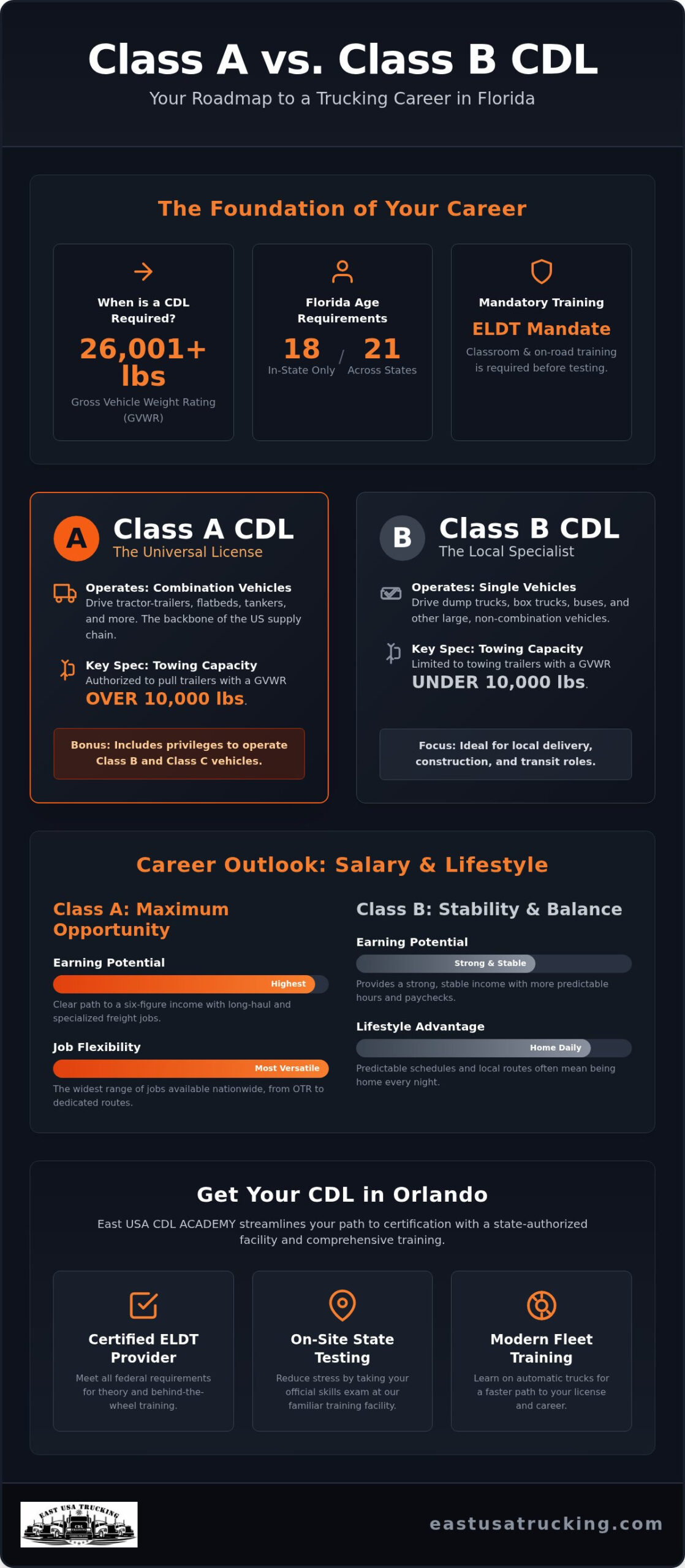
A Commercial Driver’s License (CDL) is more than just a permit; it’s a professional credential required by the state of Florida for anyone operating heavy or specialized vehicles. The primary factor that determines if you need one is the Gross Vehicle Weight Rating (GVWR). Think of GVWR as the maximum weight the manufacturer says the vehicle can safely weigh when fully loaded with fuel, cargo, and passengers. In Florida, if that number is 26,001 pounds or more, a standard Class E license isn’t enough. You must step up to a commercial grade to stay legal on the road.
Deciding between a Class A vs Class B CDL Florida often starts with where you want to drive. Florida offers two types of authority. Intrastate driving keeps you within state lines, moving freight from Miami up to Jacksonville or Tampa. Interstate driving allows you to cross into Georgia, Alabama, and beyond. To get started, you’ll need to meet Florida residency requirements by providing two proofs of address to the FLHSMV. This usually includes items like a utility bill or a lease agreement. It’s a simple step that proves you’re a local resident ready to contribute to the state’s logistics industry.
Who Needs a CDL in Florida?
If you plan to operate any vehicle with a GVWR over 26,000 pounds, you belong in the commercial driver category. Age plays a huge role in your career path. You can obtain a CDL at 18 years old for local Florida routes. However, federal law requires you to be at least 21 to drive across state lines. You’ll also need to pass a vision test and complete a medical self-certification. This proves you’re physically fit for the demands of the road. It’s a straightforward process designed to keep everyone safe while ensuring you’re ready for the physical nature of the job.
The Role of ELDT (Entry-Level Driver Training)
As of 2026, the federal Entry-Level Driver Training (ELDT) mandate is fully enforced across the country. This means you can’t just study a manual and head to the testing site. You must complete a certified program from a provider listed on the FMCSA’s Training Provider Registry. East USA CDL ACADEMY is a registered provider that covers both mandatory components: classroom theory and behind-the-wheel training. Whether you’re comparing a Class A vs Class B CDL Florida, you’ll need to log these hours before you can schedule your state skills exam. This ensures every new driver has the foundational skills to handle heavy equipment safely on Orlando’s busy highways.
Class A CDL: The Universal License for Long-Haul Trucking
Class A is often called the king of the road for a reason. It’s the most flexible commercial license you can earn. The main technical difference when comparing a Class A vs Class B CDL Florida is the towing capacity. If you’re pulling a trailer that weighs more than 10,000 pounds, you need a Class A. This license allows you to operate combination vehicles, which are the backbone of the American supply chain. One major perk is versatility. Once you hold a Class A, you’re legally cleared to drive Class B and Class C vehicles too, provided you have the right endorsements. This makes you a Swiss Army knife for employers. Choosing this path often leads to Over-the-Road (OTR) roles. These jobs require more time away from home, but the financial rewards are significant. You’re paid for the distance you cover and the responsibility of handling the largest rigs on the highway.
Vehicles You Can Drive with a Class A
With this license, you aren’t limited to just one type of truck. You can operate tractor-trailers, flatbeds, tankers, and even livestock carriers. Most modern fleets now use automatic trucks. Learning on an automatic transmission is often the fastest way to get your license and start earning. It simplifies the learning curve so you can focus on safety and maneuvering. If you eventually want to drive a stick-shift, you can always take a CDL restriction removal course later. Check the official Florida CDL requirements to see the full list of testing standards for these heavy-duty vehicles. This flexibility ensures you stay competitive as equipment evolves and trucking technology continues to advance.
Class A Job Opportunities in Florida
Florida’s economy relies on heavy haulers. Major hubs like Orlando, Miami, and Jacksonville are constantly looking for drivers to move freight. You might find yourself hauling famous Florida citrus, construction materials for new developments, or retail goods for major logistics centers. Because of the specialized nature of these jobs, they typically offer the highest starting salaries. In August 2026, the average annual salary for a Class A holder in Florida is approximately $59,167. Some experienced or specialized drivers even clear over $100,000. It’s a high-demand field with plenty of room to grow. If you’re trying to decide between a Class A vs Class B CDL Florida, consider how much you value long-distance travel versus local routes. If you’re ready to see how this fits your goals, reach out to our team for a quick chat about your options.
Class B CDL: Local Routes and Specialized Vehicles
While the big rigs often get the spotlight, the Class B license is the engine behind Florida’s local infrastructure. If you operate a single vehicle over 26,001 pounds with a trailer weighing less than 10,000 pounds, you belong in this category. This weight limit is the primary technical distinction in the Class A vs Class B CDL Florida debate. Many professionals in construction, waste management, and public transit start here because it’s a faster path into the workforce. It’s the perfect choice if you don’t want to manage the complexity of a massive trailer. You can find specific details on the Class B CDL training cost Orlando to see how this fits your career budget.
Common Class B Vehicles in Florida
The variety of vehicles you can drive with a Class B is surprisingly broad. You’ll see these trucks every day on Orlando’s roads, including dump trucks, cement mixers, and straight delivery trucks. Large buses also fall into this category. To drive them, you’ll simply need to add specific endorsements like Passenger (P) or School Bus (S) to your license. One of the biggest practical advantages is maneuverability. Class B vehicles are much easier to handle in tight city traffic or narrow construction sites compared to a full tractor-trailer. This makes the learning process less intimidating for many new drivers while still providing a solid entry into the industry.
Lifestyle Benefits of a Class B License
The most significant selling point for a Class B license is the lifestyle it offers. Unlike long-haul trucking, most Class B jobs are “home daily” routes. You’ll enjoy predictable schedules that allow you to sleep in your own bed every night. This stability is common in local government roles, utility companies, and regional delivery services. According to the truck driver job outlook, there is a consistent demand for drivers who can handle these specialized local tasks. If you value a work-life balance and want to serve your local community, this is a fantastic route. When comparing a Class A vs Class B CDL Florida, think about your long-term goals. If staying local is your priority, the Class B path offers the stability and routine you’re looking for without the need for weeks away from home.
Key Differences: Salary, Job Flexibility, and Training
Choosing between a Class A vs Class B CDL Florida depends on your career priorities. While both licenses allow you to operate heavy machinery, the technical limits change what you can actually do for a living. Class A is the universal key to the industry, focusing on combination vehicles where the trailer is a major part of the load. Class B is built for single, heavy units. Because you’re dealing with a 53-foot trailer in Class A, the training timeframe is usually longer. You have to master complex backing maneuvers and pivot points that don’t exist with a straight truck. When weighing the benefits of a Class A vs Class B CDL Florida, consider these core technical specs:
- Class A: Handles combination vehicles over 26,001 lbs; trailers must exceed 10,000 lbs.
- Class B: Handles single vehicles over 26,001 lbs; trailers must be under 10,000 lbs.
- Flexibility: Class A holders can drive Class B vehicles; the reverse isn’t true.
- Training Focus: Class A emphasizes coupling and trailer control; Class B focuses on city maneuvering.
Which License Pays More in Florida?
In the Orlando market, Class A drivers generally see higher starting pay because they handle the most demanding freight. As of August 2026, the average annual salary for Class A holders in Florida is about $59,167, with top earners crossing the $100,000 mark. Class B drivers typically earn between $36,392 and $49,775. You can boost your income in either class by adding endorsements like Tanker or Hazmat. The return on investment for our $3,200 training package is exceptionally high. Most students find that their increased salary covers the course cost within their first few months of professional driving. It’s a small upfront investment for a significant jump in lifetime earnings.
Automatic vs. Manual: A Crucial Choice
Most students today opt for automatic transmission CDL training. It’s the modern industry standard for a reason. Testing in an automatic truck places an “E” restriction on your license, meaning you can’t legally drive a manual commercial vehicle. While this might sound like a limitation, the reality is that most major fleets have switched to automatics for better fuel efficiency and driver comfort. Unless your specific dream employer uses older manual rigs, going automatic is the fastest way to get on the road. It lets you focus on safety and road awareness rather than gear ratios. Ready to see which path fits your goals? Contact us today to discuss your training schedule.
Getting Your CDL in Orlando: Why East USA CDL ACADEMY?
Choosing where to train is just as important as deciding between a Class A vs Class B CDL Florida. At East USA CDL ACADEMY, we’ve built a facility designed for your success. Our 4-acre training range in Orlando provides the massive space you need to master range maneuvers without the pressure of city traffic. One of our biggest advantages is on-site testing. We are a state-authorized testing facility, so you don’t have to wait weeks for a DMV appointment. You train on our trucks and test on the same equipment in a familiar environment. This significantly reduces exam-day anxiety and gets you into the workforce faster.
We believe that language should never be a barrier to a great career. That’s why we are a proud escuela CDL Orlando Florida, offering full bilingual support in English and Spanish. Our instructors ensure you understand every safety regulation and technical skill in the language you’re most comfortable with. We also keep our programs accessible with an affordable $3,200 training package. We offer various financing options to ensure that the cost of entry doesn’t stand in the way of your professional development. It’s a straightforward, high-value investment in your future.
Training with Our Private Fleet
You won’t be practicing on worn-out equipment here. We maintain a private fleet of 8 trucks to ensure every student gets ample time behind the wheel. Our training philosophy focuses on small class sizes. You’ll receive personalized attention from seasoned instructors who know exactly what Florida recruiters are looking for. We prioritize “Behind-the-Wheel” time because that’s where true confidence is built. Whether you’re pursuing a Class A vs Class B CDL Florida, you’ll graduate with the practical skills needed to handle heavy loads safely and efficiently.
How to Start Your Career Today
Starting your journey is simple. If you’re an Orlando resident, you can begin the enrollment process with just a few documents. For those who already hold a license but have been off the road for a while, we offer a specialized CDL refresher course to help you reclaim your skills and confidence. Don’t leave your career to chance. We invite you to visit our facility at Henger Utca for a personal tour. See our fleet, meet our instructors, and get a feel for the environment where you’ll launch your new career. We are ready to help you take that first step toward financial independence.
Take the Wheel of Your New Career Today
Deciding between a Class A vs Class B CDL Florida is the first step toward a stable and high-paying career in the logistics industry. You now understand that Class A provides the ultimate versatility for long-haul routes, while Class B offers the perfect balance for those who want to stay local and be home every night. Both paths lead to significant opportunities in Florida’s growing logistics market, which is projected to reach $97 billion by 2030. Whether you want to haul freight across state lines or manage local deliveries in Orlando, your professional journey starts with the right training.
We are here to make your transition into trucking as smooth as possible. With our large 4-acre training facility and bilingual English/Spanish instructors, you’ll get the personalized guidance you need to succeed. It’s time to stop wondering and start doing. Our state-authorized testing on-site means you don’t have to deal with DMV delays or extra stress. You’ve got the facts; now it’s time to act on them. Let’s get you on the road to financial independence.
Start Your CDL Training in Orlando for Only $3,200!
Frequently Asked Questions
Can I drive a Class B vehicle with a Class A CDL in Florida?
Yes, holding a Class A license allows you to legally operate Class B and Class C vehicles in Florida. This is one of the primary benefits of the Class A credential; it covers almost every commercial vehicle on the road. When comparing a Class A vs Class B CDL Florida, the Class A is the more versatile choice for long-term career growth. It ensures you never have to turn down a job because of your license class.
What is the weight limit for a Class B license in Florida?
A Class B CDL is required for single vehicles with a Gross Vehicle Weight Rating (GVWR) of 26,001 pounds or more. If you’re towing a trailer, that trailer must weigh 10,000 pounds or less to stay within the Class B category. This makes it the standard for dump trucks, large buses, and delivery trucks. It’s the ideal choice for drivers who want to stay local and handle specialized single-unit vehicles.
How long does it take to get a Class A CDL at East USA Trucking School?
Most students complete our Entry Level Driver Training (ELDT) beginner course in approximately three to four weeks. This timeframe ensures you get the mandatory classroom theory and behind-the-wheel hours required by federal law. We focus on efficiency without cutting corners on safety. Because East USA CDL ACADEMY has a private fleet of 8 trucks and a large training facility, you spend less time waiting and more time practicing your maneuvers.
Do I need to speak perfect English to get my CDL in Florida?
You don’t need perfect English, but you must be able to read and speak enough English to understand traffic signs and communicate with law enforcement. We understand that many talented drivers in Orlando are more comfortable in Spanish. That’s why East USA CDL ACADEMY employs bilingual instructors to guide you through the technical aspects of the training. This support ensures you fully grasp the safety regulations before heading to the state-authorized testing site.
How much does Class A vs Class B CDL training cost in Orlando?
Our standard beginner course for automatic transmission starts at $3,200. This price applies to both Class A and Class B training paths at our Orlando location. We prioritize transparency and affordability to help you start your career without massive debt. Financing options are also available to help manage the investment. When weighing the Class A vs Class B CDL Florida options, our flat-rate pricing makes the decision about your career goals, not the tuition.
Can I take my CDL road test at your Orlando facility?
Absolutely. East USA CDL ACADEMY is a state-authorized third-party testing facility, which means you can take your final road test right here at our 4-acre Orlando range. You won’t have to deal with the long wait times or the unfamiliar environment of a government DMV office. Testing on the same trucks you used during training significantly reduces stress. This convenience is a major reason why local students choose our academy.
What documents do I need for Florida CDL residency proof in 2026?
To prove Florida residency in 2026, you must provide two separate documents showing your residential address. Common choices include a recent utility bill, a lease agreement, or a Florida voter registration card. You’ll also need to show a valid Florida driver’s license and proof of social security. Having these documents ready before you visit our Orlando facility will speed up your enrollment process and get you into the driver’s seat sooner.
Is it better to get an automatic or manual CDL license?
Automatic transmission is the modern industry standard and the fastest way to get licensed. Most major fleets in Florida have switched to automatics for fuel efficiency and driver comfort. Testing in an automatic does place an “E” restriction on your license, but this is rarely an issue for new drivers. If you eventually need to drive a stick-shift, East USA CDL ACADEMY offers a restriction removal course to upgrade your skills later.