Why settle for a local paycheck of $44,610 when you could be earning over $80,831 as an entry-level driver right here in Central Florida? Choosing between a Class A vs Class B CDL Orlando isn’t just about the size of the truck; it’s about the life you want to lead. You likely feel the pressure of navigating complex Florida regulations and the high costs of national schools. It’s frustrating to deal with technical training that doesn’t offer the language support you need. You want a clear, affordable path to a better future, and you want it now.
This guide breaks down the critical differences between these two licenses so you can choose the best trucking career path for 2026. We’ll compare earning potential, vehicle types, and local job stability versus the freedom of over-the-road routes. You’ll learn exactly what it takes to meet the latest ELDT mandates and how to pass your road test on the first try. Get ready to move past the confusion and start a high-paying career with confidence. Whether you’re aiming for the I-4 corridor or interstate travel, the right choice starts here.
Key Takeaways
- Learn the specific weight limits and vehicle types that distinguish Class A combination trucks from Class B single units.
- Explore how Orlando’s role as a major logistics hub impacts your salary potential and local job availability in 2026.
- Discover why backing maneuvers and pre-trip inspections differ between licenses so you can prepare for the road test effectively.
- Compare Class A vs Class B CDL Orlando training costs to find the best return on investment for your career path.
- See how bilingual instruction and a dedicated local training facility can help you overcome language barriers and technical challenges.
Class A vs Class B CDL: The Core Differences for Florida Drivers
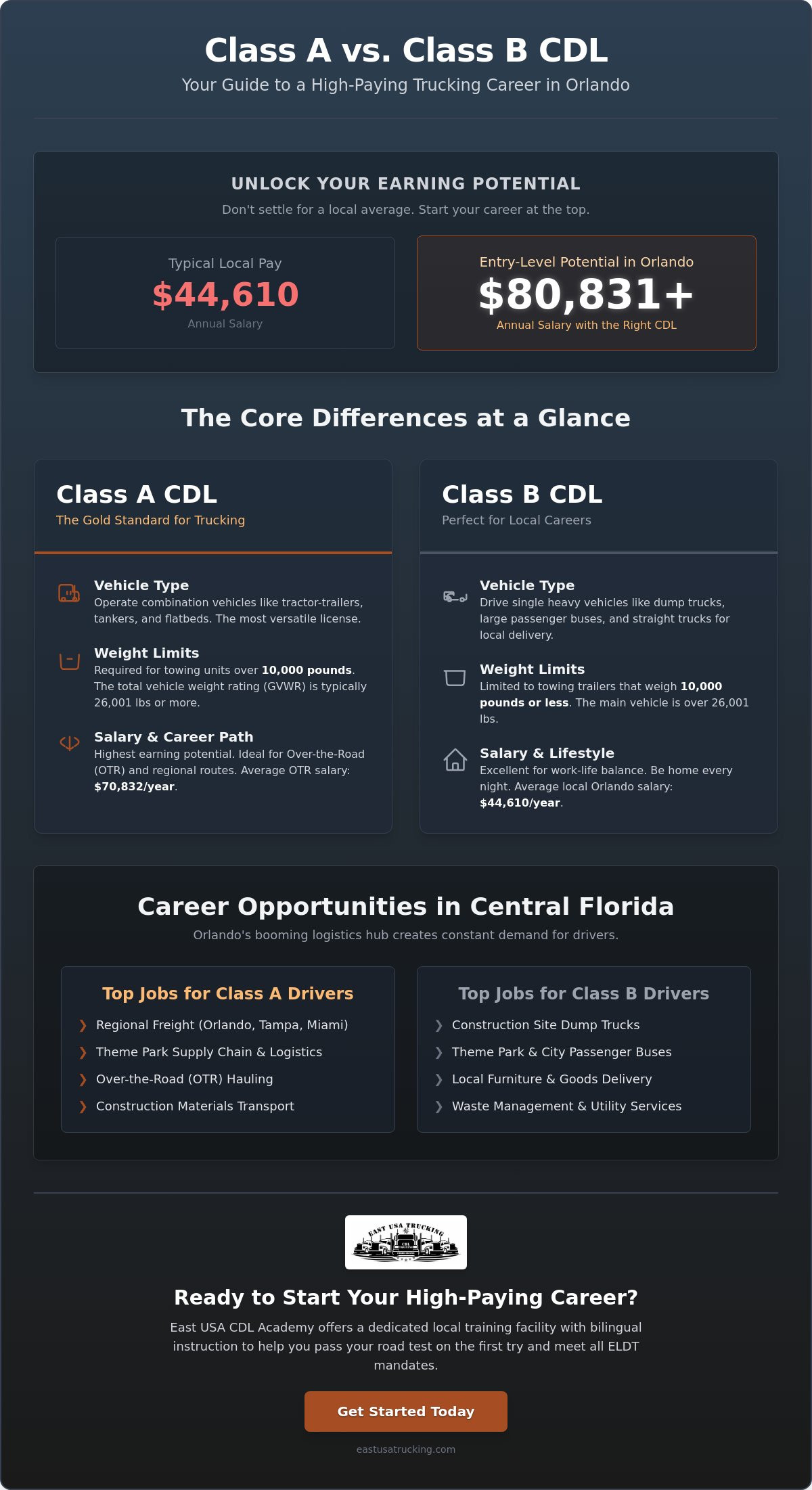
Understanding the weight limits is the first step toward your new career. In Florida, the distinction between a Class A vs Class B CDL Orlando depends on the Gross Vehicle Weight Rating (GVWR). A Commercial Driver’s License is required for any vehicle with a GVWR of 26,001 pounds or more. If you plan to haul heavy loads across state lines or manage massive combination vehicles, you need to know exactly where these legal lines are drawn. It’s not just about the size of the truck; it’s about the weight of what you’re pulling behind you.
To better understand this concept, watch this helpful video:
Class A CDL: The Universal License for Heavy Hauling
The Class A license is the “gold standard” for the trucking industry. It allows you to operate combination vehicles where the towed unit weighs more than 10,000 pounds. Think of the classic 18-wheeler tractor-trailers, tankers, or flatbeds you see daily on I-4. This license is the primary requirement for Over-the-Road (OTR) trucking careers. It offers the most flexibility because a Class A holder is legally permitted to drive Class B and Class C vehicles too. If you want the widest range of job options, this is the path to take.
Class B CDL: Perfect for Local Orlando Delivery and Services
A Class B license is designed for single, heavy vehicles that don’t have a heavy trailer attached. You’re limited to towing trailers that weigh 10,000 pounds or less. This class is ideal for local Orlando work. You’ll often see Class B drivers operating dump trucks for construction sites, large passenger buses for the theme parks, or straight trucks for furniture delivery. If you want a job that keeps you within Central Florida and lets you sleep in your own bed every night, Class B is a fantastic choice.
Don’t let the technical jargon confuse you. The 26,001-pound mark is the magic number for professional drivers in 2026. Getting the right classification is the difference between a high-paying career and a missed opportunity. Focus on your long-term goals. Do you want the unlimited hauling power of a Class A, or the local lifestyle of a Class B? Both paths offer great pay, but they serve very different lifestyles in the Florida logistics market.
Career Opportunities and Salary Outlook in Central Florida
Orlando is much more than a destination for tourists; it’s a massive engine for freight and logistics. The constant expansion of theme parks and the booming construction sector along the I-4 corridor create a relentless demand for skilled drivers. When weighing Class A vs Class B CDL Orlando, you must look at how these local industries pay. For example, entry-level truck drivers in Orlando are seeing average annual salaries around $80,831 as of June 2026. This high starting point reflects the urgent need for talent in a city that never stops building or growing.
Meeting Florida CDL requirements is your ticket into this lucrative market. While the pay is excellent, the lifestyle varies. Class A drivers often handle regional or over-the-road (OTR) routes, averaging $70,832 per year. These roles offer high earning potential but involve more time away from home. On the other hand, local Class B drivers in Orlando earn about $44,610 annually. This path is perfect if you value daily home time and a predictable schedule. Both options provide stability, but your choice depends on your financial goals and family needs.
Top Jobs for Class A Drivers in Orlando
Class A drivers are the backbone of Florida’s supply chain. You’ll find high-demand roles hauling regional freight between Orlando, Tampa, and Miami. Major theme parks require a steady stream of supplies, from food to construction materials, often handled by specialized Class A rigs. Many Florida-based carriers are currently offering competitive packages for OTR positions that leverage Orlando’s central location as a primary logistics hub. These jobs often come with sign-on bonuses for those who can start immediately.
Local Opportunities for Class B License Holders
If you prefer staying within Orange County, a Class B license opens doors in essential services. Waste management companies and construction firms constantly recruit drivers for dump trucks and refuse vehicles. Additionally, the rise of “last-mile” delivery has increased the need for local LTL (Less Than Truckload) drivers. Passenger transport is another huge sector here; Orlando’s transit systems and tourism shuttles rely on Class B professionals to keep the city moving safely.
Adding endorsements like Hazmat or Tanker can significantly boost your hourly rate regardless of your license class. These certifications show employers you’re a versatile professional ready for specialized tasks. If you’re ready to see which path fits your personal goals, you can reach out for a career consultation to get started on the right foot.
Which CDL is Harder to Get? Training and Testing in Orlando
Are you worried about the difficulty of the road test? It’s a common concern for new drivers. When comparing a Class A vs Class B CDL Orlando, the learning curve depends on your comfort with large equipment. Generally, the Class A is considered more challenging because you must master the “pivot point.” Backing a 53-foot trailer requires a different mental approach than driving a straight truck. You aren’t just steering one vehicle; you’re managing two units that move in opposite directions when you reverse. Mastering this skill is often the primary hurdle for students during their training. If you’ve been away from the cab for a while and feel rusty on these maneuvers, a CDL refresher course Orlando drivers trust can help you rebuild your confidence before tackling the road test.
The Federal CDL standards set by the FMCSA require all new applicants to complete Entry-Level Driver Training (ELDT) from a registered provider. This mandate ensures you receive a baseline of safety knowledge before you ever touch the wheel. In Orlando, your training will focus heavily on the pre-trip inspection. For a Class A, this inspection is more complex. You must verify the safety of the tractor, the trailer, and the coupling system that connects them. A Class B inspection is shorter since it focuses on a single unit, but it still requires absolute precision to pass. Understanding what to look for in a CDL training program Florida drivers can trust will help you evaluate your options before you commit.
Mastering the Learning Curve
Class A students must learn the technical art of coupling and uncoupling. This process involves securing the fifth wheel and connecting air lines correctly. If you choose a Class B, your challenge shifts to maneuverability. You’ll practice navigating tight city streets and managing the “tail swing” of a large bus or dump truck. To make the process faster, many beginners choose an automatic transmission course. This allows you to focus on road safety and spatial awareness without the added stress of shifting gears.
Orlando Road Test Requirements and 3rd Party Testing
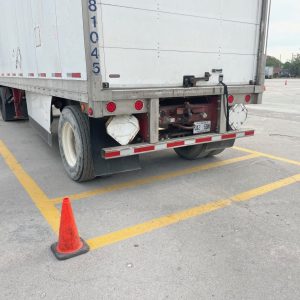
Passing the Florida DHSMV-authorized road exam is much easier when you train on a dedicated 4-acre facility. This large, private space gives you the room to fail, learn, and try again without the pressure of public traffic. Choosing a school that offers authorized 3rd party testing onsite is a major advantage. You can take your final exam using the exact same truck you used during your practice sessions. This familiarity reduces anxiety and significantly increases your chances of passing on your first try. Don’t let the fear of the test hold you back; the right environment makes all the difference.
Evaluating CDL Training Costs and ROI in 2026
Choosing between a Class A vs Class B CDL Orlando involves more than just picking a truck type; it’s a major financial decision. You need to look at the total cost of entry to understand your potential return. In Florida, the state sets specific administrative fees, such as the $75 original commercial license fee and $7 for each endorsement. There are also small costs for knowledge retests if you don’t pass on your first attempt. While these state fees are fixed, your tuition is where you have the most control over your investment.
Think about the Return on Investment (ROI) for your new career. If you spend a few weeks in training and land a local job paying $21 per hour, you start earning a steady income immediately. If you go for the Class A and hit the $80,000 entry-level average seen in Orlando for 2026, your training pays for itself within the first two months. This is why many Central Florida residents are shifting away from traditional degrees toward vocational training. It’s a much faster path to financial independence and a stable lifestyle.
Don’t fall for the “free training” pitch from large national carriers. These programs usually come with a “Contract Trap.” You’ll likely have to sign a deal to work for that specific company for at least a year. If you leave early, they’ll bill you for the full tuition at a much higher rate. You’re also often stuck with lower “training” wages during that first year. By paying for independent training, you keep your freedom. You can take the highest offer from any employer in the Orlando logistics hub.
Affordable Training vs. High-Cost National Chains
Some national schools charge between $5,000 and $8,000 for a standard beginner program. You don’t need to pay those inflated prices to get high-quality instruction. Local Orlando programs often offer comprehensive training starting in the $3,000 range. A standard course should include everything required by the ELDT mandate, including classroom theory and plenty of behind-the-wheel time. Make sure you check for hidden charges in specialized services like a CDL refresher course Orlando programs offer or a Refresher Course. Transparency in pricing is vital for staying on budget. You can also review what essential components to look for when choosing the right CDL training program in Florida to ensure you’re getting full value for your investment.
Financing Your Future Trucking Career
Most students don’t pay their full tuition out of pocket. Flexible payment plans allow you to spread the cost over the duration of your course, making the transition easier if you’re currently working another job. The goal is to get you on the road as quickly as possible. Every week you spend in a classroom is a week you aren’t earning a professional driver’s salary. You can find more details on Understanding CDL Training Costs and Financing in Florida to help plan your budget.
Ready to see which path fits your financial goals? You can get a personalized quote and class schedule to see how quickly you can start your new career in the trucking industry.
Why East USA CDL Academy is the Top Choice for Orlando Students
Finding the right school is just as important as deciding between a Class A vs Class B CDL Orlando. You need a partner that understands the local market and provides the tools for immediate success. Our training facility spans 4 massive acres right in the heart of Orlando. This private space allows you to practice maneuvers safely without the distractions of city traffic. We maintain a dedicated fleet of 8 trucks, ensuring you get maximum wheel time during your course. You won’t just watch others drive; you’ll be in the driver’s seat every day.
Efficiency is the core of our approach. We are an authorized 3rd party testing site, which means you don’t have to wait weeks for a state appointment at a busy DMV office. You can complete your training and take your road exam in the same familiar environment. This streamlined process is designed to get you into a high-paying job as fast as possible. We value your time and resources, providing a straightforward path to your professional license without unnecessary delays.
Bilingual Training for a Diverse Workforce
Clear communication is the foundation of safety on the road. We provide bilingual instructors who offer full support in both English and Spanish. This ensures that every student fully grasps technical concepts, especially during the detailed pre-trip inspection. You won’t have to worry about language barriers when learning about air brake systems or engine components. We create a supportive environment for all Orlando communities, helping you build the confidence needed to pass your exam on the first try. Our goal is to make professional training accessible to everyone motivated to succeed.
The “Own Fleet” Advantage
Training on the same equipment you use for your test is a massive advantage. It builds muscle memory and reduces anxiety on exam day. Whether you choose our CDL Entry Level Driver Training – Automatic Transmission Standard Beginner Course or prefer a manual setup, we have the right vehicle for you. This consistency is a primary reason for our high success rates. You can see how we compare to other local options in our Best Truck Driving School Near Me in Orlando: 2026 Comparison Guide. Don’t leave your career to chance; train with experts who own their fleet and prioritize your results.
Start Your High-Paying Driving Career Today
Deciding between a Class A vs Class B CDL Orlando is the most important career choice you’ll make this year. You now have the facts about weight limits, salary expectations, and the lifestyle differences between regional hauling and local Orlando routes. The demand for professional drivers in Central Florida’s logistics hub is at an all-time high. It’s time to stop wondering about your potential and start earning what you’re worth. Your path to a stable, high-paying career is clearer than ever.
You don’t have to face technical training or licensing hurdles alone. Our team provides the support you need with low-cost training packages and expert bilingual instructors who teach in both English and Spanish. You’ll gain hands-on experience on our massive 4-acre facility, ensuring you’re ready for the road test. We focus on your success from day one so you can secure a job and see a rapid return on your investment. We value your time and resources, offering a straightforward path to professional development.
Start Your Trucking Career Today – Enroll at East USA CDL Academy. Take control of your future and join the thousands of successful drivers moving Florida forward. We’re ready to help you succeed.
Frequently Asked Questions
Is a Class A CDL better than a Class B in Florida?
A Class A license is often considered “better” because of its versatility and higher earning potential. It permits you to drive all vehicles in Class B and Class C, opening more doors for over-the-road and regional freight jobs. However, the best choice depends on your goals. If you prefer local work and daily home time in Central Florida, a Class B license might be the perfect fit for your lifestyle.
How much does it cost to get a Class B CDL in Orlando?
Tuition for a Class A vs Class B CDL Orlando varies depending on the school and the specific program you choose. You should budget for the training itself plus state-mandated costs like the $75 original license fee and $7 for each endorsement. Many students find that the investment pays for itself quickly once they start earning a professional driver’s salary in Orlando’s booming logistics market.
Can I drive a bus with a Class A CDL?
Yes, you can operate a bus with a Class A license as long as you have the proper passenger (P) endorsement. Since a Class A license covers all lower classifications, you’re legally allowed to drive Class B and C vehicles. This flexibility is a major reason why many drivers choose the Class A path; it ensures they’re qualified for the widest possible range of local and regional jobs.
How long is the CDL training program at East USA CDL Academy?
Most students complete their training within 3 to 4 weeks. This timeframe allows you to meet all federal ELDT requirements while getting sufficient behind-the-wheel practice on our 4-acre facility. Our goal is to move you through the process efficiently so you can pass your road test and start your new career without unnecessary delays. We value your time and focus on practical results.
Do I need to know how to drive a manual transmission to get my CDL?
No, you don’t need to learn a manual transmission to get your license. We offer an Automatic Transmission Standard Beginner Course that simplifies the learning process for many students. Just keep in mind that testing on an automatic truck will result in an “E” restriction on your license. This means you won’t be legally permitted to operate commercial vehicles with a manual gearbox.
Does Florida allow 3rd party CDL testing?
Yes, Florida allows authorized 3rd party providers to conduct CDL skills tests. This is a huge advantage for students because it often eliminates the long wait times associated with state-run DMV appointments. At East USA CDL Academy, we provide this service onsite. You can train and test in the same environment using the same trucks you’ve already mastered, which significantly boosts your confidence on exam day.
What is the minimum age to get a CDL in Florida for interstate driving?
You must be at least 21 years old to drive a commercial vehicle across state lines (interstate). If you’re between 18 and 20 years old, you can still obtain a Florida CDL, but you’ll be restricted to driving within the state of Florida (intrastate). This is a great way for younger drivers to gain experience in local delivery or construction roles before they turn 21.
Are there bilingual CDL schools in Orlando?
Yes, East USA CDL Academy is a leading bilingual school in Orlando. We provide instructors who speak both English and Spanish to support our diverse student body. This ensures you fully understand the technical requirements of the pre-trip inspection and road safety rules. Clear communication is vital for success, and we’re committed to making professional training accessible to everyone in our community.