Why settle for a $36,000 starting salary when a few extra days of training could put you on track to earn over $59,000? Deciding on a class a vs class b license florida isn’t just about learning to drive a bigger truck; it’s about choosing the ceiling for your future income. You’ve likely heard the technical talk about GVWR and GCWR and felt more confused than when you started. It’s frustrating to feel like your career is stalled before it even begins because the requirements seem like a moving target.
You aren’t alone in wanting a straightforward path to a high-paying job without the headache of “CDL mills” or hidden fees. We’ve built this guide to help you master the differences between these licenses so you can select the career path that fits your lifestyle. You’ll get a clear comparison of 2026 job stability, exam difficulty, and the most efficient ways to get behind the wheel. We also preview how an affordable Orlando training program can get you road-ready using modern automatic trucks. Let’s clear the fog and get your new career moving.
Key Takeaways
- Identify the specific weight limits and vehicle combinations that define each license class to ensure you choose the right training program.
- Compare the long-term earning potential and local job stability of a class a vs class b license florida to maximize your career ROI.
- Navigate the updated 2026 Florida requirements for obtaining your Commercial Learner’s Permit and completing mandatory ELDT training.
- Explore how choosing an automatic transmission course can lead to a faster job placement and a more streamlined testing process.
- Learn why an Orlando-based facility with bilingual instructors and on-site testing offers the most efficient path to your first commercial driving job.
Defining Class A and Class B Commercial Licenses in Florida
Choosing the right path starts with understanding your legal driving authority. In the Sunshine State, a Commercial Driver’s License (CDL) is more than just a permit to drive; it’s a professional credential that defines the equipment you can legally operate. Florida follows federal weight standards, but the local demand for construction and freight makes your choice between a class a vs class b license florida a critical career decision. Think of these classes as levels of authority. The higher the license class, the more doors you open for your professional future.
To better understand the core differences between these two options, watch this helpful breakdown:
One of the most valuable rules to remember is the hierarchy of licensing. A Class A license is often called the “universal” license because it automatically grants you the authority to drive Class B and Class C vehicles, provided you have the correct endorsements. This flexibility is why many Florida drivers aim for the top tier from day one. You don’t want to turn down a high-paying job because your license doesn’t cover the weight of the trailer you’re pulling. Understanding the class a vs class b license florida distinction ensures you don’t waste time on a testing path that limits your options.
What is a Class A CDL in Florida?
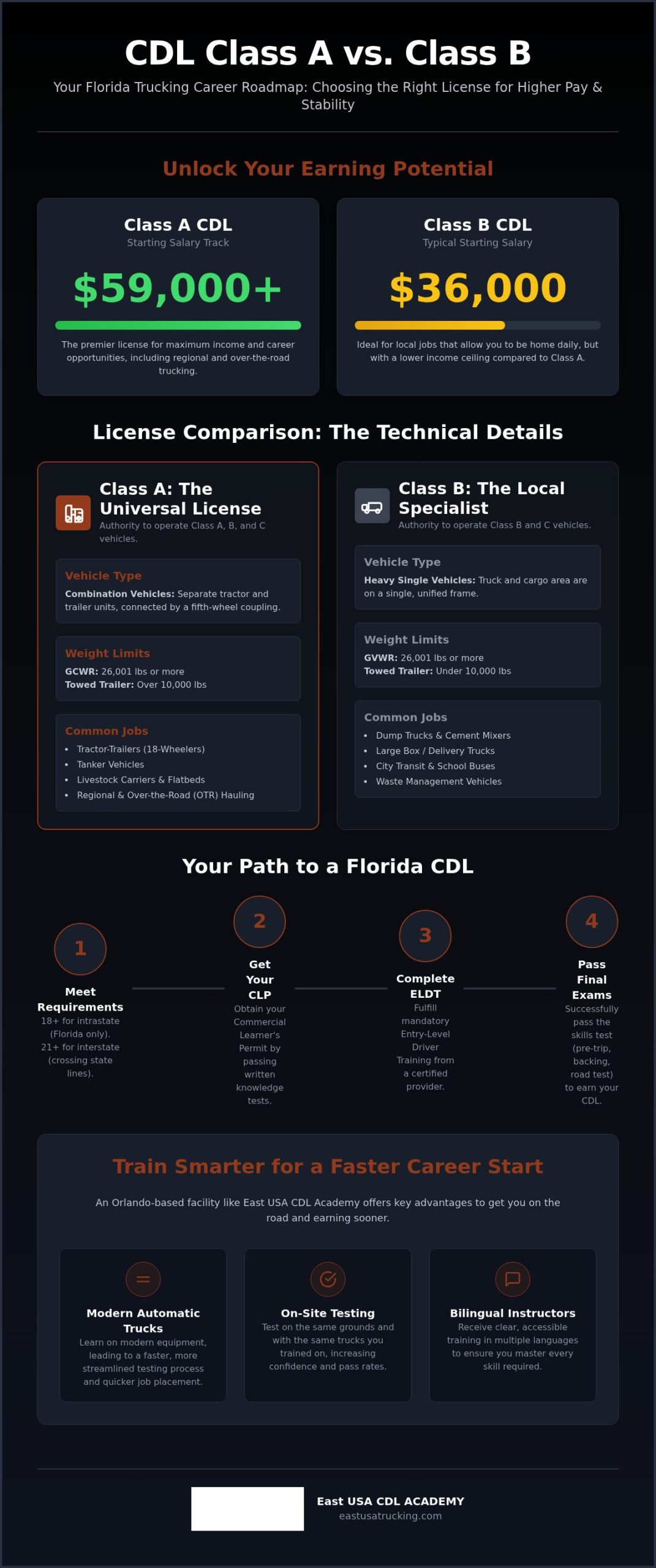
A Class A license is designed for combination vehicles. These are rigs where the tractor and trailer are separate units. To qualify, the Gross Combination Weight Rating (GCWR) must be 26,001 pounds or more, and the vehicle being towed must weigh more than 10,000 pounds. While you can obtain this license at 18 for intrastate driving, you must be 21 to cross state lines. This is the gold standard for anyone looking into regional or over-the-road (OTR) trucking, where many drivers enjoy the company of a dog; Alan’s K9 Academy offers helpful health and ownership tips for these four-legged travel companions. Common vehicles include:
- Tractor-trailers (Big rigs or 18-wheelers)
- Tanker vehicles
- Livestock carriers
- Flatbeds and double trailers
What is a Class B CDL in Florida?
A Class B license focuses on “heavy single” vehicles. These are trucks where the cargo area and the engine are on the same frame. The vehicle’s Gross Vehicle Weight Rating (GVWR) must be 26,001 pounds or more. While you can pull a trailer, it cannot exceed 10,000 pounds. This license is perfect for drivers who prefer to stay local and return home every night. You’ll commonly see Class B drivers operating:
- Dump trucks and cement mixers
- Large box trucks for furniture delivery
- City transit and school buses
- Waste management vehicles
If you’re ready to start your journey, visit East USA CDL Academy to see which training program aligns with your goals.
Vehicle Specs and Weight Limits: The Technical Differences
Don’t let the technical jargon stall your progress. Understanding the vehicle specs for a class a vs class b license florida is mostly about mastering two numbers: 26,001 and 10,000. These aren’t just random figures; they are the legal thresholds that determine your training path and your future paycheck. In Florida, the authorities look at the manufacturer’s weight ratings rather than what the truck actually weighs on a scale at any given moment.
GVWR stands for Gross Vehicle Weight Rating. This is the maximum weight of a single vehicle plus its load. GCWR stands for Gross Combination Weight Rating, which is the weight of the truck and the trailer together. According to official Florida CDL requirements, these ratings decide which license you must hold to stay legal on the road. It’s vital to check the manufacturer’s plate on the door jamb or trailer frame before you get behind the wheel. If your plate says 26,001 pounds but you’re driving empty, you still need that CDL.
Class A: The King of the Road
If you see a truck with a “fifth-wheel” coupling, it’s likely a Class A vehicle. These are combination rigs where the tractor and trailer are separate units. The trigger for a Class A license happens when your combination vehicle has a GCWR of 26,001 pounds or more, and the trailer you’re towing is over 10,000 pounds. This category includes tractor-trailers, tankers, and livestock carriers. Driving these requires mastering articulation, which is how the truck pivots during tight turns and backing maneuvers. You can also add endorsements for Doubles/Triples or Tankers to broaden your job prospects and increase your market value.
Class B: Local and Specialized Hauling
Class B vehicles are often called “straight trucks” because they don’t have a pivot point between the cab and the cargo area. You need this license for single vehicles weighing 26,001 pounds or more. You can still tow a trailer, but it must weigh 10,000 pounds or less. This category is perfect for local Florida roles like dump trucks, cement mixers, and large box trucks used for furniture delivery. Because these vehicles are easier to navigate in city traffic, many drivers find Class B roles offer better “home daily” schedules. Specialized roles like driving a school bus or a motor coach also fall under this class. If you’re unsure which vehicle fits your career goals, reach out to our Orlando team for a quick consultation.
Career Outlook: Which CDL License Earns More in Florida?
Money talks, and in the trucking industry, your license class dictates your starting pay. If you want to maximize your earning potential right out of the gate, the data points toward one clear winner. The average annual salary for a Class A driver in Florida is approximately $59,167, with top earners in the majority bracket reaching over $65,800. While entry-level drivers typically start around $45,000, those with a Class A license have the highest ceiling for growth. This pay gap is a major factor when weighing a class a vs class b license florida for your long-term career.
Class B drivers in Florida average around $36,392 annually. While this is lower than Class A, these roles often provide a different kind of value through local consistency. Most Class B positions in sectors like waste management or local delivery fall between $31,400 and $39,600. You aren’t just choosing a salary; you’re choosing a lifestyle. Class A holders often work regional or over-the-road routes that keep them away from home, while Class B roles are usually “home daily” positions. Your choice between a class a vs class b license florida should align with both your bank account goals and your family needs. Additionally, specializing in technical equipment operation can further boost your income; for example, A1 Crane Academy provides certification for crane operators, a field that often commands premium wages in the Florida construction market.
Orlando has transformed into a massive e-commerce hub as of August 2026, creating a surge in demand for both license types. Class A drivers are essential for moving freight from Florida’s busy ports to these distribution centers. If you prefer working in the agricultural or port sectors, the Class A license is your best bet for job security. Conversely, Florida’s ongoing infrastructure boom keeps Class B drivers busy in construction and local logistics. Before you commit to a path, review the official Florida CDL Handbook to see the specific regulations for each industry.
Choosing Based on Your Lifestyle Goals
Do you want to see the country or be home for dinner every night? Class A is the path for those who enjoy the freedom of the open road and regional travel. It offers the most versatility because a Class A holder can legally step into most Class B roles if their lifestyle needs change. Class B is the preferred route for those who want a steady, predictable schedule within their own city. To help you decide, read our deeper dive on Which License Is Right for You in 2026? to find the perfect fit for your future.
How to Get Your Class A or B CDL in Orlando: Requirements & Testing
Getting your commercial license in Florida isn’t just about passing a single test; it’s about following a strict federal and state timeline. Whether you’re deciding on a class a vs class b license florida, you must meet basic eligibility first. You need to be a Florida resident with a valid Class E driver’s license. If you’re 18 years old, you’re restricted to Florida routes (intrastate). Once you hit 21, you can legally haul freight across state lines (interstate) or apply for a Hazmat endorsement.
The process starts with the Commercial Learner’s Permit (CLP). Florida charges a $75 fee for the original license, and you’ll need to pass written knowledge tests at the DMV. These tests cover General Knowledge, Air Brakes, and Combination Vehicles for Class A applicants. If you don’t pass on the first try, the knowledge test retest fee is $10. Once you have your CLP in hand, Florida law requires you to wait a minimum of 14 days before you can take the final skills test.
The 2026 Florida CDL Roadmap
As of August 2026, the most critical step in your journey is completing the mandatory Entry-Level Driver Training (ELDT). Federal regulations require you to attend an FMCSA-approved school to be eligible for the skills exam. You can’t simply “self-teach” anymore; your training hours must be logged in a federal database by a registered provider. Choosing a school like East USA CDL Academy ensures your training meets these strict standards. After your ELDT is complete, you’ll face the three-part skills test:
- Pre-trip Inspection: Demonstrating you can identify safe and unsafe vehicle components.
- Basic Control Skills: Backing and maneuvering the truck in a controlled range.
- Road Test: Driving in actual Orlando traffic with an examiner.
Language and Accessibility in Florida Testing
Florida is a multilingual hub, and the testing process reflects that. The written knowledge tests at the DMV are offered in both English and Spanish to ensure accessibility. However, federal law requires that the actual skills test be conducted entirely in English. You must be able to understand and respond to the examiner’s commands during the road portion. Having bilingual instructors during your training helps bridge this gap. They can explain complex mechanical concepts in your native language while helping you master the English technical terms needed to pass the exam. Don’t let a language barrier slow down your career. Contact our Orlando office today to learn how we support bilingual students through the entire testing process.
East USA CDL Academy: Affordable Training for Your Florida Trucking Career
Landing your first high-paying driving job shouldn’t require a mountain of debt or months of confusion. At East USA CDL Academy, we prioritize your speed to market without sacrificing the quality of your education. Our Orlando facility is designed to take the guesswork out of your career path, providing a clear roadmap whether you are pursuing a class a vs class b license florida. With our $3,200 starter package, you get access to expert instruction and the equipment you need to succeed in the current logistics economy.
Our Training Philosophy and Facilities
Success on the road starts with confidence in the yard. Our private 4-acre training facility features a fleet of 8 trucks, giving you plenty of space to master backing, docking, and safety inspections. We keep our class sizes small so you get more time behind the wheel and less time watching from the sidelines. For those looking to get hired as quickly as possible, we highly recommend our Automatic Transmission CDL Training in Orlando. Most modern fleets have switched to automatic trucks, and this path allows you to focus on road safety and maneuvering rather than mastering complex manual gear patterns.
One of the biggest advantages of training with us is our status as a state-authorized 3rd party testing site. You won’t have to deal with the stress of driving to an unfamiliar DMV location for your final exam. Instead, you’ll take your skills test on the same range where you practiced, using the same trucks you’ve already mastered. This familiarity significantly reduces testing anxiety and helps you perform your best when it counts.
Support for Every Student
We understand that the technical requirements of a class a vs class b license florida can be intimidating, especially if English isn’t your primary language. Our bilingual instructors provide support in both English and Spanish, ensuring you fully grasp the mechanical and safety concepts required for the ELDT mandate. If your career goals change later, we also offer a CDL Restriction Remove Course to help you upgrade from an automatic to a manual license. We are here to support your growth at every stage of your professional development.
Start your career at East USA CDL Academy today and join the thousands of drivers moving Florida forward.
Launch Your Florida Driving Career Today
Your choice between a class a vs class b license florida depends on your specific goals for income and lifestyle. If you want the highest earning potential and maximum versatility, Class A remains the gold standard. If you prefer staying local with a predictable schedule, Class B perfectly serves Florida’s booming construction and delivery sectors. Remember that 2026 regulations require FMCSA-approved training, so your choice of school is just as important as your choice of license class.
East USA CDL Academy makes this transition simple and affordable. With our $3,200 starter package, you get expert training on a private 4-acre facility. Our bilingual instructors ensure you understand every technical detail in your native language, and our on-site state-authorized testing means you’ll finish your journey exactly where you practiced. We take the stress out of the process so you can focus on the road ahead.
Stop waiting for the right moment to change your life. Enroll in Orlando’s Top-Rated CDL Training Today and get behind the wheel of your new career. You have the drive; we have the tools to help you succeed. Let’s get moving.
Frequently Asked Questions
Is a Class A CDL harder to get than a Class B in Florida?
Deciding if a Class A CDL is harder than a Class B depends on your comfort with combination rigs. Generally, Class A is more difficult because you must master articulation and backing a trailer with a pivot point. While both licenses require passing standard safety exams, the Class A skills test includes complex coupling procedures. Understanding the technical difficulty is a major part of comparing a class a vs class b license florida before you enroll.
Can I drive a Class B truck with a Class A license in Florida?
Yes, you can legally operate any Class B or Class C vehicle if you hold a valid Class A license. This hierarchy is one of the biggest benefits when evaluating a class a vs class b license florida. By earning the higher classification, you gain the flexibility to accept local delivery jobs or heavy construction roles without additional skills tests. Just ensure you have the specific endorsements required for the vehicle type, such as Passenger or Tanker.
What are the age requirements for a CDL in Florida?
In Florida, the minimum age to obtain a CDL for intrastate driving is 18 years old. However, federal regulations require you to be at least 21 years old to drive across state lines or engage in interstate commerce. You must also be 21 to apply for a Hazardous Materials (Hazmat) endorsement. These age requirements apply to all commercial drivers, whether you are operating a tractor-trailer or a local delivery box truck.
How much does CDL training cost in Orlando for 2026?
Training costs vary by school, but East USA CDL Academy offers a $3,200 low-cost training package for automatic transmission students. This all-inclusive price covers the Entry-Level Driver Training (ELDT) required by federal law. When researching schools, always ask if the price includes your 3rd party testing fees and use of the school truck for the exam. Investing in a quality program ensures you pass your skills test efficiently without hidden costs or surprises.
Do I need to know how to drive a manual to get a CDL?
No, you don’t need to learn a manual transmission to earn your license. Many students choose the automatic transmission path for faster career entry. If you test in an automatic truck, your license will have an “E” restriction, meaning you can’t legally drive manual commercial vehicles. You can always remove this restriction later by taking a specialized course and a simplified skills test once you’ve gained experience on the road and feel more comfortable.
How long does it take to get a Class A CDL in Florida?
Most students complete their training within three to five weeks. Florida law requires you to hold your Commercial Learner’s Permit (CLP) for at least 14 days before taking the skills test. You’ll pay a $75 fee for the original license at the DMV. Your total timeline depends on how quickly you complete the mandatory ELDT theory and behind-the-wheel hours. Choosing a school with on-site testing can often shave days off your wait time.
What happens if I fail my CDL road test in Orlando?
If you fail the skills test, you don’t have to start the entire process over. You’ll need to wait at least 24 hours to retest. Florida charges a $20 skills test retest fee if you are testing at a state facility, though 3rd party schools have their own scheduling fees. Use the waiting period to practice the specific maneuvers that caused the failure, such as the pre-trip inspection, to ensure success on your next attempt.
Can I get a CDL in Florida if I am not a US citizen?
Yes, non-citizens can obtain a CDL in Florida if they provide proof of legal permanent residency or a valid employment authorization document. You must meet the same residency and identity requirements as U.S. citizens, including providing a Social Security number. While the knowledge tests are available in multiple languages, remember that federal law requires the skills test and all road communications to be conducted in English to ensure safety and compliance.