You could spend weeks searching for a straight answer about how many hours of behind-the-wheel training for CDL in Florida you actually need — and still walk away confused. Regulations have changed, schools give different numbers, and if you’re juggling a current job, every extra week in training costs you money.
Here’s what most people already sense: getting your CDL isn’t just about showing up and logging time. It takes real, hands-on practice behind the wheel of a commercial truck before you’re ready to pass your road test with confidence.
This guide cuts through the noise. You’ll get the exact behind-the-wheel hour requirements under current federal Entry Level Driver Training (ELDT) rules, what those hours actually look like in practice, and how to choose a Florida CDL school that gets you road-ready as efficiently as possible. Whether you’re worried about failing your skills test or figuring out how to fit training around your current schedule, you’re in the right place. Let’s get into it.
Key Takeaways
- If you’ve been wondering how many hours of behind-the-wheel training for CDL in Florida you actually need, the answer isn’t a single fixed number — federal ELDT rules focus on proficiency, not a mandatory hour count.
- Most reputable Florida CDL schools structure a 160-hour total curriculum, splitting time between classroom theory and hands-on driving practice — and understanding that split helps you choose the right program.
- Proficiency-based training means two students in the same class may log different BTW hours, and that’s by design — what matters is that you can demonstrate mastery before your skills test.
- The quality of your training facility matters as much as the hours you log — dedicated lot space, a private truck fleet, and bilingual instruction all directly impact your pass rate.
- By the end of this guide, you’ll know exactly what to look for in a Florida CDL program so you can stop guessing and start training with confidence.
How Many Behind-the-Wheel Hours Are Required for a Florida CDL?
Here’s the answer most websites bury or skip entirely: there is no federally mandated minimum number of behind-the-wheel hours for a CDL. If you’ve been searching for a single definitive number, that’s why you keep getting different answers. The federal standard isn’t hour-based. It’s proficiency-based.
That distinction matters more than most people realize, and understanding it will save you from choosing the wrong school for the wrong reasons.
The FMCSA and ELDT Mandate in Florida
The Entry-Level Driver Training (ELDT) regulation, implemented in 2022, is a proficiency-based federal standard that requires aspiring CDL holders to complete structured training through an FMCSA-registered provider before taking their CDL skills test. It sets required theory and skills curriculum areas, but it does not prescribe a fixed number of behind-the-wheel hours. Florida enforces ELDT compliance through the Department of Highway Safety and Motor Vehicles (FLHSMV), which requires training completion certification before a skills test can be scheduled.
For a broader overview of how commercial driver’s license requirements are structured across the United States, including licensing categories and the federal framework that shapes Florida’s rules, the regulatory picture becomes much clearer.
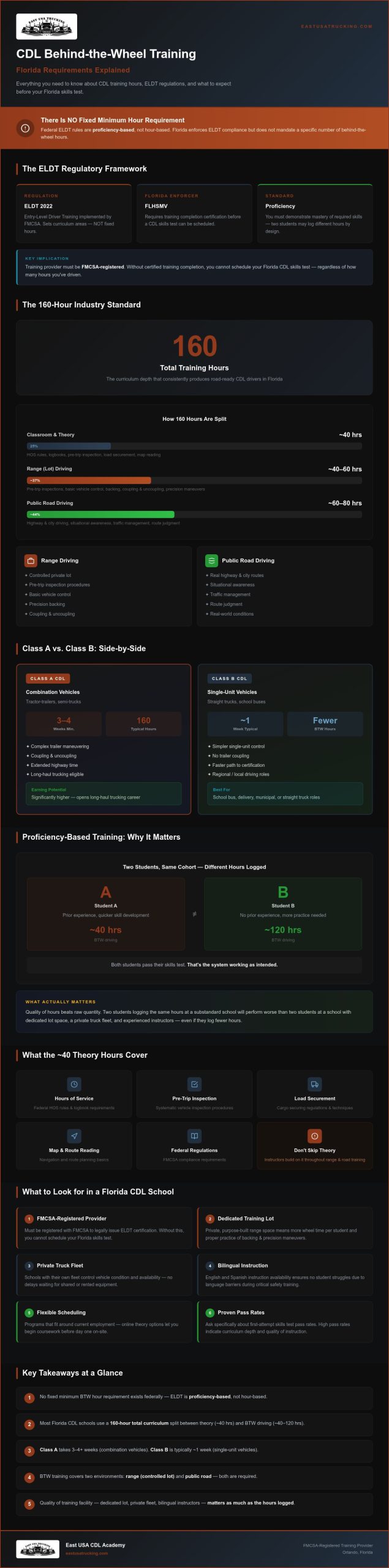
In practice, most Florida CDL schools structure programs around 160 total hours, splitting time between classroom instruction and hands-on driving. The behind-the-wheel portion typically falls between 40 and 120 hours depending on the license class and the student’s rate of skill development. Two students in the same cohort may log different driving hours. That’s not a gap in the program. That’s the system working as intended.
Behind-the-wheel time itself is divided into two distinct environments:
- Range driving: Controlled lot work covering pre-trip inspections, basic vehicle control, and precision maneuvers like backing and coupling.
- Public road driving: Real-world highway and city driving that builds situational awareness, traffic management, and route judgment.
Both components are required. Neither alone is enough to prepare you for the skills test.
Class A vs. Class B Hour Differences
The license class you’re pursuing directly affects how much time you’ll spend behind the wheel. Class A training involves combination vehicles with trailers, which means more complex maneuvering, coupling and uncoupling procedures, and extended highway time. Programs typically run three to four weeks at minimum. Class B training covers single-unit vehicles and is often structured as a one-week program, making it a faster path for drivers targeting roles like school bus or straight truck operation.
Class A takes longer. But it also opens the door to long-haul trucking, where earning potential is significantly higher. For most people asking how many hours of behind the wheel training for CDL in Florida they’ll need, the answer starts with which class you’re actually pursuing.
The 160-Hour Industry Standard: A Full Breakdown
160 hours. That number comes up constantly when you research CDL programs in Florida, but almost nobody explains what’s actually inside it. Knowing the total isn’t enough. You need to know how those hours are structured, what you’re doing during each phase, and why that structure directly affects your chances of passing your skills test on the first attempt.
Reputable schools use 160 hours because it’s the curriculum depth that consistently produces road-ready drivers. It’s not arbitrary. It reflects the realistic time most entry-level students need to move from zero experience to demonstrable proficiency across every required skill area, which is exactly what ELDT compliance demands.
Classroom and Theory Hours
Theory comes first. Before you touch a steering wheel, you need a working understanding of federal hours-of-service rules, logbook requirements, pre-trip inspection procedures, load securement, and basic map reading. Most programs allocate roughly 40 hours to this phase. Many schools now offer online theory modules that let students complete this work before their first day on-site, compressing the overall calendar and getting you into the truck faster. Don’t skip or rush theory. Instructors build on it throughout your range and road training, and gaps show up quickly during your skills test debrief.
Practical Behind-the-Wheel Time
This is where the real training happens, and it splits into two distinct environments. Understanding both answers the core question of how many hours of behind the wheel training for CDL in Florida students actually need to feel prepared.
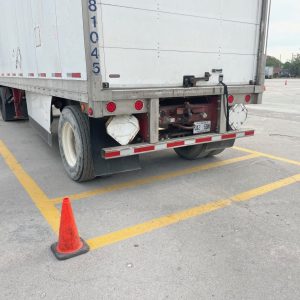
Range time is controlled lot work. At a facility like East USA CDL Academy, that means a full 4-acre training space with eight trucks dedicated entirely to student practice. You’ll run pre-trip inspections, work on straight-line backing, offset backing, alley docking, and coupling and uncoupling procedures. The space matters. Tight lots with shared equipment slow everyone down. A dedicated 4-acre lot means more repetitions per session, and repetitions are what build muscle memory.
Road time puts you into real traffic conditions. Orlando’s mix of highway merges, urban intersections, and high-speed interstate driving covers almost every scenario you’ll encounter in a commercial driving career. Some programs also incorporate night driving and adverse weather sessions, both of which sharpen hazard perception skills that daytime-only training can’t fully develop.
Observation hours round out the picture. Riding alongside an instructor or a peer during their drive builds situational awareness before you’re the one making the calls. It’s low-pressure learning that accelerates your own behind-the-wheel performance.
Major OTR carriers have their own hiring benchmarks, and graduates of structured 160-hour programs consistently meet those expectations. If you want to understand how a program like this fits your schedule and goals, reach out to East USA CDL Academy directly for a straightforward conversation about your options.
Proficiency-Based Training: Why Quality Beats Quantity
The FMCSA defines proficiency simply: a student must demonstrate the ability to perform required skills before they’re cleared to test. Not log a specific number of hours. Not sit in a classroom for a set period. Actually perform the skills. That distinction is the entire foundation of the ELDT framework, and it’s what separates a legitimate CDL program from one that’s just selling you a seat.
In practice, this means two students training side by side will often need different amounts of behind-the-wheel time. One driver might master alley docking in three sessions. Another might need eight. Neither outcome is a failure. It’s proficiency-based training doing exactly what it’s designed to do. When people ask how many hours of behind the wheel training for CDL in Florida they should expect, the honest answer is: as many as it takes to pass every required skill check with confidence.
That flexibility is also where the danger lies.
Some schools, often called CDL mills, exploit the absence of a federal hour minimum by pushing students through the fastest possible curriculum, signing off on proficiency before it’s genuinely demonstrated, and sending underprepared drivers into skills tests they’re not ready for. The result is predictable: higher failure rates, wasted retest fees, and drivers who enter the workforce without the instincts the job demands. Choosing a school based on price alone or on promises of the shortest possible program is a real risk.
At East USA CDL Academy, the approach is straightforward: no student advances until they can demonstrate each skill reliably, not just once, but consistently. With eight trucks and a dedicated 4-acre training facility, instructors aren’t rationing range time or rushing students off the lot to make room for the next group. If you need more repetitions on a specific maneuver, you get them.
Mastering the Pre-Trip Inspection
Most students underestimate this component. The pre-trip inspection is the first scored element of your CDL skills test, and examiners are watching from the moment you approach the vehicle. The “point and call” method, where you physically point to each component and verbally identify its condition, is the standard technique instructors use to build both accuracy and examiner confidence. Rushing through this phase of training is one of the most common reasons students fail their first attempt.
Range Skills: Backing and Maneuvering
Straight-line backing, offset backing, and alley docking are the maneuvers that end more skills tests early than any other element. They require spatial awareness that can’t be shortcut. Practicing on a private lot matters because it removes the pressure of live traffic while you’re still building the muscle memory. A 4-acre facility gives students room to reset, reposition, and run the same maneuver multiple times in a single session without waiting. That volume of repetition is what actually answers the question of how many hours of behind the wheel training for CDL in Florida you need: enough to make these moves automatic, not just familiar.
What to Expect During Your Driving Hours
Transitioning from the safety of a 4-acre practice lot to the active streets of Orlando is the most significant milestone in your training. It’s where the mechanics you’ve practiced become real-world instincts. Managing a 53-foot trailer in city traffic isn’t just about steering. It’s about spatial awareness, timing, and understanding that your vehicle doesn’t behave like a passenger car. Every turn requires a wider arc, and every stop requires a longer lead time.
When you consider Manual vs Automatic CDL Training, the hours you spend on the road will feel very different. Manual training requires significant time dedicated just to mastering the gear patterns and clutch control. Automatic training allows you to focus more of your road hours on lane control, mirror scans, and hazard perception from day one.
Public Road Driving Requirements
Once you’re on public roads, your instructor’s focus shifts to your ability to manage a massive vehicle in a changing environment. You’ll spend your hours practicing lane control, defensive driving techniques, and highway merging. Instructors don’t just watch to see if you stay in the lines. They grade your performance based on how often you check your mirrors, how you manage your speed in intersections, and your ability to anticipate the actions of other drivers.
The total time you spend in this phase varies. If you’re wondering how many hours of behind the wheel training for CDL in Florida you’ll need on the road, it often comes down to your comfort level with defensive driving. Instructors look for consistency. They need to see that you can handle a 53-foot trailer through a tight city right-turn as reliably as you can maintain a steady speed on the interstate.
Automatic Transmission Training
The vast majority of modern trucking fleets have moved to automatic transmissions, which is why many beginners choose the Automatic Transmission CDL course. This path is often more efficient. By removing the complexity of shifting, you can reach the required proficiency levels for the skills test faster. This allows you to enter the workforce and start earning a paycheck sooner.
It’s important to understand the “E” restriction. If you test in an automatic truck, your license will have a restriction stating you cannot operate a manual commercial vehicle. For most modern drivers, this isn’t an issue since manual trucks are becoming rare in major fleets. If you ever need to drive a manual in the future, you can simply take a focused course to remove the restriction later in your career.
Ready to get behind the wheel and start your new career? Contact East USA CDL Academy today to learn more about our upcoming Class A and B training schedules.
Choosing the Right CDL Training in Orlando
Choosing a school is the final hurdle before you start your new career. It’s a decision that dictates whether your training hours feel like a productive investment or a frustrating waste of time. When you evaluate how many hours of behind the wheel training for cdl in florida you need, don’t just look at the clock; look at the facility. A school with a cramped lot or limited equipment will force you to spend more time waiting and less time driving. At East USA CDL Academy, our 4-acre training space and 8-truck private fleet ensure that your time is spent in the driver’s seat, not standing on the sidelines.
Value matters just as much as quality. For many beginners, the $3,200 beginner package for automatic transmission provides a clear, affordable path into the industry. This package is designed to maximize your hands-on experience while keeping costs predictable. If you already have your license but haven’t driven in a while, a CDL Refresher Course Orlando can help you reclaim your skills and get back on the road in 2026 without starting from scratch.
Bilingual Support for Florida Drivers
In Orlando, the ability to learn in your native language is a massive advantage. We provide bilingual instructors who can explain complex technical concepts in both English and Spanish. This approach speeds up your path to proficiency because you aren’t struggling with a language barrier while trying to master air brake systems or backing maneuvers. While the state exam is conducted in English, our instructors bridge that gap by ensuring you understand the “why” behind every procedure in the language you’re most comfortable with. This method builds deep confidence that translates directly to a higher pass rate on testing day.
Authorized On-Site Testing
Anxiety is the biggest enemy of a student during their final exam. One of the best ways to combat that stress is to test in a familiar environment. We are an authorized state testing site, which means you can take your final skills test on the same 4-acre lot where you practiced every day. You’ll use the same school trucks you’ve already mastered, eliminating the “new vehicle” jitters that often lead to simple mistakes.
Don’t leave your future to chance. You can book your CDL exam prep or full beginner course today to secure your spot in our next session. Whether you’re starting from zero or just need a quick restriction removal, having the right team in your corner makes all the difference. Your new career is waiting; it’s time to get behind the wheel.
Start Your Journey Toward a High-Paying Career
Mastering the skills to drive a commercial vehicle is about more than just checking a box. It’s about building the confidence to handle a massive trailer in any condition. Knowing exactly how many hours of behind the wheel training for cdl in florida you need gives you the clarity to pick a school that values your progress over a simple schedule. True proficiency comes from repetition and expert guidance in a real-world environment.
East USA CDL Academy provides everything you need to succeed. With our 4-acre private training facility and a dedicated fleet of trucks, you won’t waste time waiting for your turn. Our bilingual English/Spanish instructors ensure you understand every technical detail. Additionally; our status as an authorized 3rd party testing site means you can finish your journey right where you started. Don’t let confusion over regulations slow you down. The road is open, and we’re ready to help you navigate it.
Start your career with Orlando’s top CDL academy—Enroll for $3, 200 today!
Frequently Asked Questions
How many hours of behind-the-wheel training is required for a CDL in Florida?
There is no legally mandated minimum number of hours for behind-the-wheel training in Florida under current ELDT regulations. Instead, the FMCSA requires that you demonstrate proficiency in all required maneuvers before your training provider can certify you for the skills test. While many schools structure their programs around 40 to 120 hours of driving, the focus is always on your ability to perform the skills safely and consistently.
Can I get my CDL in Florida in 3 weeks?
Yes, it is entirely possible to earn your Class A CDL in Florida within three to four weeks through an accelerated program. These intensive courses typically require full-time attendance, often eight hours a day, to meet the theory and proficiency requirements. This fast-paced schedule is ideal for motivated students who want to enter the workforce quickly and start their new career without a long-term time commitment.
What is the ELDT requirement for behind-the-wheel training?
The ELDT requirement for behind-the-wheel training mandates that students must receive instruction on both a private range and public roads. Your training provider must verify that you have mastered specific maneuvers like backing, docking, and defensive driving. When determining how many hours of behind the wheel training for cdl in florida you need to meet these standards, remember that your instructor must record and report your proficiency to the federal registry.
Do I need to drive a manual truck to get my Florida CDL?
No, you don’t have to drive a manual truck to obtain your Florida CDL. You can choose to train and test in an automatic transmission vehicle, which is the standard for most modern trucking fleets. However; if you test in an automatic, your license will include an “E” restriction. This prevents you from operating commercial vehicles with a manual transmission unless you take a skills test to remove it later.
How much does behind-the-wheel training cost in Orlando?
The cost for CDL training in Orlando varies depending on the license class and the depth of the curriculum. Comprehensive beginner programs often range from $3,000 to $5,000. At East USA CDL Academy, we offer an affordable $3,200 beginner package for automatic transmission training. This price includes the hands-on instruction and range time needed to build the skills required for your state exam.
What happens if I fail my CDL road test in Florida?
If you fail your CDL road test in Florida, you must wait at least 48 hours before you can attempt the exam again. You’ll need to pay a retesting fee to the authorized testing site. It’s best to use this time to return to the training lot and focus on the specific maneuvers that caused the failure, ensuring you are fully prepared for your next attempt.
Is there a minimum number of miles I must drive during training?
There is no federal or state requirement for a minimum number of miles driven during CDL training. The focus of the ELDT mandate is on the quality of the maneuvers performed and your overall control of the vehicle. Whether you drive 50 miles or 500 miles, what matters most is that you can demonstrate safe operation on both the practice range and public highways during your evaluation.
Can I do my behind-the-wheel training on weekends?
Availability for weekend training depends entirely on the specific CDL school you choose. While many programs operate on a standard weekday schedule to mirror the typical work week, some providers may offer flexible hours for students juggling other jobs. You should contact your local training academy directly to see if they can accommodate a weekend schedule that fits your current professional or personal obligations.