You can be the most skilled driver in Orlando, but if you don’t master the “point and explain” choreography, you might fail before you even put the truck in gear. It’s a common frustration for many applicants who feel buried under the information overload of the official manuals. You probably fear failing on a small technicality or forgetting a specific “point and touch” requirement during the inspection. We know that feeling of uncertainty. This Florida CDL skills test checklist is designed to strip away the confusion and give you a clear, step-by-step path to success.
Mastering the modernized 2026 testing standards requires a systematic approach to every maneuver and inspection point. This guide provides a categorized breakdown of the pre-trip vehicle inspection, basic vehicle control maneuvers, and the on-road driving test. You’ll learn exactly what to say and do to satisfy the examiners and prove your competence. We’ll show you how to handle the “point and explain” method with confidence so you can focus on starting your new career with total peace of mind.
Key Takeaways
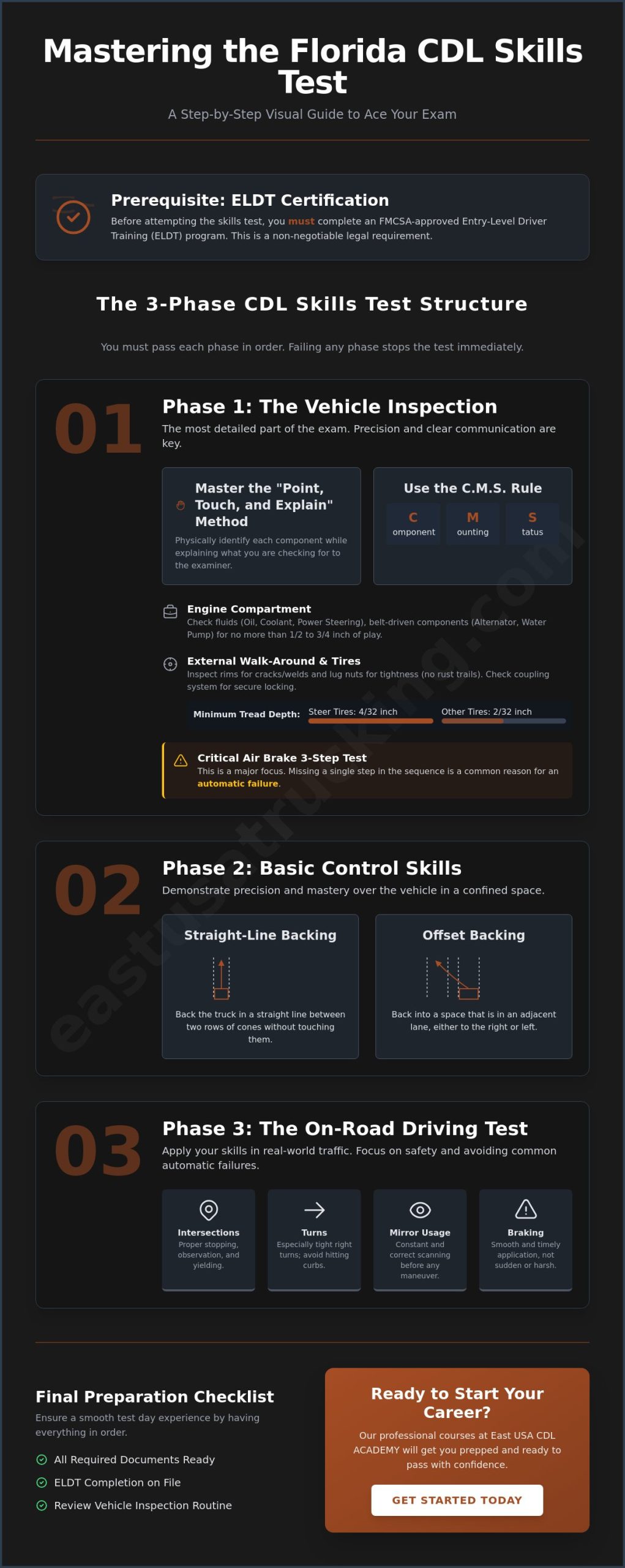
- Learn the exact three-part structure of the exam and why passing each phase in order is mandatory.
- Master the “point and explain” choreography using the C.M.S. rule to ace your vehicle inspection without missing a single detail.
- Follow our detailed Florida CDL skills test checklist to perfect your straight-line and offset backing maneuvers before test day.
- Identify the most common automatic failures during the road test so you can navigate intersections and right turns like a professional.
- Get organized with a final preparation plan that covers required documents and ELDT completion for a smooth experience at an Orlando training center.
Understanding the Three-Part Florida CDL Skills Test Structure
Earning your Commercial driver’s license (CDL) isn’t just about driving; it’s about proving you can handle a massive vehicle with total precision. Before you even step into the cab for your exam, you must complete an FMCSA-approved Entry-Level Driver Training (ELDT) program. This is a non-negotiable legal requirement that updated the industry standards in 2022. If you haven’t finished this step yet, professional courses at East USA CDL ACADEMY can get you ready. Once your certification is on file, you’re cleared to face the Florida CDL skills test checklist that stands between you and your new career.
Think of this exam as a three-act performance where you’re the lead. You’ll move through the Vehicle Inspection, Basic Control Skills, and the On-Road Driving Test in a specific sequence. You must pass each section in order. If you fail any single part, the examiner will stop the test immediately. You won’t get to move on to the next phase until you’ve successfully cleared the previous one. Most testing sessions in Florida take about 2 to 3 hours to finish. This time varies based on your vehicle class and how efficiently you move through your inspection routine.
To better understand how these maneuvers look in practice, watch this helpful video from our training center:
Phase 1: The Vehicle Inspection (Pre-Trip)
This is where many candidates feel the most pressure. You aren’t just looking at the truck; you’re performing a safety audit for the examiner. Florida requires you to use the “Point, Touch, and Explain” method. You must physically identify components like the alternator, water pump, and air compressor while explaining exactly what you’re checking for. Your focus will be split between the engine compartment, the cab interior, and the critical air brake check. Missing a single step in the air brake sequence is a common reason for an automatic failure, so precision is everything.
Phase 2 & 3: Basic Controls and the Road Test
After you prove the truck is safe, you’ll move to the backing range. You’ll demonstrate mastery over maneuvers like straight-line backing and offset tracking in a confined space. Once you clear the range, you’ll head out into real-world Orlando traffic for the road test. The examiner will watch your turns, braking, and mirror usage at every intersection. Maintaining a safety-first mindset is your top priority. Whether you’re navigating a tight right turn or merging onto a highway, your ability to stay calm and follow the Florida CDL skills test checklist determines your success.
The Vehicle Inspection Checklist: Mastering the Point and Explain Method
Success during the pre-trip inspection isn’t just about knowing where parts are located. It’s about how you communicate that knowledge. You must use the “Point, Touch, and Explain” method to show the examiner you’ve truly verified the safety of the vehicle. To simplify this process, many successful drivers use the C.M.S. rule: Component, Mounting, and Status. For every item on your Florida CDL skills test checklist, you’ll identify the part, state that it’s “securely mounted,” and describe its condition, such as “not cracked, bent, or broken” or “not leaking.”
Your inspection begins under the hood in the engine compartment. You’ll need to check all fluid levels, including oil, coolant, and power steering fluid. Don’t just glance at them; point to the dipstick or the reservoir sight glass. You must also inspect all belt-driven components, like the alternator and water pump, to ensure the belts have no more than 1/2 to 3/4 inch of play. Meeting all Florida CDL requirements starts with this level of mechanical detail. If you’re feeling overwhelmed by the technical phrasing, you can always schedule a practice session to sharpen your delivery.
The external walk-around is equally vital. You’ll inspect the tires for a minimum tread depth of 4/32 inch on steers and 2/32 inch on all other tires. Check the rims for welds or cracks and ensure the lug nuts are tight with no rust trails or shiny threads, which indicate looseness. Finally, verify that your coupling system is secure. This means checking that the fifth wheel is properly lubricated, the locking jaws are closed around the kingpin, and there’s no gap between the apron and the skid plate.
The Critical Air Brake 3-Step Test
This is the most dangerous part of the exam because a single mistake results in an automatic failure. First, perform the Applied Pressure Test by holding the brake pedal down for one minute; you cannot lose more than 4 PSI in a combination vehicle. Second, fan the brakes to trigger the Low Air Warning light and buzzer, which must happen at or above 60 PSI. Third, continue fanning until the protection valves pop out, which should occur between 20 and 45 PSI. You must perform these steps in the exact order to pass.
Coupling System and Trailer Inspection
When inspecting the trailer, look closely at the “glad hands” and air lines. Ensure the seals are soft and not leaking. Check that the landing gear is fully raised and the handle is secure. You must also verify that all trailer lights, reflectors, and ABS indicators are functional. By following this Florida CDL skills test checklist with discipline, you demonstrate the professional readiness examiners expect from new drivers.
Basic Control Skills: Navigating the Florida CDL Backing Maneuvers
Once you’ve successfully cleared the inspection, you’ll move to the backing range. This is where you prove you can control the trailer’s direction in tight spaces. The CDL skills test requires three specific maneuvers in Florida: straight-line backing, offset backing, and the alley dock. You’ll need to keep your unit within the boundary lines at all times. Touching a cone or crossing a line results in an encroachment. Points add up fast.
Straight line backing is the simplest, but don’t get overconfident. You must back the vehicle through a 12-foot wide lane for 100 feet without stopping or hitting boundaries. Offset backing is more complex. You’ll have to move the vehicle from one lane to an adjacent lane while backing up. This tests your ability to manage the pivot point of your trailer. Keeping a professional Florida CDL skills test checklist handy during practice at East USA CDL ACADEMY will help you memorize these lane dimensions. If you’re pursuing a Class A CDL in Florida, understanding these backing maneuver requirements is essential to meeting the full scope of state licensing standards.
Mastering the Alley Dock
The alley dock is the “final boss” of the backing range. It requires you to back into a simulated loading dock at a 90-degree angle. Your set-up is the most important part of the maneuver. If you pull too far forward or angle your tractor incorrectly at the start, you’ll struggle to get the trailer deep into the dock. Watch your mirrors constantly to track the rear of the trailer as it swings. Save your “free looks” for the final moments when you need to verify your distance from the rear boundary line.
Scoring and Boundary Rules
Every time a tire touches a boundary line or you pull forward unnecessarily, the examiner will mark a deduction. Encroachments are the leading cause of failure during this phase. In Florida, exceeding the point threshold of 12 points for Class A will end your test immediately. You’re allowed two free pull-ups for most maneuvers, but any additional pull-up adds a point. Understanding these limits is just as important as the steering itself. Focus on slow, controlled movements to avoid unnecessary corrections that eat into your point allowance.
The On-Road Driving Test: Avoiding Automatic Failures
The road test is where theory meets reality. You’ve proven the truck is safe and shown you can back it up; now you must navigate real-world traffic. This final phase isn’t just about driving from point A to point B. It’s about demonstrating total awareness of your surroundings. By keeping your focus on the Florida CDL skills test checklist during this final phase, you ensure no detail goes overlooked. Examiners prioritize safety over everything else, so your “safety-first” mindset must be visible in every move you make.
Intersection safety is a major focal point for every examiner. You must check your mirrors and perform a clear left-right-left head movement before entering any intersection. Even if the light is green, show the examiner you’re scanning for hazards. Railroad crossings require similar vigilance. Depending on your vehicle class, you may be required to stop or simply slow down and check the tracks. If you’re just starting this journey, review How to Get Your CDL in Florida: A Simple Step-by-Step Guide to see how this fits into the bigger picture.
Right turns are often where candidates stumble. You must account for “off-tracking,” which is when the trailer follows a shorter path than the tractor. If your trailer tires strike a curb or sidewalk, it’s considered a disqualifying behavior and results in an immediate failure. For those testing in a manual vehicle, your shifting technique is under the microscope. Avoid grinding gears and never “coast” by keeping the clutch depressed for longer than the length of the vehicle. Smooth, purposeful gear changes show the examiner you’re in full control of the machine. Before test day, it’s worth reviewing the full Class A CDL Florida requirements and career path to ensure you’ve met every prerequisite and understand how your license class affects what’s expected of you on the road test.
Common Mistakes in Orlando Traffic
Orlando roads are busy, and heavy-duty vehicles need extra space. Many applicants fail to use their turn signals early enough to warn other drivers. You should also maintain a safe following distance by using the “one second per 10 feet of vehicle” rule. If you’re driving a 60-foot combination, you need at least six seconds of space. Remember, striking a curb isn’t just a point deduction; it’s an automatic end to your test day.
Communicating with the Examiner
Maintain a professional demeanor throughout the drive. If an examiner gives a command that’s unclear, don’t hesitate to ask for clarification. They’re assessing your confidence as much as your skill. Follow directions exactly and stay calm even if you make a small mistake. One minor error doesn’t mean you’ve failed, but losing your composure might lead to a bigger one. Ready to perfect your road skills? You can contact our team today to schedule a practice run before your big day.
Final Preparation: How to Ace Your Test at an Orlando Training Center
You’ve studied the maneuvers and memorized the inspection steps. Now it’s time to pull everything together for the big day. Before you head to the testing site, you must verify your documentation. You’ll need your Commercial Learner’s Permit (CLP), a valid Medical Card, and proof of your ELDT completion. Remember that Florida law requires you to hold your CLP for at least 14 days before you’re eligible to take the practical exam. Double-checking this final Florida CDL skills test checklist ensures a technicality doesn’t derail your progress before you even start the engine.
Practicing in an environment that mirrors the official state testing site is the best way to calm your nerves. Many students find that using a school truck they’ve already practiced in provides a significant advantage. You’re already familiar with the mirror placements, the clutch feel, and the dimensions of the vehicle. This familiarity allows you to focus on the examiner’s instructions rather than fighting with an unfamiliar machine. If English isn’t your first language, look for a facility that offers bilingual support. Having an instructor who can explain the nuances of the verbal inspection in your native tongue can be the difference between a pass and a fail. Investing in quality CDL behind the wheel training in Orlando before your exam date is one of the most effective ways to build the real-world confidence that examiners look for.
Why Training at East USA CDL ACADEMY Matters
Our Orlando facility provides the space and expertise you need to succeed. With a 4-acre training ground, you have room for unlimited backing practice without feeling cramped. Our bilingual instructors specialize in the “Point and Explain” method, ensuring you can deliver your inspection in English with total confidence. If you’re looking for a faster entry into the industry, consider our Automatic Transmission CDL Training: The Modern Path to a Trucking Career in Orlando. This course streamlines the learning process while still preparing you for every item on the Florida CDL skills test checklist.
Booking Your State Exam
We know that testing at a government office can be stressful. That’s why we offer state-authorized testing right here at our academy. You can choose to test using our fleet of modern automatic trucks or stick with a traditional manual transmission. Our goal is to reduce your anxiety by providing a familiar environment with equipment you trust. Testing on-site means you’re already comfortable with the range where you’ll be performing your backing maneuvers. Don’t leave your career to chance. Ready to pass? Book your CDL Exam Prep course at East USA CDL ACADEMY today! and take the final step toward your new life on the road.
Take the Final Step Toward Your New Career
Passing your exam requires more than just luck; it demands preparation and precision. By following the Florida CDL skills test checklist and mastering the “point and explain” method, you eliminate the guesswork that often leads to technical failures. You now understand the critical three-part structure and how to navigate the road test without triggering an automatic disqualification. Success is within reach when you have the right resources and a supportive environment to practice in.
At East USA CDL Academy, we simplify the process with state-authorized testing on-site and bilingual English/Spanish instructors who guide you every step of the way. We also offer an affordable $3,200 training package to ensure your professional development is within budget. Don’t let uncertainty or a small technicality stand between you and a rewarding career in the trucking industry. Our team is ready to provide the logistical mastery you need to succeed on your first attempt.
Start Your Trucking Career—Enroll in Our Orlando CDL Prep Course Today!
Your future on the road is waiting for you. Let’s get to work and make your professional goals a reality.
Frequently Asked Questions
What is the most common reason for failing the Florida CDL skills test?
The most common reasons for failure are striking a curb during the on-road test and failing the air brake check during the vehicle inspection. These are automatic disqualifications that end your exam immediately. Maintaining a strict focus on your Florida CDL skills test checklist helps you avoid these high-stakes errors by ensuring every safety step is performed with total precision.
How many items are on the Florida CDL pre-trip inspection checklist?
A standard pre-trip inspection includes approximately 90 to 100 specific items that you must identify and explain to the examiner. This total covers the engine compartment, cab interior, air brake system, and external components like tires and coupling systems. You don’t need to crawl under the vehicle, but you must point to or touch every component while explaining its condition and mounting status.
Can I take the Florida CDL skills test in Spanish?
No, federal regulations require the actual CDL skills test to be conducted in English. You must be able to understand and respond to the examiner’s commands and perform the verbal “point and explain” inspection in English. However, training with bilingual instructors at our Orlando center is a great way to master the specific English terminology needed to pass the exam with confidence.
What happens if I fail the air brake check portion of the test?
Failing any part of the air brake check results in an immediate automatic failure of the entire skills test. You won’t be allowed to proceed to the backing maneuvers or the road test on that day. You’ll need to schedule a retest and pay the associated fees to attempt the exam again after a mandatory waiting period.
How many “pull-ups” are allowed during the backing maneuvers?
You are typically allowed two free pull-ups for most backing maneuvers, such as the offset backing or the alley dock. Any pull-up beyond the first two results in a one-point deduction from your score. If you accumulate more than the maximum allowed points for your license class, you will fail that section of the Florida CDL skills test checklist.
Do I need to bring my own truck for the Florida CDL road test?
You have the choice to bring your own vehicle or use a truck provided by a training school. Many applicants prefer using a school truck because they’ve already spent hours practicing in it and understand its specific pivot points and mirror views. If you bring your own truck, it must pass a safety inspection and be the appropriate class for the license you’re seeking.
How long is the Florida CDL skills test valid after I pass?
Once you pass all three parts of the skills test, your results are generally valid for the duration of your Commercial Learner’s Permit. If you only pass one or two sections, those passing scores typically remain valid as long as your CLP is active. Always verify current administrative deadlines with the FLHSMV to ensure your scores don’t expire before you finalize your license.
What documents do I need to bring to the testing site in Orlando?
You must bring your valid Florida driver’s license, your Commercial Learner’s Permit (CLP), and a current Medical Examiner’s Certificate. Additionally, your ELDT completion certificate must be verified in the federal Training Provider Registry before you can begin. Having these documents ready and organized ensures you won’t be turned away from the testing facility due to a simple paperwork error.