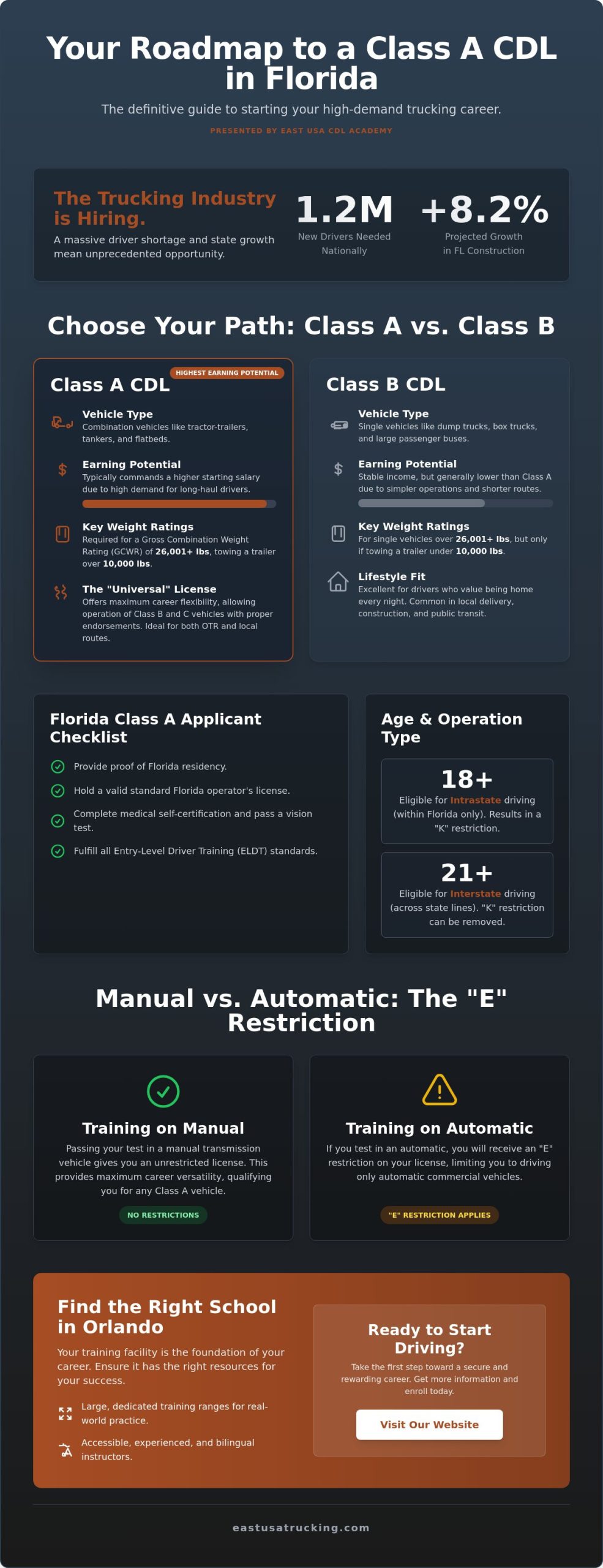
Did you know the trucking industry needs to hire approximately 1.2 million new drivers over the next decade just to replace a retiring workforce and meet rising demand? With Florida’s construction sector projected to grow by 8.2% through 2026, the opportunity to secure a stable, high-paying career has never been better. You likely already recognize that professional driving offers a level of independence and financial security most jobs can’t match. However, the path to earning your class a cdl florida often feels like a maze of confusing FMCSA regulations and high-pressure road tests.
Don’t let the technical hurdles stall your progress. This guide simplifies the entire journey. Discover everything you need to know about obtaining a Class A CDL in Florida, from meeting state-specific requirements to choosing the right license for your specific career goals. We’ll clear up the uncertainty surrounding manual versus automatic transmission restrictions and explain the latest ELDT standards. Use this roadmap to build your confidence, pass your exams, and start your new career as a professional driver in the Orlando area.
Key Takeaways
- Understand the weight rating standards for a class a cdl florida to ensure you’re qualified for the heavy-duty tractor-trailer roles currently in high demand.
- Compare the differences between Class A and Class B licenses to choose the career path that offers the highest earning potential in the Florida freight market.
- Prepare your documentation by identifying the specific Florida residency and operator license requirements needed for a successful application.
- Learn how to navigate the ‘E’ restriction on your license to maintain career versatility across both manual and automatic commercial vehicles.
- Discover what to look for in an Orlando training facility, including the importance of large training ranges and accessible, bilingual instructors.
What is a Class A CDL in Florida? Definitions and Weight Ratings
A Commercial Driver’s License (CDL) serves as the professional standard for anyone looking to operate heavy machinery on public roads. In Florida, the 2026 FLHSMV standards define a Class A license by the specific weight and configuration of the vehicle. If you intend to drive a combination vehicle with a Gross Combination Weight Rating (GCWR) of 26,001 pounds or more, this is the license you need. It’s the gold standard for the trucking industry, covering the largest and most powerful vehicles on the road today.
The defining factor that separates a Class A from a Class B license is the weight of the trailer. If the vehicle you are towing has a GVWR of more than 10,000 pounds, a Class A is mandatory. This requirement applies to the massive tractor-trailers you see on I-4, as well as flatbeds hauling construction materials and tankers transporting liquids. Understanding these weight ratings is the first step toward securing your class a cdl florida and entering a high-demand workforce.
To better understand how the licensing process works in the Sunshine State, watch this helpful video:
Why Class A is the ‘Universal’ License
Holding a Class A license offers unparalleled career flexibility. It’s often called the “universal” license because it typically allows you to operate Class B and Class C vehicles, provided you have the correct endorsements. You can pivot between long-haul over-the-road (OTR) routes and local Florida deliveries without needing to re-test for a lower class. This versatility is vital in 2026. The logistics boom in the Orlando area has created a massive surge in local “last-mile” delivery jobs, giving drivers the option to stay close to home or chase higher mileage pay on the open road.
Intrastate vs. Interstate Operations
Your age and medical status dictate where you can legally drive. Florida allows residents who are at least 18 years old to apply for a Class A license, but they are restricted to driving within state lines. This is known as intrastate operation and results in a “K” restriction on the license. Once you turn 21, that restriction can be removed, allowing you to cross state lines for interstate routes. To maintain your status, you’ll need to complete the Florida medical self-certification process and pass a vision test. These steps prove you’re physically capable of handling a 40-ton vehicle safely on busy highways.
Class A vs. Class B CDL: A Florida Career Comparison
Choosing between a Class A and Class B license is the most important decision you’ll make at the start of your trucking career. While both allow you to operate commercial motor vehicles, the scope of work differs significantly. A Class A license is for combination vehicles, most commonly the tractor-trailers you see hauling freight across the country. Class B is reserved for single vehicles that don’t have a trailer weighing over 10,000 pounds, such as dump trucks, delivery box trucks, or large passenger buses. Because Class A vehicles are more difficult to maneuver, especially when backing into tight loading docks, the training intensity is higher. However, this extra effort pays off. In the current market, a class a cdl florida typically commands a higher starting salary than a Class B license.
The national driver shortage is a major factor in this pay gap. The American Trucking Associations projects a shortage of over 82,000 truck drivers in the U.S. in 2026. This shortage is most acute for Class A drivers who handle long-haul freight. While Class B roles are essential, they often involve simpler operations and shorter routes. If you’re looking for the highest possible earning potential and the widest range of job opportunities, Class A is the clear winner. It’s a more challenging credential to earn, but it makes you a more versatile asset to any logistics company in the Sunshine State.
Which License Fits Your Florida Lifestyle?
Do you value being home every night, or do you crave the freedom of the open road? Class B drivers in Orlando often find work in local delivery or construction, allowing them to finish their shift and head home for dinner. Class A long-haul trucking often involves staying out for days or weeks, but it offers the chance to see the entire country while earning top-tier mileage pay. The primary choice factor is simply whether you prefer the challenge of high towing capacity or the relative simplicity of a single vehicle. If you’re still weighing your options, check out our Class A CDL vs Class B comparison guide to see which path aligns with your long-term goals.
Job Market Trends in Orlando and Central Florida
Orlando sits at the heart of Florida’s logistics network. As a major distribution hub, the demand for Class A drivers to move freight along the I-4 corridor is relentless. Simultaneously, Florida’s construction sector is projected to grow by 8.2% through 2026, creating a massive need for Class B drivers to operate dump trucks and cement mixers. Whether you want to join the tourism transport industry or haul heavy freight, meeting the Florida CDL requirements is your ticket to a recession-resistant career. Securing your class a cdl florida is an investment that pays dividends through job security and competitive pay. If you’re ready to get behind the wheel, feel free to reach out to our team for personalized guidance on your next steps.
Florida-Specific Requirements for Class A Applicants
Proving your residency is the first hurdle. You must provide a lease, mortgage agreement, or voter registration card to the FLHSMV. You also need a valid Florida Class E operator’s license. Without these basics, you can’t even begin the application process for a class a cdl florida. These documents establish your legal status and ensure you’re eligible for state-specific licensing benefits.
Health is just as important as paperwork. You must pass a DOT physical and receive a Medical Examiner’s Certificate. This ensures you’re physically capable of handling the rigors of long-haul driving. Once your medical is cleared, you’re on the path to earning your class a cdl florida. You’ll then enter the FMCSA Entry-Level Driver Training (ELDT) system. This federal mandate requires specific, certified training before you’re allowed to take the final road test.
The Florida CLP (Commercial Learner’s Permit) Process
The permit is your ticket to the driver’s seat. You’ll need to pass three written exams: General Knowledge, Combinations, and Air Brakes. These tests cover the physics of heavy vehicles and the safety systems that keep them on the road. After you earn your CLP, Florida requires a 14-day waiting period before you can attempt the skills test. Don’t waste this time. Review the Florida CDL skills test checklist to master the pre-trip inspection and backing maneuvers.
ELDT Compliance in 2026
You must choose a school registered with the FMCSA Training Provider Registry (TPR). ELDT involves both theory (classroom) and behind-the-wheel (BTW) training. This isn’t just about passing a test; it’s about building a foundation of safe driving habits. Theory training covers the essential rules of the road, while BTW training puts you in the cab for range and road practice. To truly master the practical skills required, investing in quality CDL behind the wheel training in Orlando gives you the hands-on experience needed to build real confidence before your state exam. All East USA CDL Academy programs are fully ELDT compliant, so you can train with confidence. For the most current list of Florida CDL Requirements, always check official state resources. Keeping your paperwork in order now prevents unnecessary headaches when you’re ready to start your professional career.
Automatic vs. Manual Transmissions: Navigating the Restriction
The choice between automatic and manual transmission is often the biggest fork in the road for new drivers. If you complete your skills test in a vehicle with an automatic transmission, the FLHSMV places an “E” restriction on your license. This officially prohibits you from operating any commercial vehicle with a manual transmission. While this might seem limiting, it’s a practical choice for many seeking a class a cdl florida in today’s market. Choosing the right transmission type depends entirely on your specific career goals and how quickly you want to start earning. To make a fully informed decision, reviewing a detailed breakdown of CDL automatic vs manual training options for 2026 can help you weigh the long-term impact on your salary and career flexibility.
The trucking industry has undergone a massive shift toward automatic fleets in 2026. Most major carriers, including companies like Swift and Werner, have transitioned nearly their entire operations to automatic trucks. These vehicles are more fuel-efficient and significantly reduce driver fatigue, which is a major win for long-haul routes. However, if you plan to work in specialized sectors like heavy hauling, oil fields, or logging, you’ll still encounter manual gearboxes frequently. Deciding which path to take is a balance between speed to hire and total career versatility.
The Case for Automatic Transmission Training
For many beginners in Orlando, automatic training is the most efficient route to a paycheck. It allows you to focus on the complex maneuvers of the road test, like offset backing and parallel parking, without the added stress of mastering a double-clutching technique. Our Automatic Transmission CDL Training offers a modern path that gets you into the workforce faster. Since the vast majority of local distribution and OTR jobs use automatic equipment, you aren’t losing out on opportunities by starting here. It’s about working smarter, not harder, to reach your goals.
Why Manual Training Still Matters
Manual proficiency remains a requirement for specialized niches, including heavy haul and older equipment fleets. Drivers who can shift manually often have an edge when applying for niche roles that pay a premium for technical skill. If you start with an “E” restriction and decide you want more variety later, you can always upgrade through a dedicated course. The process for restriction removal typically involves a 10-hour behind-the-wheel training program to master shifting techniques. You must then pass a successful road test in a manual vehicle to have the “E” restriction removed from your class a cdl florida. This flexibility ensures you can grow your career as your interests change. If you’re unsure which transmission type fits your future, contact our experts today for a personalized career consultation.
Choosing the Right CDL School in Orlando, Florida
Selecting the right training facility is the final, most critical step in your journey toward a professional driving career. Not all schools are equal. Some operate on small, crowded lots that severely limit your actual practice time. In contrast, a 4-acre training range provides the space needed to master complex backing maneuvers and pre-trip inspections without feeling rushed or cramped. When you’re looking for a school to earn your class a cdl florida, always ask about the size of their range and the number of trucks in their fleet. A facility with eight or more trucks ensures that you spend more time behind the wheel and less time watching others from the sidelines. Exploring your options for CDL behind the wheel training in Orlando will help you identify programs that prioritize real, hands-on practice over classroom time alone.
Beyond physical space, consider the quality and accessibility of instruction. In Central Florida, bilingual support is a significant advantage that many competitors overlook. Having instructors who can explain technical concepts in both English and Spanish ensures that every student fully understands the safety regulations and mechanical requirements of the job. This inclusive environment doesn’t just make learning easier; it builds a stronger, more confident workforce for the Florida logistics industry. It’s about ensuring nothing gets lost in translation when safety is on the line.
The East USA CDL Academy Advantage
East USA CDL Academy stands out by offering a supportive, bilingual environment tailored to the diverse needs of Florida applicants. Whether you’re interested in our CDL Entry Level Driver Training – Automatic Transmission Standard Beginner Course or the Manual Transmission version, we have the resources to help you succeed. We provide the convenience of state-authorized third-party testing right on-site. This means you can take your final exam using the same school trucks you used during training. This familiarity reduces the stress of the road test and significantly increases your chances of success on the first try.
Next Steps: From Classroom to Career
Ready to get started? The enrollment process for our Standard Beginner Course is straightforward and designed to get you moving toward your class a cdl florida quickly. We encourage all prospective students to visit our facility in Orlando for a personal tour. Seeing our 4-acre range and meeting our expert instructors will give you the confidence that you’re making the right choice for your future. Don’t let confusion about regulations or transmission types hold you back any longer. Take control of your career path and join a high-demand industry. Start your Class A CDL journey with East USA CDL Academy today!
Take the Wheel and Start Your Career Today
You now have the roadmap to navigate the complexities of federal regulations and state-specific licensing. Earning your class a cdl florida is more than just passing a test; it’s about securing a position in a high-growth industry that values skill and reliability. You understand the weight ratings, the transmission restrictions, and the importance of ELDT compliance. Whether you choose the versatility of manual training or the efficiency of an automatic fleet, your path to a professional driving career in Orlando is clear.
Success depends on where you train. Our 4-acre private training facility in Orlando provides the ample space you need to master maneuvers, while our bilingual instructors ensure you understand every technical detail in English or Spanish. We even offer state-authorized third-party testing on-site to make your final exam as stress-free as possible. Stop waiting for the right moment and start building your future today. Enroll in Orlando’s Top-Rated Class A CDL Program and take the first step toward your professional driving career. We’re ready to help you succeed.
Frequently Asked Questions
How much does a Class A CDL cost in Florida for 2026?
An original Class A CDL in Florida costs $75.00 as of June 2026. If you choose to add specific endorsements, such as HazMat or Tanker, each one costs an additional $7.00. You should also budget for potential retesting fees; knowledge retests are $10.00 and skills retests are $20.00. Transactions handled at a county tax collector’s office may include an additional service fee of up to $6.25.
How long does it take to get a Class A CDL in Florida?
Most students complete their training and testing within three to six weeks. Florida law requires you to hold your Commercial Learner’s Permit (CLP) for at least 14 days before you can attempt the final road skills test. The total duration depends on whether you attend a full-time or part-time program and how quickly you master the required pre-trip inspection and backing maneuvers.
Can I take the Florida CDL test in Spanish?
You can take the written knowledge exams in Spanish at many Florida driver license offices. However, federal regulations require that the pre-trip inspection and the road skills test be conducted entirely in English. Training at a bilingual facility allows you to learn complex technical concepts in Spanish while preparing for the English commands and responses required during the official state road test.
What happens if I fail my CDL road test in Florida?
If you fail the skills test, you can schedule a retest after a mandatory waiting period. Florida charges a $20.00 fee for each skills retest attempt. It is very common for students to require a second attempt to master specific maneuvers like the alley dock or parallel park. Use the time between tests to practice in a familiar school truck to build the confidence needed to pass.
Is a DOT physical required for a Florida CDL?
Yes, a valid Medical Examiner’s Certificate is a mandatory requirement for anyone applying for a class a cdl florida. You must be examined by a healthcare professional listed on the National Registry of Certified Medical Examiners. This exam proves you meet the physical standards to operate a heavy vehicle safely. You must keep this certification current and self-certify your driving category with the state of Florida.
What is the difference between a Class A and Class B CDL in Florida?
The difference is defined by the weight of the vehicle and the trailer. A Class A license is for combination vehicles with a weight rating of 26,001 pounds or more, provided the towed unit weighs over 10,000 pounds. A Class B is for single vehicles or those with a smaller trailer. A Class A license is more versatile because it typically allows you to operate Class B vehicles too.
Can I get a Class A CDL if I have an automatic transmission restriction?
You can obtain your license by testing in an automatic truck, but it will result in an “E” restriction. This restriction prevents you from legally operating any commercial vehicle equipped with a manual transmission. If you want to remove this restriction later, you must complete a restriction removal course and pass a new skills test in a manual vehicle. Many modern Florida fleets now use automatic trucks exclusively.
Do I need to attend a trucking school to get my CDL in Florida?
Yes, federal ELDT regulations require all new applicants to complete training from a provider listed on the FMCSA Training Provider Registry. You cannot simply take the test at the DMV without proof of completed theory and behind-the-wheel instruction. Attending a registered school is the only way to satisfy these legal requirements and gain the skills necessary to earn your class a cdl florida and start your career.