What if you could trade your current paycheck for a high-paying trucking career in less than a month? Many aspiring drivers ask how long does CDL training take because they fear months of unpaid classroom time and confusing federal regulations. You don’t have to wait half a year to start earning. In Florida, the path from your Class E license to a professional driver’s seat is much shorter than you might expect.
We understand the stress of managing ELDT mandates and the pressure of passing a difficult road test on your first try. This guide provides the exact 2026 timeline for earning your Florida CDL and reveals how to fast-track the process. You will learn how most full-time students complete their 160 hours of training in just four weeks. We also cover the mandatory 14-day permit holding period and the specific steps to move from the classroom to a high-paying job immediately.
Key Takeaways
- Most full-time students in Florida can transition from the classroom to a high-paying career in just 3 to 6 weeks.
- Learn why how long does CDL training take is now based on your personal proficiency and mastery of skills under ELDT regulations.
- Identify the administrative hurdles, like DMV scheduling and DOT physicals, that can add unnecessary weeks to your timeline if not handled early.
- Discover the benefits of choosing specialized training, such as automatic or manual transmission courses, to fit your specific job needs.
- Understand how hands-on experience at a professional training facility prepares you to pass your road test on the first attempt.
The Standard CDL Training Timeline: What to Expect in 2026
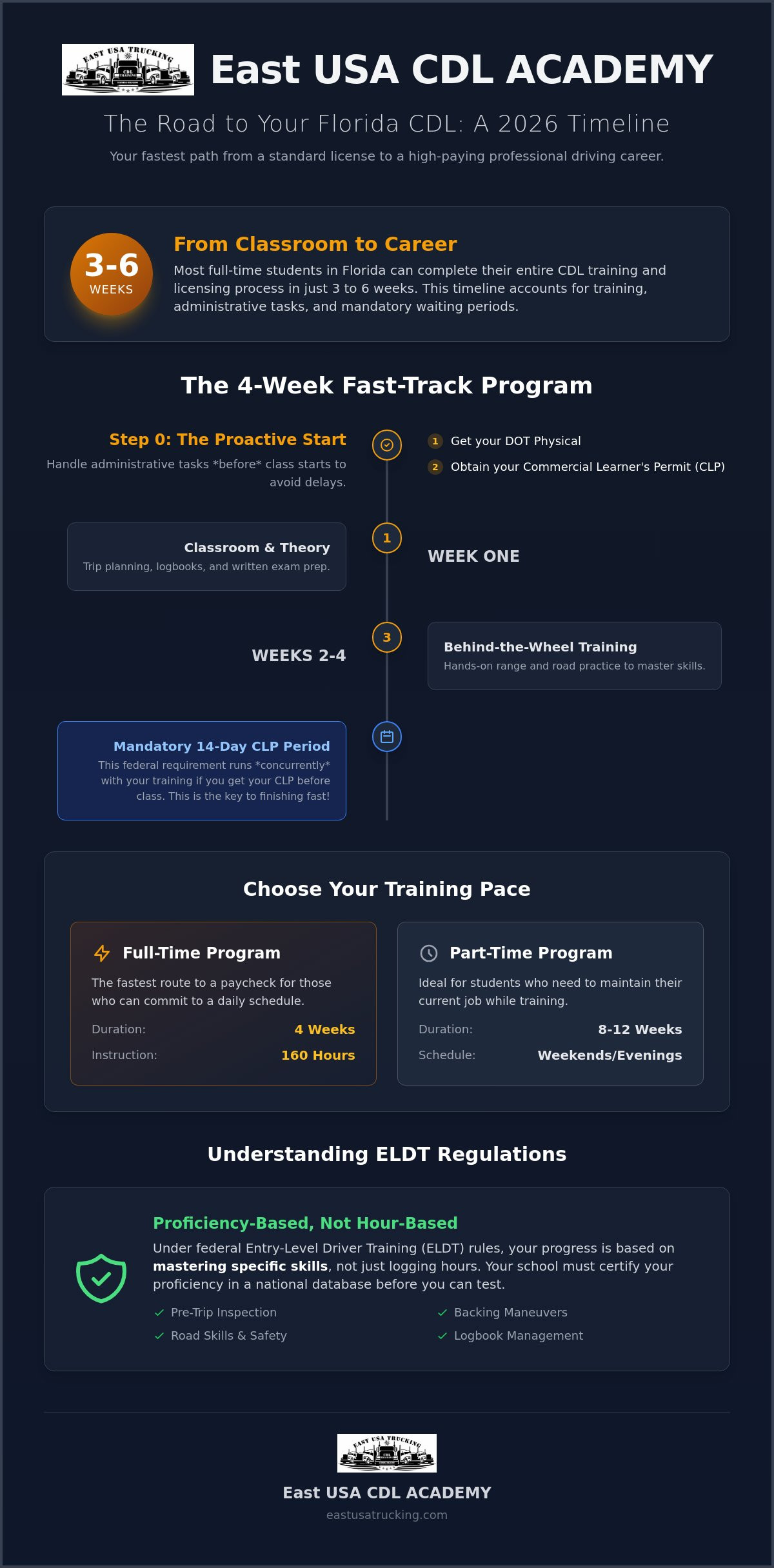
Starting a new career is a major investment in your future, so it’s natural to ask how long does CDL training take before you commit. The 2026 Florida landscape is designed for efficiency, but you must understand the difference between learning the skills and navigating the state’s licensing requirements. While some national schools claim you can be done in exactly thirty days, they often overlook the specific waiting periods and administrative hurdles that can stall your progress.
Most students should plan for a 3 to 6 week window to complete their formal education. However, your actual timeline depends heavily on your personal proficiency. Modern training isn’t just about sitting in a classroom for a set number of hours; it’s about demonstrating that you can safely handle a Class A vehicle. If you pick up backing maneuvers quickly and master the pre-trip inspection, you’ll move through the phases much faster than someone struggling with the basics.
To better understand this timeline and what the day-to-day looks like, watch this helpful video from a driver who has been through the process:
Full-Time vs. Part-Time Program Durations
For those who can treat training like a full-time job, intensive programs are the fastest route to a paycheck. These typically involve 160 hours of instruction, which most students finish in about 4 weeks. If you’re currently employed and need more flexibility, weekend or part-time options are available. These usually extend your journey to 8-12 weeks. Consider your current financial situation carefully. Can you afford a month of intensive study to start earning sooner, or do you need to maintain your current income while you learn in the evenings?
The Mandatory 14-Day CLP Holding Period
The biggest “hidden” factor in your timeline is the Commercial Learner’s Permit (CLP). Federal regulations require you to hold this permit for at least 14 days before you are eligible to take your road test. This is where many people lose time. If you wait until you start school to get your permit, you’ve already added two weeks to your “licensing time.”
Smart students obtain their CLP before their first day of class. This allows you to spend those 14 days focused entirely on behind-the-wheel practice. High-quality CDL training programs will help you maximize this window so you’re ready to test the moment your 14 days are up. By being proactive with your paperwork, you ensure that your classroom time and your mandatory waiting period overlap, cutting your total wait time significantly.
Breaking Down the ELDT Requirements and Training Phases
To understand how long does CDL training take, you have to look at the federal rulebook. Since February 2022, the Entry-Level Driver Training (ELDT) regulations have standardized how new drivers are taught. This isn’t just about putting in a set number of hours. Instead, it’s a proficiency-based system. Your school must document that you’ve mastered specific skills in the classroom and behind the wheel before you’re cleared to test.
The FMCSA now requires all training providers to report your progress directly to a national database. If your record isn’t in the Training Provider Registry, the DMV won’t let you schedule your skills test. This system ensures every driver meets a high safety standard. It’s a common worry that these rules might slow you down, but a well-organized academy integrates these requirements so you never waste a day. If you have questions about how these federal rules apply to your situation, you can always reach out to our instructors for a clear explanation.
Theory and Classroom Education
The first phase is all about the “why” and “how” of trucking. You’ll spend about one week in the classroom covering essential topics. This includes map reading, trip planning, and the technical side of maintaining logbooks. You’ll also prepare for the written knowledge tests required for your permit and any endorsements you want, such as Tanker or Hazardous Materials. Most students find that focusing intensely for this one week builds the foundation they need to pass the written exams on their first try.
Behind-the-Wheel (BTW) Range and Road Training
Once the classroom work is done, you move to the hands-on portion. This is divided into range training and on-road driving. On the range, you’ll master vehicle control, including backing, docking, and the all-important pre-trip inspection. The pre-trip is actually the most common point of failure for new drivers, so we spend significant time ensuring you know every part of the truck.
After you’re comfortable on the range, you’ll take the truck out onto the streets of Orlando. You’ll navigate real-world traffic, practice turns, and learn how to manage the vehicle’s size in a city environment. This phase is where your confidence really grows. By the time you finish this portion, you won’t just be ready for the test; you’ll be ready for your first day on the job.
- Range Training: Focuses on slow-speed maneuvers and safety checks.
- Road Training: Focuses on shifting, lane control, and defensive driving.
- Proficiency: You move at the speed of your own success.
Factors That Speed Up or Slow Down Your CDL Journey
While the standard timeline is a solid baseline, several variables can shift your actual finish date. If you have spent years backing up boat trailers or operating heavy farm equipment, you will likely master the range maneuvers faster than a total beginner. Previous experience gives you a head start on spatial awareness, but it isn’t the only factor. Your choice of school also plays a massive role. If a program has a high student-to-instructor ratio, you might spend more time watching others drive than actually sitting in the driver’s seat. This lack of wheel time is a primary reason why some people wonder how long does CDL training take when their progress feels stalled.
Administrative bottlenecks are another common hurdle in Florida. Even if you’re ready to test tomorrow, a backlog at the DMV or a lack of available testing dates can add weeks to your timeline. You should also consider environmental factors. While Orlando offers great driving weather, heavy summer storms can occasionally pause range training for safety. To stay on track, it’s vital to stay ahead of the Florida CDL requirements and schedule your exams as early as the law allows.
Class A vs. Class B License Timelines
The type of vehicle you want to drive dictates your training length. A Class A license allows you to operate tractor-trailers, which involves learning complex pivot points and coupling procedures. This typically requires 4 to 5 weeks of intensive study. A Class B license is for straight trucks, dump trucks, or buses. Because these vehicles don’t articulate like a trailer, the programs are shorter, usually taking only 2 to 3 weeks. You can read more about these differences in our guide on Class A vs Class B CDL Orlando.
Automatic vs. Manual Transmission Training
One of the fastest ways to shorten the time it takes to get your license is choosing an automatic transmission. Learning to double-clutch a non-synchronized manual transmission is a steep learning curve that adds significant time to your training. Beginners often master automatic trucks in a fraction of the time. While this results in an “E” restriction on your license, most modern fleets have already transitioned to automatic equipment. If your dream job requires a manual later on, you can simply return for a CDL Restriction Removal Course to clear that restriction from your record.
How to Get Your CDL Faster in Orlando
Speeding up your career transition starts long before you climb into a cab. While we have already covered how long does CDL training take on average, your personal preparation can reduce that window by several weeks. Many students wait until their first day of class to think about medical exams or mechanical terminology. By then, you are already falling behind. Start by choosing a school that maintains a large fleet of modern trucks. High vehicle availability ensures you spend your training days behind the wheel, not standing on the sidelines waiting for a turn.
Mastering pre-trip inspection terminology is another major time-saver. Use online videos and the Florida manual to memorize the components of the engine, the suspension system, and the braking system. If you arrive on day one already knowing what a slack adjuster or a pitman arm is, you can spend your range time practicing the physical inspection rather than memorizing a list of words. If you’re ready to start this journey, contact our Orlando office to discuss which training path fits your goals.
Streamlining the CLP and Medical Exam
Don’t let a doctor’s appointment delay your start date. Secure your DOT medical card before you even enroll in a program. This card is a prerequisite for your Commercial Learner’s Permit (CLP), and without it, your training stops before it begins. Once you have your medical clearance, dive into the Florida CDL Handbook. If you pass your permit test at the DMV early, you can start your 14-day mandatory holding period immediately. This proactive step ensures you are eligible to take your final skills test the moment your formal training concludes.
The Power of 3rd Party State-Authorized Testing
The most effective way to fast-track your license is to avoid the standard DMV testing queue. In many parts of Florida, the wait for a state-administered road test can stretch to 6 weeks. Choosing a school authorized for 3rd-party testing changes everything. This allows you to take your exam on the same range where you practiced, using the same school truck you’ve been driving for weeks. It eliminates the anxiety of a new environment and, more importantly, it eliminates the wait. You can often test within days of finishing your ELDT requirements, getting you on the road and into a high-paying job while others are still waiting for a DMV appointment.
Start Your Career with East USA CDL ACADEMY’s Efficient Programs
East USA CDL ACADEMY operates a massive four-acre training facility right here in Orlando. We designed this space to mirror the real-world environments you’ll face as a professional driver. One of the biggest factors in how long does CDL training take is the availability of equipment. If a school doesn’t have enough trucks, you spend your time watching instead of driving. We maintain a private fleet of eight trucks to ensure our students get maximum wheel time every single day. This constant access to equipment prevents the downtime that often plagues larger, less organized programs.
We prioritize hands-on experience because that’s how you actually learn to handle a tractor-trailer. Our instructors are seasoned professionals who focus on the skills that matter most for the Florida road test. We don’t just aim for a passing grade; we prepare you for the actual demands of the workforce. From mastering the pre-trip inspection to navigating tight docks, our goal is to make you a safe, competent driver in the shortest possible window. You won’t just leave with a license; you’ll leave with the confidence to start a high-paying job immediately.
Our Automatic Transmission Standard Beginner Course
If you want the fastest path to a paycheck, our CDL Entry Level Driver Training – Automatic Transmission Standard Beginner Course is the ideal choice. This course removes the complexity of shifting non-synchronized gears, allowing you to focus entirely on safety and vehicle control. It is specifically designed for speed and ease of entry. Most students find they are road-ready much faster with this modern equipment. Since most major carriers use automatic fleets today, you can start your career without the long learning curve of a manual transmission. Learn more about Automatic Transmission CDL Training and how it streamlines your path to a license.
Bilingual Support for Faster Learning
Language should never be a barrier to your professional success. We provide full bilingual support in both English and Spanish to ensure every student stays on track. This clear communication is vital when discussing complex federal regulations or technical mechanical systems. It significantly reduces the time spent on theory because you can learn in the language you’re most comfortable with. Our Escuela CDL provides a welcoming environment for all Orlando residents. By removing the language gap, we ensure you understand the material on the first pass, keeping your how long does CDL training take timeline as short as possible.
Take the Wheel of Your New Career Today
You now have a clear roadmap for your transition into the professional trucking industry. While the answer to how long does CDL training take depends on your personal proficiency, most dedicated students in Florida can be road-ready in under six weeks. By mastering the 14-day permit holding period and choosing a school with the right resources, you can minimize downtime and maximize your earning potential immediately.
East USA CDL ACADEMY is ready to help you cross the finish line. Our four-acre training facility and private fleet of 8 trucks ensure you get the wheel time needed to pass your test on the first try. We provide expert bilingual instruction in both English and Spanish to keep your learning pace fast and clear. Best of all, our state-authorized 3rd party testing on-site means you won’t wait weeks for a DMV appointment. Start your trucking career today at East USA CDL ACADEMY and secure your future on the road. We are ready to help you succeed, and we can’t wait to see you in the driver’s seat.
Frequently Asked Questions
Can I get my CDL in 2 weeks?
No, you cannot legally obtain a CDL in just two weeks. Federal regulations require all applicants to hold their Commercial Learner’s Permit (CLP) for a minimum of 14 days before they are eligible to take the skills test. Even if you master the driving maneuvers in a few days, the state of Florida will not allow you to finalize your license until that mandatory waiting period has passed.
Does the 14-day CLP waiting period count toward my training time?
Yes, the 14-day waiting period is the ideal time to complete your behind-the-wheel training. You can attend classes and practice on the range while holding your permit. Overlapping your school hours with this waiting period is the most effective way to reduce how long does CDL training take so you are ready to test the moment you hit the 15th day.
What happens if I fail the CDL road test on the first try?
If you don’t pass the road test, you must wait at least 24 hours before you can try again. Florida requires a $20 skill retest fee for each additional attempt. Most schools offer extra practice sessions to help you polish the specific skills that caused the failure, ensuring you feel more confident for your second appointment.
How long does a CDL refresher course take for experienced drivers?
A CDL refresher course typically takes one to two weeks to complete. These programs are designed for drivers who already have a license but haven’t been behind the wheel for an extended period. The training focuses on updating your knowledge of current regulations and sharpening your backing and shifting skills to meet modern employer standards.
Does prior driving experience shorten the ELDT training requirements?
Prior experience won’t change the curriculum you must cover, but it often speeds up your progress through the program. Since modern training is proficiency-based, an experienced operator can demonstrate mastery of backing and road skills much faster than a beginner. This allows your instructors to document your competency and move you toward testing sooner.
How long is the classroom portion of CDL school?
The classroom portion usually lasts for one full week, totaling approximately 40 hours of instruction. During this time, you will cover essential theory topics such as federal safety regulations, logbook management, and trip planning. You must successfully complete this phase and be entered into the federal registry before you can begin your hands-on training on the range.
Can I take my CDL test in a different language in Florida?
Florida offers the written knowledge tests for your permit in Spanish. However, federal safety regulations require the pre-trip inspection and the road test to be conducted entirely in English. Our bilingual instructors specialize in helping students learn the specific English technical terms required to communicate effectively with state examiners during the practical exams.
How long does it take to get a job after finishing CDL school?
Most graduates start their new careers within one to two weeks of earning their license. Because the demand for drivers in Florida is so high, many students actually secure job offers before they even finish their training. Once you have your license, you can often begin company orientation and start earning a professional paycheck almost immediately.