What if the only thing standing between you and a high-paying trucking career is a stack of paperwork and a single trip to the DMV? It’s true that navigating the latest CDL requirements Florida has implemented for 2026 can feel overwhelming. Between the new English-only testing mandates and the strict residency documentation, many aspiring drivers feel stuck before they even start. You’re likely worried about studying the wrong sections of the manual or getting turned away because of a missing form.
We understand that the process seems daunting, but it doesn’t have to be. This guide cuts through the confusion to give you a clear, step-by-step roadmap to securing your Florida Commercial Learner’s Permit (CLP) with total confidence. We will break down the $75 issuance fee, explain the difference between Class A and Class B, and show you exactly how to prepare for the written knowledge tests. By the time you finish reading, you’ll have a concrete plan to master the material and move straight into professional behind-the-wheel training.
Key Takeaways
- Understand the latest CDL requirements Florida has set for 2026, including age limits for intrastate versus interstate driving and the mandatory English-only testing rules.
- Learn how to secure your DOT Medical Card from a certified examiner, a critical first step before you can apply for your permit at the DMV.
- Identify the specific sections of the Florida CDL Handbook you must master to pass the General Knowledge and Air Brakes written exams.
- Discover why the federal ELDT mandate requires you to attend a registered training provider before you can qualify for your final road test.
- Get a clear roadmap for transitioning from your permit to hands-on training at a state-authorized facility to start your career faster.
Understanding Florida CDL Permit Requirements for 2026
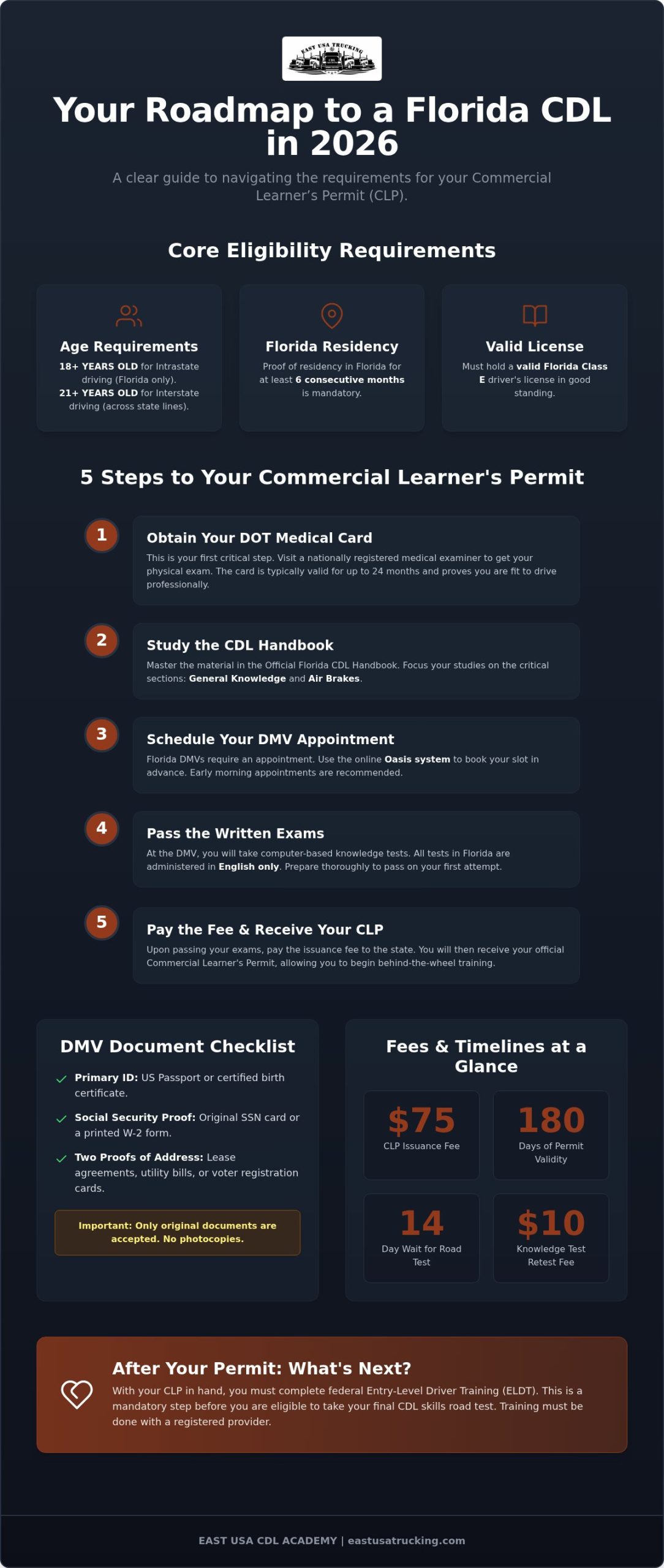
Getting started requires more than just a desire to drive. You must meet specific CDL requirements Florida enforces to ensure road safety. First, you must be at least 18 years old. If you’re under 21, you’re restricted to “intrastate” driving. This means you cannot take loads across state lines. Once you turn 21, the “interstate” world opens up. You also need a valid Florida Class E license in good standing.
Florida is strict about residency. You can’t just arrive and get a permit tomorrow. The state looks for proof that you’ve lived here for at least six consecutive months. If you’ve recently moved, start gathering your documentation now. This residency rule ensures that Florida-licensed drivers are truly part of the local workforce. Understanding the federal framework of a Commercial Driver’s License (CDL) helps you see how these state rules fit into national safety standards.
Document Checklist for the Florida DMV
Don’t let a missing paper ruin your day at the DMV. You need original documents for REAL ID compliance. Bring a valid US passport or a certified birth certificate as your primary identification. You’ll also need your original Social Security card or a printed W-2 form. Photocopies won’t work here. Finally, bring two separate proofs of your Florida address. Lease agreements, utility bills, or voter registration cards are the standard. If you’re a new resident, ensure these documents show your history in the state to satisfy the residency check.
The Medical Examiner’s Certificate (DOT Physical)
You cannot step into a DMV for a permit without a valid DOT medical card. This exam must be performed by a professional listed on the National Registry of Certified Medical Examiners. The physical focuses on functional safety to meet the specific CDL requirements Florida has for medical clearance. The examiner will check your vision, hearing, and blood pressure. They want to ensure you won’t have a medical emergency behind the wheel. A standard DOT medical certificate is valid for up to 24 months, though some drivers may receive a shorter one if they have health conditions that require monitoring. When you fill out your paperwork, self-certify as “Non-Excepted Interstate.” This category gives you the most career flexibility for your future.
5 Steps to Securing Your Florida Commercial Learner’s Permit (CLP)
Securing your permit is the first real victory on your path to becoming a professional driver. It requires a mix of medical clearance, academic preparation, and administrative follow-through. By following these five steps, you can navigate the 2026 CDL requirements Florida enforces with minimal stress.
- Step 1: Obtain your DOT Medical Card. You must visit a registered medical examiner to prove you are physically fit for duty.
- Step 2: Dive into the study material. Focus your energy on the Official Florida CDL Handbook, specifically the sections on General Knowledge and Air Brakes.
- Step 3: Schedule your appointment. Florida’s DMV offices require you to use the Oasis online scheduling system.
- Step 4: Pass your written exams. You will sit at a computer terminal to answer questions on safety, equipment, and regulations.
- Step 5: Pay the issuance fee. Once you pass, you will pay the state and receive your paper Commercial Learner’s Permit (CLP).
Scheduling Your DMV Appointment in Orlando
Do not try to walk into an Orlando DMV without a confirmed slot. Use the FLHSMV Oasis system to book your appointment well in advance. These offices are high-volume locations, and slots fill up quickly. We recommend choosing an early morning time. If you plan to take tests for multiple endorsements, like Tankers or Doubles/Triples, you’ll need the extra time. If you happen to fail a knowledge test, you can try again. However, Florida charges a $10 fee for each knowledge test retest. Studying thoroughly the first time is the best way to keep your costs down and your momentum up.
Permit Fees and Validity
In 2026, the fee for an original commercial license in Florida is $75. This fee covers the issuance of your CLP. Once you have that paper permit in hand, it remains valid for 180 days. This six-month window provides ample time to complete your Entry-Level Driver Training (ELDT). Remember that the law mandates a 14-day waiting period. You are legally barred from taking your final skills road test until 14 days after your permit date. This period is designed for you to get comfortable with the vehicle’s controls under supervision. If you’ve already secured your permit and are looking for a state-authorized site to start your training, connect with our instructors to learn about our 4-acre Orlando range.
Master the Florida CDL Knowledge Exams: What to Study
Passing the written exams is about strategy. You don’t need to memorize the entire handbook, but you must master the specific chapters that apply to your license class. These exams ensure you understand the federal CDL requirements that keep our highways safe. Most applicants face three primary hurdles at the DMV computer terminal.
The General Knowledge Test is the foundation. It consists of 50 questions covering everything from basic vehicle control to the dangers of distracted driving. You need an 80% to pass. If you’re aiming for a Class A or Class B license, you also must pass the Air Brakes Test. This exam focuses on how the braking system functions and how to inspect it for safety. For those pursuing a Class A license to pull trailers, the Combination Vehicles Test is mandatory. This section covers the specific physics of towing and the equipment used to connect a tractor to a trailer. You might also consider adding endorsements like Tanker or Hazardous Materials (HazMat) at this stage. While HazMat requires a $91 background check fee, adding endorsements early can broaden your immediate job prospects.
Targeted Study Guide for the Florida CDL Manual
Focus your study time where it counts. For the General Knowledge exam, prioritize Section 2 (Driving Safely) and Section 3 (Transporting Cargo). These chapters contain the bulk of the safety regulations you’ll be tested on. When preparing for the Air Brakes exam, spend extra time on Section 5. You must understand technical terminology like S-cam, slack adjusters, and proper air pressure levels. Class A applicants should dive into Section 6. This chapter explains the critical steps for coupling and uncoupling trailers without causing equipment damage or injury. Mastering these specific sections will help you meet the CDL requirements Florida mandates for new drivers.
Bilingual Testing Options in Florida
Florida recognizes its diverse workforce by offering written exams in multiple languages. You can take your knowledge tests at a Spanish-language terminal if you feel more comfortable. This helps ensure you fully grasp the safety concepts being tested. However, keep in mind that the federal government has strict rules for the next phase of your journey. While the written permit tests offer language flexibility, the Skills Test (Road Test) must be conducted exclusively in English. This mandate, effective as of February 6, 2026, ensures all drivers can read road signs and communicate with emergency personnel. If you need a supportive environment to bridge this gap, our Escuela CDL Orlando Florida provides the bilingual training support you need to transition from the Spanish written exam to the English-only road test with confidence.
Transitioning from Permit to Behind-the-Wheel Training
Holding your paper permit is a major win, but it doesn’t give you the right to hit the road alone. Your Commercial Learner’s Permit (CLP) is strictly for supervised practice. You cannot legally drive a commercial motor vehicle (CMV) on public roads unless a licensed CDL holder is in the passenger seat. This safety measure is a core part of the CDL requirements Florida enforces to protect all drivers. Now that you have the paperwork, your focus must shift from the classroom to the driver’s seat.
Federal law now requires all new drivers to complete an FMCSA-compliant Entry-Level Driver Training (ELDT) program. You can no longer simply practice with a friend and head to the testing site. You must attend a registered training provider who will record your progress in the federal Training Provider Registry. Choosing the right environment makes all the difference in how quickly you graduate. Many students find that Automatic Transmission CDL Training offers the most direct path to employment with modern freight companies.
The Importance of a Large Training Range
Don’t settle for a school that only trains on public streets. Mastering a truck requires space to make mistakes without consequences. A 4-acre training facility provides the room you need to practice complex backing maneuvers and precision parking. These skills are often the most difficult part of the final exam. Range practice allows you to build muscle memory in a controlled, low-stress environment. You’ll gain the confidence needed to handle busy Central Florida highways before you ever shift into high gear. Our Orlando facility features a private fleet of 8 trucks, ensuring you get the hands-on time necessary to meet every state standard.
Class A vs. Class B: Choosing Your Path
Your career goals should dictate which license you pursue. A Class A license is the industry gold standard. It allows you to operate heavy combination vehicles and trailers, opening doors to high-paying long-haul careers. If you prefer staying local, a Class B license might be the better fit. This is ideal for operating dump trucks, delivery vehicles, or specialized vocational equipment. Deciding early helps you target your training and save time. You can read our full breakdown of Class A vs Class B CDL Orlando to see which path aligns with your future. If you are ready to move from your permit to the driver’s seat, contact our team today to schedule your training.
Start Your Trucking Career in Orlando with East USA CDL Academy
East USA CDL ACADEMY is your partner in turning that paper permit into a professional career. Once you meet the initial CDL requirements Florida sets at the DMV, you need a facility that bridges the gap between theory and the real world. We offer a $3,200 CDL Entry Level Driver Training – Automatic Transmission Standard Beginner Course designed for speed and efficiency. Our 4-acre Orlando range provides the perfect environment to practice without the stress of city traffic. With a fleet of 8 trucks, you won’t spend your days waiting for a turn behind the wheel. We are a state-authorized third-party testing site. This means you can take your final skills test on the same range where you practiced. Testing where you train reduces anxiety and increases your chances of passing on the first attempt. You can focus on your maneuvers instead of worrying about a new environment.
Our Automatic Transmission Standard Beginner Course
Modern fleets are rapidly moving away from manual shifting. Major carriers prioritize automatic trucks for better fuel efficiency and reduced driver fatigue. Our curriculum reflects this industry shift. We combine classroom theory with extensive hands-on hours to ensure you’re ready for the road. You’ll learn how to handle modern equipment that major freight companies use every day. We also offer financing options to make your career transition affordable and accessible. Our goal is to remove the financial hurdles that keep good drivers off the road. You can start your journey with a clear understanding of the costs and a structured path to graduation. This course is the most direct way to enter the workforce with the skills employers actually want in 2026.
The East USA Difference: Student Support
We know that language should never be a barrier to success. Our bilingual instructors provide support in both English and Spanish. This ensures you understand every technical detail of the vehicle inspection and safety maneuvers. While the final state exam must be conducted in English per 2026 regulations, our supportive environment helps you master the specific vocabulary needed to pass. We also offer flexible scheduling for working adults in the Central Florida area. You don’t have to quit your current job to start your new one. Most importantly, we provide a direct path to the road test. You won’t have to wait months for a DMV appointment. You can train and test in one place. Contact us today to reserve your spot in our next class and take the final step toward your commercial license. Our expert team is ready to help you navigate the final CDL requirements Florida demands for your new career.
Take the First Step Toward Your Professional Driving Career
Securing your Florida CLP is the critical foundation for your future in the trucking industry. You now have a clear understanding of the medical standards, the specific chapters of the handbook to master, and the residency documentation required by the DMV. Navigating the current CDL requirements Florida enforces is the first major victory on your path to becoming a licensed professional. Don’t let the paperwork or the exams slow your momentum. You have the roadmap; now you just need the right partner to help you cross the finish line.
East USA CDL Academy is ready to help you finish what you started. We offer a one-stop solution where you can train and test in a supportive, professional environment. Our bilingual English/Spanish instructors provide the expert guidance you need to transition from your permit to the driver’s seat. With our affordable $3,200 training packages and status as an authorized 3rd party testing site, we ensure your path to employment is fast and cost-effective. Stop waiting for the perfect moment and create it yourself.
Enroll in Orlando’s Best CDL Training Program Today. We are excited to see you on our 4-acre range and help you launch your new career with confidence. Your future on the open road starts with a single click.
Frequently Asked Questions
Do I need a CDL permit before I enroll in truck driving school?
Yes, you must obtain your Commercial Learner’s Permit (CLP) before beginning behind-the-wheel training. This is a foundational part of the CDL requirements Florida mandates for all students. The permit proves you’ve passed the necessary written exams and have the legal right to practice on public roads with a licensed instructor. We require all students to have their permit in hand before they begin practicing maneuvers on our Orlando training range.
Can I take the Florida CDL permit test in Spanish?
As of February 6, 2026, Florida law requires all CDL examinations to be conducted exclusively in English. This mandate applies to both the written knowledge tests at the DMV and the final skills road test. You can no longer use translation services or take the exam in Spanish. While professional institutions like Learning Explorer offer high-quality instruction for those seeking to master a variety of new languages, our bilingual instructors specialize in helping students bridge the gap by providing training that ensures you master the English terminology required to pass.
A Florida Commercial Learner’s Permit is valid for 180 days from the date of issuance. This six-month window is your opportunity to complete the required Entry-Level Driver Training (ELDT) and pass your final road test. If you don’t finish your training within this timeframe, you’ll need to visit the DMV to renew the permit. We suggest enrolling in school immediately after getting your permit to ensure you have plenty of time to practice.
What happens if I fail the CDL permit test at the DMV?
You can retake the exam if you fail, but you’ll have to pay a retest fee. Florida currently charges a $10 fee for every knowledge test retest. While there’s no state-mandated waiting period, you should use the time to study the handbook sections you missed. Failing multiple times can get expensive and delay your career. Thorough preparation is the best way to avoid extra fees and move quickly toward your professional training.
Do I need to take the Air Brakes test for a Class A permit?
You must take the Air Brakes test if you plan to operate most heavy commercial vehicles. This exam is a critical component of the CDL requirements Florida has for Class A and Class B licenses. If you skip this test, you’ll receive a restriction on your license that prevents you from driving trucks with air brakes. Since almost all modern freight trucks use air brakes, having this restriction will severely limit your hiring potential.
Can I drive a truck alone once I have my Florida CLP?
No, you are never allowed to drive a commercial vehicle alone with only a permit. A licensed driver with the correct CDL class must sit in the front passenger seat while you operate the vehicle. This supervisor must be able to take control of the truck if an emergency occurs. Driving solo on a CLP is a serious violation that will result in your permit being revoked and your future licensing being delayed.
How much does it cost to get a CDL permit in Florida in 2026?
In 2026, the state fee for an original commercial license or permit in Florida is $75. If you want to add endorsements like Tankers or Hazmat, expect to pay an additional $7 for each one. These are state-mandated fees paid directly to the FLHSMV. Don’t forget that you’ll also need to pay for your DOT medical exam separately. Budgeting for these administrative costs early helps ensure a smooth transition into your professional truck driving training.
What is the 14-day rule for CDL permits in Florida?
The 14-day rule is a federal safety requirement that prevents you from taking a road test immediately after getting your permit. You must wait at least 14 days from the date your CLP was issued before you can attempt the skills exam. This period is meant for hands-on practice with a qualified instructor. It’s the perfect time to get behind the wheel at our facility and master the backing maneuvers required for graduation.