The air brake test isn’t just a memory game; it’s a safety rhythm that guarantees your truck can stop before you ever leave the yard. Many drivers fail their pre-trip inspection within the first ten minutes because they treat this check like a stressful math quiz. If you’re worried about memorizing exact PSI numbers or mixing up the order of your “LAB” steps, you’re not alone. These are the most common hurdles for any newcomer preparing for the CDL air brake test Florida exam.
We understand that the pressure of an automatic failure can feel overwhelming. That’s why we’ve built this guide to turn your anxiety into expertise. You’ll learn how to master the Florida air brake inspection steps, avoid the mistakes that end tests early, and pass your road exam on the first try. We’re providing a clear, 2026-ready checklist that breaks down every gauge movement and warning buzzer. We’ll also show you how to find a local Orlando site for 3rd party testing where you can train and test in a familiar environment. Let’s get you ready to start your career with confidence.
Key Takeaways
- Learn why the air brake check is the most critical part of your pre-trip inspection and how one small error results in an immediate failure.
- Master the “LAB” procedure to handle the CDL air brake test Florida without second-guessing your PSI numbers or step order.
- Avoid common automatic disqualifiers like forgetting to chock your wheels or failing to perform a proper “Safe Start.”
- Build muscle memory through repetition training on a dedicated 4-acre range to ensure you pass on your first attempt.
- Skip the long DMV lines by using a state-authorized third-party testing site in Orlando for both your training and your final exam.
What is the Florida CDL Air Brake Test?
The CDL air brake test Florida is the safety-critical gateway to the Florida road exam. It isn’t just a minor box to check; it’s a high-stakes demonstration of your ability to manage a heavy vehicle’s most vital stopping system. During this portion of the Pre-Trip Inspection, you must prove that the air compressor, governor, and warning signals are all functioning exactly as designed. In Florida, the rules are unforgiving. Failing even a single component of this check results in an immediate failure of your entire road test. You won’t even get the chance to put the truck in gear if you can’t prove the brakes are safe first.
Understanding how air brakes work is fundamental to passing this exam. Unlike hydraulic systems in standard cars, air brakes rely on a constant supply of compressed air to function. If that supply fails or leaks beyond specific limits, the truck becomes a multi-ton hazard. The examiner needs to see that you can identify these mechanical issues before they turn into highway emergencies. This test validates that the governor cuts out at the right pressure and that your warning buzzers are loud enough to alert you to danger.
Why Florida Examiners Are Strict on Air Brakes
Safety is the only priority during the air brake check. A failure in this system on a loaded trailer can lead to catastrophic accidents. Because of this risk, examiners look for absolute precision in your mechanical actions and your verbal callouts. You can’t just point at a gauge; you must explain what the needle is doing and why that specific PSI level matters. For example, you must verify the low air warning activates around 60 PSI and the spring brakes pop out between 20 and 45 PSI. This strictness ensures that every driver on Florida roads knows how to catch a leak before it’s too late.
Class A vs. Class B Air Brake Requirements
The steps you take depend on the vehicle you intend to drive. Class A applicants face a more complex challenge. This version of the test includes checking the trailer supply valve and the tractor protection valve to ensure the entire combination system holds pressure. Class B testing is slightly less complex, focusing only on the single-vehicle air system found in straight trucks or buses. If you’re still deciding which path to take, check out our guide on Class A vs Class B CDL Orlando: Which License Is Right for You? to see the specific requirements for each license type. No matter which class you choose, the goal is the same: absolute mastery of the brake system.
The 3-Step ‘L-A-B’ Air Brake Check Procedure
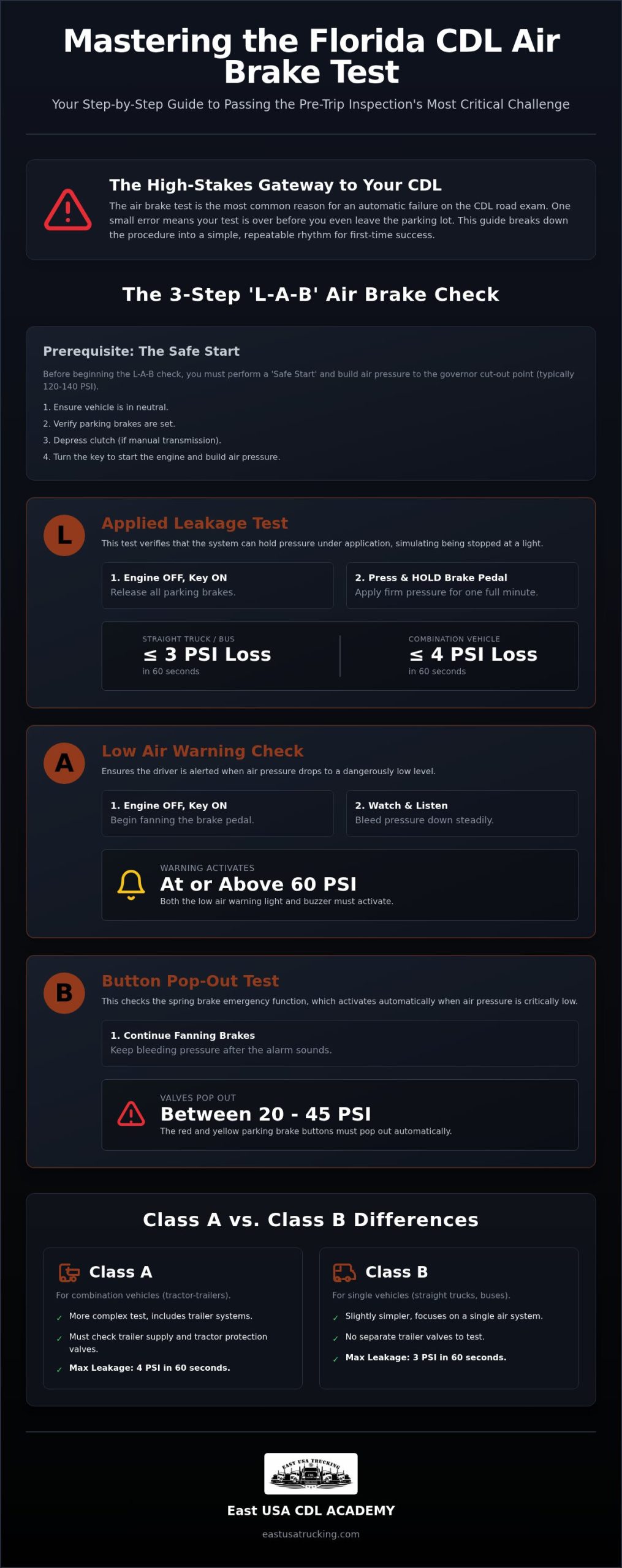
Mastering the CDL air brake test Florida requires a memorized rhythm. You can’t afford to stumble over your words or forget the sequence while an examiner watches your every move. The “L-A-B” acronym (Leaks, Alarm, Button Pop) is the industry standard for keeping your inspection organized and accurate. Before you begin this sequence, you must perform a “Safe Start.” This means ensuring the vehicle is in neutral, depressing the clutch if it’s a manual, and verifying the parking brakes are set before turning the key. Once your air pressure is built to the governor cut-out point, you’re ready to start the real work.
Phase 1: The Applied Leakage Test (L)
The “L” stands for Leaks. After turning the engine off and turning the key back to the “on” position, release your parking brakes. Let the air settle, then press and hold the brake pedal firmly. You must time this test for a full 60 seconds. Don’t guess. Use a watch or the clock on the dashboard. In Florida, a straight truck cannot lose more than 3 PSI in one minute. A combination vehicle is allowed a 4 PSI drop. You must verbalize this clearly to the examiner: “I am checking that I do not lose more than 4 PSI in one minute.” If you let go of the pedal early, it’s an automatic failure.
Phase 2: Low Air Warning Check (A)
The “A” stands for Alarm. With the engine still off and the key in the “on” position, begin fanning the brake pedal. This bleeds off air pressure rapidly. You are looking for the low air warning light and buzzer to activate. These standards are rooted in Federal Air Brake Regulations which dictate how every commercial vehicle must behave under pressure. In Florida, these signals must trigger at or above 60 PSI. If your buzzer doesn’t sound or the light stays dark, the vehicle is legally grounded. Point to the gauge and tell the examiner exactly when the alarm starts.
Phase 3: The Pop-Out Test (B)
The “B” stands for Button Pop. Continue fanning the brakes to lower the pressure even further. You are waiting for the tractor and trailer protection valves (the yellow and red buttons) to pop out automatically. This should happen when the pressure drops between 20 and 45 PSI. This test proves that the emergency spring brakes will engage if you ever lose air pressure on the highway. Once the buttons pop, your verbalized check is complete. Finish the sequence by re-starting the engine and ensuring the air pressure builds back to the normal operating range. If you need a professional set of eyes to check your form, you can always reach out to our instructors for a quick prep session on the range.
Common Mistakes That Cause Automatic Failure
The CDL air brake test Florida is a high-stakes environment where one small oversight ends the day. You can perform the mechanical steps perfectly, but if you miss a safety protocol, the examiner will stop the test immediately. These “automatic failures” are the most frustrating way to lose your chance at a license. Understanding where most students trip up is the first step toward a passing score. It isn’t just about what you do; it’s about what you remember to do before the clock starts ticking.
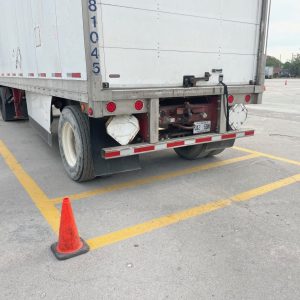
One of the most frequent “silent killers” is forgetting to chock your wheels. Before you begin the leakage test, you must ensure the vehicle cannot roll. If the truck moves even an inch while you have the parking brakes released, you’ve failed. Similarly, the “Safe Start” is a non-negotiable requirement. Starting the engine while the vehicle is in gear or failing to depress the clutch on a manual transmission truck will result in an instant disqualification. Always verify the transmission is in neutral and your brakes are set before you ever turn the key.
Timing is another area where precision is mandatory. During the applied leakage test, you must hold the brake pedal for a full 60 seconds. If you release the pedal at 58 seconds, the test is over. Many drivers feel the pressure of the silence and rush the process. Use a stopwatch or a clear clock on the dash to ensure you meet the requirement exactly. There is no room for “close enough” when it comes to Florida state standards.
The ‘Verbalization’ Trap
You must act as a narrator for your own exam. Examiners cannot read your mind; they need to hear you state exactly what you are seeing on the gauges. If the needle hits 125 PSI and the governor cuts out, you must say, “My air compressor governor cut out at 125 PSI.” Failing to verbalize these specific numbers is a common reason for failure. For students who are more comfortable in their native language, our Escuela CDL Orlando Florida training provides bilingual support to ensure you know the exact English phrases needed to satisfy the examiner.
Mechanical Errors During the Test
Small mechanical blunders often lead to big problems. A frequent mistake is turning the key to the “Off” position instead of “On” or “Accessory” during the alarm check. If the key is off, your gauges won’t have power, and the warning buzzer won’t sound. You also need to ensure you have full air pressure before moving from one phase of the test to the next. Rushing into the “LAB” sequence without a full air build-up means your numbers will be off from the start. Take your time, let the pressure build, and confirm your valves are pushed in before you begin your timing.
How to Prepare for Your CDL Road Test in Orlando
Preparing for the CDL air brake test Florida requires more than just reading a manual. You need a space where you can focus without the distraction of city traffic or the pressure of other drivers watching you. Utilizing a dedicated 4-acre training facility allows you to run through the steps until they become second nature. This is where theory meets reality. You aren’t just memorizing numbers; you’re learning the personality of the air system. When you practice in a controlled environment, you can focus on the nuances of the gauges rather than the noise around you.
Repetition is the key to passing on your first try. We recommend a method called “repetition training,” which involves performing the entire air brake check at least 10 times in a row. By the tenth time, your hands will move to the valves and your eyes will find the gauges automatically. This muscle memory is what saves you when test-day nerves kick in. If you feel stuck or uncertain, enrolling in CDL Exam Prep Orlando provides the structured environment you need to perfect your routine under professional supervision.
Visual Aids and Memory Hacks
Use the “LAB” acronym (Leaks, Alarm, Button) as your mental anchor. It keeps the sequence logical and prevents you from jumping ahead. Beyond the acronym, try diagramming the air system on paper. Sketching the path from the compressor to the brake chambers helps you understand why each step is performed. Most importantly, practice in the exact truck you will use for the exam. Every vehicle has a slightly different feel to its valves and a different sound to its buzzer. Familiarity with your specific equipment breeds the confidence needed for a smooth inspection.
The Advantage of Hands-On Training
Reading the handbook is a start, but it isn’t enough for the pre-trip inspection. You need to feel the physical “pop” of the valves and hear the exact moment the governor cuts out. These sensory cues are vital for accurate verbalization. For those who already have a license but haven’t been behind the wheel in a while, our CDL refresher course Orlando helps you reclaim those sharp skills and update your knowledge on current standards. Physical practice ensures you don’t just know the answer; you know the feeling of a safe truck.
Don’t practice alone. Use a study partner to act as the examiner. Have them hold a clipboard and grade your performance against a checklist. They should look for missed verbalizations, timing errors, or safety lapses like forgetting to chock the wheels. If you want to ensure your practice is up to state standards, schedule a session with our authorized instructors to get professional feedback before your actual test date.
Fast-Track Your License with East USA CDL Academy
East USA CDL Academy offers a streamlined path to your commercial license. We remove the logistical hurdles that often slow down new drivers. As a state-authorized 3rd party testing site in Orlando, we eliminate the long wait times associated with government-run DMV locations. You can train on our 4-acre facility and take your final exam on that same familiar ground. This continuity reduces test-day anxiety and helps you focus on the technical details of the CDL air brake test Florida. Mastering the CDL air brake test Florida is much simpler when the truck and the range are already familiar to you.
We offer flexible testing options tailored to your specific situation. You can choose to use your own equipment for the exam or utilize one of the 8 trucks in our professional school fleet. For those looking for a comprehensive start, our $3,200 training package provides everything you need to become road-ready quickly. This investment covers the intensive hands-on practice required to master the pre-trip inspection and the maneuvers needed for the road test. We focus on efficiency and transparency, ensuring you know exactly what to expect from day one. Why wait months for a slot when you can move forward now?
Authorized 3rd Party Testing in Orlando
Testing where you train is a massive advantage for any student. You already know the layout of the range and the specific feel of the equipment you’ve been using. This familiarity allows you to perform the air brake check with the confidence of a seasoned professional rather than a nervous beginner. If you currently hold a license with an automatic transmission restriction, we can help you expand your career opportunities. Check out our CDL restriction removal course to upgrade your skills and begin driving manual transmission trucks.
Bilingual Instructors and Support
Clear communication is the foundation of driver safety and exam success. We provide bilingual support in English and Spanish for all our training and testing materials. Our instructors ensure you understand the technical terms in both languages. This ensures you can verbalize your PSI numbers and mechanical checks clearly to any examiner without hesitation. You won’t just memorize a script; you’ll understand the logic behind every safety step. This expert-led approach is designed to get you behind the wheel as a confident, professional driver.
Ready to pass? Schedule your CDL exam prep or road test today! Our team is ready to act as your partner in reaching this significant career milestone. Let’s get you on the road.
Get Road-Ready and Pass Your Exam
You now have the roadmap to navigate the CDL air brake test Florida without the stress of the unknown. By mastering the “LAB” sequence and sticking to the strict 60-second timing requirements, you’re already ahead of the curve. Avoiding the common “Safe Start” errors and mechanical oversights ensures you won’t face an automatic failure in the first ten minutes of your inspection. Remember that clear verbalization is just as important as the mechanical steps themselves.
Don’t let long DMV wait times or unfamiliar equipment stand in your way. East USA CDL Academy is a state-authorized 3rd party testing site with an 8-truck fleet and a dedicated 4-acre facility right here in Orlando. Our affordable $3,200 beginner packages and bilingual instructors provide the specific support you need to test with confidence. We’ve helped countless drivers launch their careers by providing a professional, supportive environment for their final exam. Your new career is just one successful test away, and we’re ready to help you cross the finish line.
Book Your CDL Exam Prep and Road Test in Orlando!
Frequently Asked Questions
What happens if I fail the air brake test in Florida?
Failing any part of the air brake check results in an automatic failure of your entire CDL road exam. You won’t be allowed to proceed to the basic control skills or the on-road driving portion of the test. You must reschedule and attempt the full examination again at a later date, which is why mastering these steps early is so vital.
What are the PSI requirements for the low air warning in Florida?
The low air warning light and buzzer must activate at or above 60 PSI. This is a critical safety threshold that ensures you have enough air to stop the vehicle safely. During your CDL air brake test Florida, you must fan the brakes to bleed off pressure and verbalize the exact moment these signals trigger to the examiner.
Do I need to chock my wheels for the air brake test?
Yes, you must chock your wheels before starting the air brake inspection. This prevents the vehicle from rolling when you release the parking brakes for the leakage test. Forgetting this step is considered a major safety violation and will lead to an immediate failure of your exam before you even start the engine.
Can I take the CDL air brake test in Spanish in Florida?
You can receive training and take your test with bilingual instructors who speak both English and Spanish. While the state requires you to use specific English technical terms for your verbal callouts during the official exam, our instructors help you master these phrases. This ensures you can communicate effectively during your CDL air brake test Florida regardless of your native language.
What is the difference between a static and applied leakage test?
A static leakage test checks for air loss while the engine is off and the parking brakes are released without any pedal pressure. An applied leakage test is performed while you are firmly depressing the brake pedal. Florida examiners specifically focus on the applied leakage test, where you must hold the pedal for 60 seconds and lose no more than 3 or 4 PSI.
What PSI should the air governor cut out at?
The air governor should cut out between 120 and 140 PSI. You’ll know it has reached this point when you hear the “sneeze” or air release from the system. You must watch your gauges and tell the examiner the exact PSI reading when this occurs to prove the system is regulating pressure correctly.
Can I use my own truck for the CDL air brake test at East USA CDL Academy?
Yes, you have the option to use your own truck or one of our school trucks for your exam. We maintain a fleet of 8 professional trucks on our 4-acre facility to ensure students have reliable equipment available. If you use your own vehicle, it must meet all state safety requirements and pass a basic equipment inspection before the test begins.
How long does the air brake portion of the pre-trip inspection take?
The air brake portion typically takes between 5 and 10 minutes to complete. This includes the time needed to build air pressure, perform the “LAB” steps, and verbalize your findings to the examiner. While you shouldn’t rush the safety checks, staying organized with a memorized checklist helps you move through the procedure efficiently and confidently.