Did you know that over 90% of new heavy-duty trucks are now built with automatic transmissions? It might seem like the traditional gear shifter is a relic of the past, but making the wrong choice for your CDL automatic vs manual training could accidentally cap your earning potential before you even start. You likely want the fastest route to a license without the constant fear of stalling during your road test, yet you probably worry about being disqualified from high-paying local jobs because of an “E-restriction” on your license.
We understand the pressure of making the right investment in your professional future. You deserve a clear path that leads to a first-time pass and the widest range of job offers possible. This article breaks down the critical differences between manual and automatic CDL training to help you maximize your trucking salary and career flexibility. We will explore how to future-proof your license, the reality of specialized haul requirements in 2026, and the exact steps to ensure you never leave money on the table because of a transmission restriction.
Key Takeaways
- Understand the legal “E” restriction and why testing in an automatic vehicle limits your license to specific truck types.
- Evaluate the ROI of CDL automatic vs manual training by comparing the needs of massive over-the-road fleets against high-paying specialized roles.
- Identify which transmission type aligns with your career goals, whether you prioritize a faster path to your license or long-term flexibility.
- Learn how technical proficiency in manual shifting can make you a more attractive candidate for specialized construction and heavy-haul positions.
- Discover how dedicated behind-the-wheel practice at a private facility helps you gain the confidence needed for a successful road test.
The Core Difference: Understanding the Automatic Transmission “E” Restriction
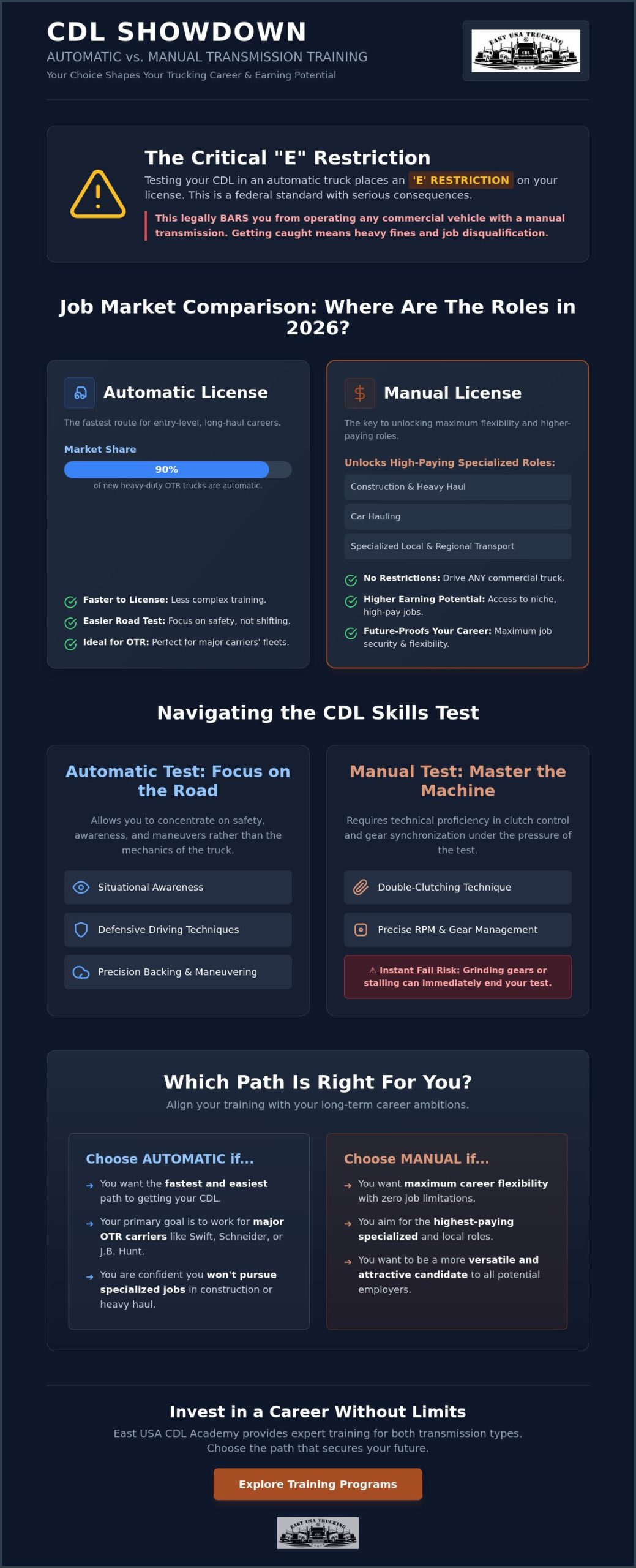
Choosing your path for Automatic Transmission CDL Training in Orlando starts with understanding one specific letter. When you earn a Commercial Driver’s License (CDL), the transmission you use during your skills test dictates your legal driving rights. If you test in a truck with an automatic transmission, the Florida DHSMV places an “E” restriction on your license. This code legally prohibits you from operating any commercial vehicle equipped with a manual transmission. It’s a federal standard enforced by the FMCSA that essentially splits the industry into two camps.
The legal reality here is stark. If a state trooper pulls you over while you’re behind the wheel of a 10-speed manual and your license has an E-restriction, it’s treated as driving without a valid license. This is not a minor paperwork error; it can lead to heavy fines, points on your record, and immediate disqualification from your job. Understanding the trade-offs of CDL automatic vs manual training is the first step toward a long and profitable career.
To better understand this concept, watch this helpful video:
How the Florida CDL Skills Test Differs
The road test changes significantly depending on which transmission you choose. Manual testing is notoriously difficult because it requires mastery of double-clutching and downshifting while braking. You cannot simply coast to a stop; you must maintain gear control at all times. In contrast, automatic testing allows you to focus more on road awareness and safety maneuvers. If you want to see exactly what examiners look for, review our Florida CDL skills test checklist to prepare for either path. Key differences in the testing process include:
- Manual Focus: Precise RPM management, clutch control, and gear synchronization.
- Automatic Focus: Situational awareness, defensive driving, and backing precision.
- Failure Points: Grinding gears or stalling in a manual can lead to an immediate fail, while automatic drivers can focus entirely on the traffic environment.
Why One Code on Your License Matters
That small letter on the back of your physical license carries massive weight with employers. Many insurance companies refuse to cover drivers for manual fleets if they have a restricted license because of the higher risk of transmission damage. This means even if you’re an excellent driver, a local heavy-haul company or a construction firm might have to pass you over. The E-restriction acts as a permanent career barrier for specialized roles that require shifting through 10, 13, or 18 gears. While CDL automatic vs manual training both lead to a career, one keeps every door open while the other prioritizes speed and ease of entry into the workforce.
Job Market Comparison: Manual vs. Automatic Roles in 2026
The trucking landscape has shifted toward automation, with 90% of over-the-road (OTR) fleets now operating exclusively on automatic transmissions. This transition is driven by industry trends in transmission technology that prioritize fuel economy and lower maintenance costs. For new drivers, this means that most entry-level OTR positions are fully accessible with an automatic license. When weighing the pros and cons of CDL automatic vs manual training, you’ll find that the “mega-carriers” value the safety and reduced fatigue these trucks offer their long-haul teams.
While the volume of jobs favors automatics, the highest-paying specialized roles often remain manual. Industries like car hauling, heavy-haul, and construction transport in the Orlando area still rely on the precision gear control found in manual transmissions. These sectors require drivers who can manage massive loads on unpredictable terrain where an automatic might struggle to find the right gear. Being the driver who can operate any truck in a mixed fleet ensures you’re never sidelined when the only available rig is a stick-shift.
Salary expectations also reflect this skill gap. While the median annual wage for heavy truck drivers was $57,440 in May 2024, specialized manual roles in Florida often command a premium. Companies pay more for the technical expertise required to handle 13-speed or 18-speed gearboxes in demanding environments. If you want to explore which path offers the best return on your investment, you can discuss your career goals with our team.
Industries That Still Require Manual Mastery
- Fuel and hazardous materials (Hazmat) transport often prefer manual for superior engine braking control.
- Heavy equipment and car hauling fleets in Orlando frequently utilize manual transmissions for torque management.
- Florida’s agricultural and local construction sectors often operate rugged, manual equipment that requires a non-restricted license.
The Rise of Smart Automatics
Modern Automated Manual Transmissions (AMT) are not the simple automatics of the past. These smart systems use computer logic to optimize shifts for maximum efficiency and safety. Many drivers in the Orlando metro area prefer AMTs because they significantly reduce the physical strain of stop-and-go traffic on I-4. This technology has become a key tool for driver retention, allowing professionals to focus more on defensive driving and less on the mechanics of the gearbox.
Learning Curves: Skill-Building vs. Speed-to-License
Shifting a commercial vehicle is a physical skill that takes time to develop. When comparing CDL automatic vs manual training, you have to weigh your patience against your career timeline. Manual trucks require you to synchronize your feet and hands with the engine’s RPMs without the help of modern synchros found in cars. It’s a high-pressure environment for a beginner that demands intense concentration and mechanical sympathy. If you struggle with multitasking, the learning curve for a 10-speed can feel steep.
Choosing the automatic path removes this physical hurdle entirely. This allows you to dedicate more hours to CDL behind the wheel training in Orlando, where you can perfect your backing maneuvers and situational safety. Most students find they can focus better on the complex “Pre-Trip Inspection” when they aren’t stressed about grinding gears or missing a shift in traffic. It’s simply a more streamlined way to get your license and start your career without the mechanical distractions.
Stress management plays a massive role in whether you pass your road test on the first try. In a manual truck, stalling at a busy intersection or during a turn can result in an immediate failure. This risk adds a layer of test anxiety that can be overwhelming for many applicants. By opting for an automatic, you eliminate the risk of stalling, which significantly boosts your confidence during the exam. You can focus on the road rather than the gearbox.
Your financial investment also varies between these two paths. Manual courses typically require a higher tuition because they involve more instructor hours and higher maintenance costs for the training fleet. You’re paying for the extra time needed to master a complex mechanical skill. If you need to start earning a paycheck as quickly as possible, the automatic route is often the more cost-effective choice for your initial entry into the industry. It gets you through the door and onto a company payroll faster.
Mastering the 10-Speed Manual
Double-clutching remains the biggest hurdle for most new students. It requires two separate movements of the clutch pedal for every single gear change. If you lose your rhythm, you might find yourself “stuck in neutral” while rolling down the road, which is a dangerous and stressful situation for a novice. Manual training requires roughly 20% more range time for mastery compared to automatic programs. This extra time is spent solely on gear recovery and smooth transitions to ensure you don’t fail the road test.
The Automatic Advantage for Fast Entry
If your goal is speed, the automatic transmission is your best friend. You can spend your training time mastering the “Skills Maneuvers” like offset backing and parallel parking rather than fighting a shifter. This is the ideal choice for students who have a job offer waiting and need to get through CDL automatic vs manual training with the highest probability of a first-attempt pass. It reduces the technical complexity of the drive, letting you prove your safety and awareness to the examiner without unnecessary distraction.
Future-Proofing Your Career: When Manual is Non-Negotiable
Deciding between CDL automatic vs manual training isn’t just about passing your test next week. It’s about where you want to be in five years. If your goal is to become an owner-operator, manual mastery is often a financial necessity. When you’re ready to buy your first truck, the used market is filled with reliable, high-mileage manual rigs that are often more affordable than late-model automatics. Starting your business with a manual truck can lower your initial overhead and provide a machine that’s frequently simpler and cheaper to repair for a solo operator.
Employers also view the lack of an E-restriction as a “proven skill” indicator. In a stack of resumes, the driver who can handle any transmission in the fleet stands out as more technically proficient. It signals that you have the coordination and mechanical awareness to handle complex machinery. This perception of competence can move you to the front of the line for premium routes or leadership roles within a company. You want to be the driver who solves problems, not the one who creates scheduling headaches because you’re legally barred from driving half the fleet.
Practicality also matters during equipment failures. If your primary automatic rig breaks down, your company might provide a loaner or a rental truck. If the only available vehicle is a 10-speed manual and you have a restricted license, you’re off the clock and losing money. Keeping your options open is a core part of understanding the Class A CDL Florida requirements for long-term success. If you’re ready to secure your future with an unrestricted license, contact our training experts today to get started.
Specialized Equipment and Heavy Hauling
Torque management is where manual transmissions truly shine. When you’re hauling massive loads or navigating the soft, sandy terrain of remote Florida construction sites, you need total control over your gear selection. Manuals allow you to hold a specific gear to maintain momentum through muck or up steep inclines without the computer trying to upshift at the wrong moment. This is why the logging and heavy-haul industries in the Southeast still rely heavily on manual gearboxes for their daily operations. Mastering these low-range gears is essential for safety and efficiency in specialized sectors.
Job Security in a Changing Industry
Manual drivers often enjoy better job security during economic shifts. When a fleet downsizes, managers prefer to keep the universal drivers who can operate any piece of equipment in the yard. There’s also an undeniable advantage in building respect with veteran fleet managers; many of these leaders started on manuals and value drivers who respect the craft of shifting. Maintaining a clean license with no restrictions ensures maximum portability, allowing you to jump between industries or states without ever needing to retake a skills test just to remove a restriction.
The East USA Academy Path: Choosing Your Transmission in Orlando
East USA Academy provides a structured environment where you can decide your future based on your specific career goals. We maintain a private 4-acre facility in Orlando designed to mirror real-world driving conditions. With a dedicated fleet of 8 trucks, you won’t spend your days waiting for your turn behind the wheel. Our instructors understand the pressure of the road test. We focus on building your confidence through practical, repetitive practice in a controlled space that allows you to learn at your own pace until you get it right.
For many, the most accessible entry point is our CDL Entry Level Driver Training – Automatic Transmission Standard Beginner Course. At $3,200.00, this program is designed to get you behind the wheel and into a paycheck as quickly as possible. It’s a pragmatic choice for career changers who want to bypass the mechanical stress of shifting and focus on the safety protocols required to pass the Florida skills test on the first try. You get the same high-quality classroom instruction and 30 hours of behind-the-wheel training as our manual students, but with a focus on modern, widely-used equipment.
We also prioritize inclusivity by offering professional instruction in both English and Spanish. This bilingual support ensures that every student fully understands the technical requirements and safety regulations, regardless of their native language. Our goal is to remove every barrier between you and your commercial license, providing a supportive atmosphere that is both business-like and welcoming.
Why Start with Automatic?
Starting with an automatic transmission is a strategic move for those who want to enter the Orlando job market immediately. Most local logistics companies and large fleets have already transitioned to automatic equipment, meaning your “E” restriction won’t hinder your initial job search. High pass rates are a hallmark of this path because it allows you to master road awareness and backing maneuvers without the distraction of gear synchronization. It’s an affordable entry point that maximizes your ROI by getting you on a company payroll faster.
Restriction Removal: The Best of Both Worlds
If you start with an automatic license and later decide that specialized hauling or owner-operator work is your calling, we offer a dedicated “safety net” that most other schools ignore. Our CDL restriction removal course is specifically designed for existing drivers who want to upgrade to a non-restricted license. This 10-hour intensive program allows you to skip the classroom entirely and focus 100% of your time on mastering the 10-speed manual shifter. It’s the perfect middle ground for drivers who want to start earning now but keep their long-term options open.
You will return to our facility to sharpen your gear recovery and double-clutching skills on our private range. Once you’re ready, you’ll take your final authorized road test on-site using one of our school trucks. This flexible approach to CDL automatic vs manual training means you don’t have to make a “forever” decision today. You can grow your license as your career evolves and your goals shift toward more specialized, higher-paying roles.
Take Control of Your Trucking Future
Your career path depends on your personal goals and how quickly you want to start earning. Deciding on CDL automatic vs manual training is a balance of immediate speed and long-term versatility. If you need to enter the workforce quickly, the automatic path offers a streamlined, stress-free route to your license. If you aim for specialized, high-paying roles in construction or heavy-haul, mastering the manual transmission remains a powerful investment in your future.
At East USA Academy, we provide the professional tools you need to succeed regardless of the transmission you choose. As an Authorized 3rd Party Testing Site, we offer affordable $3,200 training packages and expert guidance from bilingual English/Spanish instructors. You can start with an automatic license today to get on the road and return to remove your restriction whenever you’re ready for a new challenge.
Start your trucking career today—choose the right CDL course at East USA CDL Academy. We are ready to help you reach your professional milestones with confidence and efficiency.
Frequently Asked Questions
Does a manual CDL pay more than an automatic CDL in Florida?
Manual CDL holders often access higher paying specialized roles in Florida. While the median annual wage for all heavy truck drivers was $57,440 in May 2024, specialized sectors like heavy haul or construction often pay more. These industries frequently require manual transmissions for better torque control. If you only have an automatic license, you’re legally barred from these high paying niche positions. Choosing the right CDL automatic vs manual training path early on determines your long term salary ceiling.
How hard is it to remove the E-restriction from my CDL later?
Removing the E-restriction is a straightforward process but requires a new skills test. You must demonstrate your ability to operate a manual transmission vehicle to a state authorized examiner. We offer a CDL Restriction Remove Course specifically for this purpose. This intensive 10-hour program focuses entirely on behind the wheel manual shifting skills. It’s an efficient way to upgrade your license without starting your entire training from scratch.
Do I have to retake the whole CDL test to switch from automatic to manual?
You don’t have to retake the entire CDL exam. To remove a transmission restriction, you only need to pass the behind the wheel skills test in a manual truck. This includes the pre-trip inspection, basic maneuvers, and the road portion. Your existing written test scores and endorsements remain valid. This makes the transition easier for experienced drivers who originally chose CDL automatic vs manual training based on speed rather than versatility.
Are most new trucks automatic or manual in 2026?
The vast majority of new trucks are automatic. As of 2026, over 90% of new heavy duty commercial vehicles are manufactured with automatic or automated manual transmissions. This shift helps mega-carriers improve fuel economy and reduce driver fatigue. While manual trucks are still common in older fleets and specialized industries, the general market has moved toward automated technology to attract new drivers and lower maintenance costs.
Can I drive an automatic truck if I have a manual CDL license?
Yes, an unrestricted manual CDL allows you to drive any commercial vehicle. This is the primary benefit of testing in a manual truck. You have the legal right to operate both manual gearboxes and the latest automatic models. This versatility makes you a more valuable asset to employers with mixed fleets. You won’t have to worry about which truck is assigned to you on any given day.
How long does it take to learn how to drive a 10-speed manual truck?
Mastering a 10-speed manual typically requires roughly 20% more training time than an automatic. Most students need between 10 and 30 hours of dedicated behind the wheel practice to become proficient. This time is spent learning double-clutching, gear recovery, and RPM management. Your previous experience with manual passenger cars can help, but shifting a heavy duty truck is a unique skill that requires professional instruction and repetition.
Is the CDL road test harder in a manual truck?
The road test is technically more demanding in a manual vehicle. Examiners watch for specific mechanical skills like smooth gear transitions and proper downshifting while braking. Stalling the engine or grinding gears can lead to an immediate failure. In an automatic truck, you can focus entirely on road safety and traffic maneuvers. This lower stress level is why many students choose automatic training for their first attempt.
Does East USA CDL Academy offer bilingual training for manual transmissions?
Yes, we provide full bilingual support for all our training programs. Our professional instructors offer guidance in both English and Spanish to ensure you understand every technical detail. This includes our manual transmission beginner courses and our restriction removal programs. We believe clear communication is essential for safety and success. You can learn the complexities of double-clutching in the language that makes you most comfortable.